
Purpose and Function of Electroslag Remelting
As material requirements continue to rise, manufacturers are increasingly focused on not just mechanical strength but also internal cleanliness, microstructural uniformity, and surface finish. This is especially true in critical sectors like aerospace, nuclear, medical, and tooling industries.
Recently, customers have asked about the differences between ESR-treated and non-ESR materials, especially regarding mechanical performance and product reliability. This article offers a clear and comprehensive explanation to help engineers, buyers, and technical managers understand why and when to choose ESR.
What Is Electroslag Remelting?
Electroslag Remelting (ESR) is a high-efficiency secondary refining process used to remelt steel under a highly reactive slag bath. This process employs resistance heating generated when electric current passes through the molten slag. The slag serves both as a heat source and as a refining agent that absorbs non-metallic inclusions, sulfur, and other impurities.
The outcome is an ultra-clean, homogeneous, and densely structured steel ingot with excellent mechanical properties.
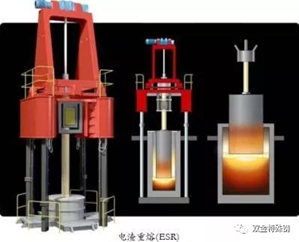
Electroslag Remelting (ESR) furnace system showing external structure, molten slag pool, and vertical remelting process.
Working Principle of ESR
The basic ESR process is illustrated below:
- A copper water-cooled mold is filled with molten slag.
- A consumable electrode is inserted into the slag bath.
- An electrical circuit is formed via the transformer, short cable, slag bath, molten metal pool, and base water tank.
- The slag is heated by electrical resistance to a high temperature.
- The electrode tip melts, forming metal droplets.
- These droplets pass through the slag bath into the molten metal pool.
- Due to the strong cooling effect of the mold, the molten metal solidifies rapidly from bottom to top.
- A slag shell forms on the inner mold wall, smoothing the ingot surface and providing insulation.
- Crystallization progresses upward as the top remains hot and the bottom is cooled.

Image showing schematic of ESR process flow and solidification from bottom to top inside a copper mold.
Primary Goals of ESR
The key purpose of Electroslag Remelting is to purify the metal and produce dense, clean, and uniform steel ingots. ESR steel has:
- High purity
- Low sulfur content
- Minimal non-metallic inclusions
- Smooth and clean surfaces
- Uniform microstructure and chemical composition
The mechanical properties of ESR cast ingots often match or exceed those of forged counterparts of the same grade. The overall quality depends heavily on optimized ESR process parameters and well-maintained equipment.
Metallurgical Advantages of ESR
ESR fundamentally solves the challenges present in conventional casting processes. It integrates:
- The metallurgical quality of ESR refining
- The precision casting of complex components
Key Benefits:
- High-density structure similar to deformed metal
- Isotropic properties (no directional weakness)
- Comparable or superior performance to traditional forgings
- Eliminates some common forging limitations

Live operation of an Electroslag Remelting (ESR) furnace with visible molten slag and electrode heating inside a water-cooled mold.
Superior Performance of ESR Steel
Thanks to its purity, density, and uniform composition, ESR steel demonstrates significantly better performance, durability, and surface quality than the same steel grades made via arc furnace methods.
Sample ESR Ingot: XM-19
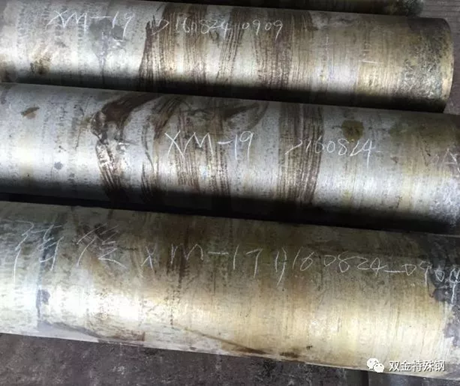
ESR remelted ingot of XM-19 stainless steel with smooth surface and refined structure.
Conclusion – Is ESR Worth It?
In high-performance applications, steel quality is mission-critical. ESR offers a way to go beyond conventional arc melting or forging, delivering materials that meet the highest international metallurgical standards.
ESR Is Ideal For:
- Engineers requiring ultra-clean, reliable steel
- Critical components in aerospace, nuclear, or medical sectors
- Manufacturers needing fine grain structure and excellent surface finish
- Tooling applications that demand wear resistance and fatigue strength
If your process or product cannot tolerate failure, ESR is not just beneficial — it’s essential.