
Electric Arc Furnace (EAF)
Principle of EAF
The Electric Arc Furnace (EAF) primarily relies on the intense heat generated by electric arcs. In the arc zone, temperatures can reach up to 4000°C. The steelmaking process inside an EAF generally includes three stages:
- Melting phase
- Oxidation phase
- Reduction phase
The furnace atmosphere can be manipulated to be either oxidizing or reducing, which significantly improves the efficiency of dephosphorization and desulfurization. These characteristics make EAFs especially suitable for refining high-quality steel.
Another key advantage is its flexibility in raw material usage. While traditional blast furnace–converter methods require a large infrastructure investment, EAF steelmaking can use scrap metal. The development of direct reduced iron (DRI) has allowed EAFs to partially replace scrap with metallized pellets, further expanding their applicability.
Function of EAF
In modern steelmaking, especially in China, many medium-frequency furnaces have been phased out in favor of EAFs. The EAF is now commonly used for:
- Melting high-quality steels
- Producing alloy steels and stainless steels
It serves as the first step in stainless steel production. Its main functions are:
- Melting steel
- Dephosphorization and desulfurization
- Initial composition adjustment
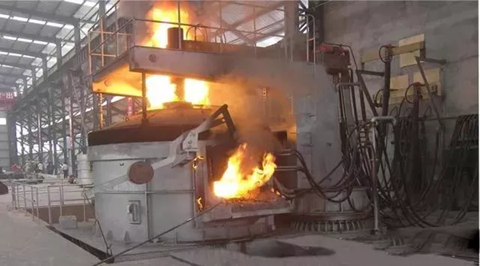
Electric arc furnace (EAF) in operation with molten metal pouring and intense flame emission
Argon Oxygen Decarburization Furnace (AOD)
Principle of AOD
The AOD furnace is a widely adopted method for refining stainless steel, known for its simplicity, adaptability, and cost efficiency. Its working process includes the following:
- Molten steel from the EAF (or sometimes hot metal from the blast furnace) is poured into the AOD furnace.
- A mixture of oxygen (O₂), argon (Ar), or nitrogen (N₂) is blown into the molten steel to decarburize.
- At the same time, reductants, desulfurizers, ferroalloys, and coolants are added to adjust the chemical composition and temperature.
Gas Mixing and Delivery System
AOD’s core lies in its precise control of gas ratios. Oxygen produced in the oxygen plant is stored in nearby tanks and piped into the AOD system. After metering, pressure reduction, and mixing, the gases are introduced into the furnace through a side lance at a specific ratio based on process needs.
- Initially, pure oxygen is blown into the molten pool via a double-layer water-cooled lance from the top to decarburize.
- In the refining phase, gas mixtures (O₂ + Ar/N₂) are blown through side lances located near the bottom of the furnace.
- During charging and tapping, the furnace tilts to keep the nozzles above the steel level.
- During normal refining, the nozzles are immersed deep in the steel bath.
Through adjusting the oxygen-to-argon ratio, the partial pressure of CO is reduced, enhancing carbon removal while preserving chromium.
Unique AOD Lance Design
The lances are consumable-type, double-layer nozzles cooled by inert gas (argon or nitrogen). The inner tube carries the reactive gas mixture, while the outer tube delivers cooling gas.
- Flow rates of the lance and annular ring are controlled from the main control room to optimize refining results.
- AOD furnaces often use three side lances, enhancing oxygen delivery and metal yield. This setup also:
- Reduces AOD refining time
- Lowers gas and material consumption
- Improves final steel quality through stable automation
Function of AOD
The AOD’s primary function is decarburization and refining, especially in stainless steel production. It removes carbon efficiently while minimizing chromium loss, thus achieving:
- Precision in chemical composition
- High metal recovery rates
- Improved final product consistency

High-temperature steel tapping process from a large AOD furnace in an industrial steel plant
Ladle Furnace (LF)
Principle of LF
The Ladle Furnace (LF) is one of the most important secondary refining units in steelmaking. Though technically a variation of the EAF, it operates externally from the main furnace and is dedicated to precision control of the molten steel.
The LF uses graphite electrodes to heat the steel via an electric arc. In a low-oxygen atmosphere (O₂ ~5%), argon gas is blown from the bottom to stir the molten pool. Simultaneously, a basic slag layer forms, aiding further refining.
- Argon stirring accelerates reactions between slag and steel.
- Electric arc heating compensates for heat loss, allowing extended refining without cooling.
- This results in a significant reduction of oxygen and sulfur, and removal of inclusions (often rated 0–0.1 by ASTM standards).
Key Features and Roles of LF
LF furnaces are typically integrated with EAFs or converters (LD) to replace or complement their reduction phase. They are indispensable in continuous casting lines, especially for alloy steel production, due to their ability to:
- Control chemical composition and temperature
- Preserve steel cleanliness during transfer
- Enhance uniformity
The LF is part of modern production chains like:
LD → LF → RH → Continuous Casting (CC)
This configuration makes LF the main reduction and refining stage for a wide range of steels, from ordinary carbon steels to specialty grades.
Functional Highlights of LF
- Desulfurization
- Precise temperature control
- Micro-adjustment of alloy composition
- Steel cleanliness improvement
- Slag forming and reaction control
Functions of LF in Practice
-
With EAF:
- Speeds up EAF cycles
- Improves steel quality
- Speeds up EAF cycles
-
With LD Converter:
- Allows deep reduction and refining
- Enables the production of new alloy grades
- Allows deep reduction and refining
-
After AOD:
- Serves as a second-stage refining unit
- Reduces inclusions, enhances steel purity
- Serves as a second-stage refining unit
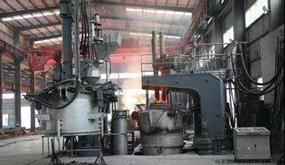
Ladle furnace (LF) system setup for secondary steel refining inside a steel mill
Vacuum Degassing Furnace (VD)
Principle of VD
The Vacuum Degassing (VD) process involves placing pre-treated molten steel (from EAF or converter) into a sealed vacuum tank. Argon is blown from the ladle bottom while a vacuum is applied to extract unwanted gases.
- The steel undergoes initial melting and oxidation
- Then it’s transferred to the vacuum chamber
- Argon stirring and vacuum degassing remove dissolved hydrogen, nitrogen, and oxygen
Typically, VD units are paired with LF furnaces—LF handles composition and temperature control, while VD specializes in degassing.
Some VD systems are equipped with oxygen lances on the vacuum lid, converting them into VOD (Vacuum Oxygen Decarburization) systems for stainless steel refining.
Function of VD
The VD furnace is a critical vacuum refining unit with broad applications. Its key roles include:
- Dehydrogenation and denitrogenation
- Deoxidation via carbon–oxygen reactions
- Desulfurization through basic slag interaction
- Temperature and composition homogenization
VD furnaces are essential in producing:
- Ultra-low gas steels
- Clean steels for bearings, tools, and pipelines
- Stainless steels with strict inclusion control
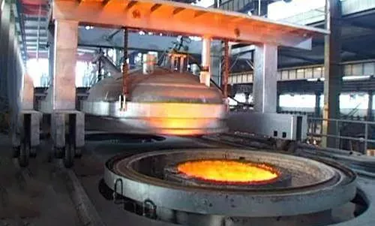
Vacuum degassing (VD) furnace with open chamber for molten steel refining under vacuum conditions