
Table of Contents
Heat Treatment Quenching Crack Types and Characteristics in Steel Components
Heat treatment quenching processes are fundamental to achieving desired mechanical properties in steel components, yet they present significant challenges regarding crack formation. During the quenching process, mechanical components frequently experience improper treatment conditions and various external factors that create intense internal quenching stresses, ultimately leading to the development of quenching cracks. Understanding these crack formation mechanisms is crucial for manufacturers like FUSHUN SPECIAL STEEL, who specialize in producing high-quality tool steel, alloy steel, and specialty steel products.
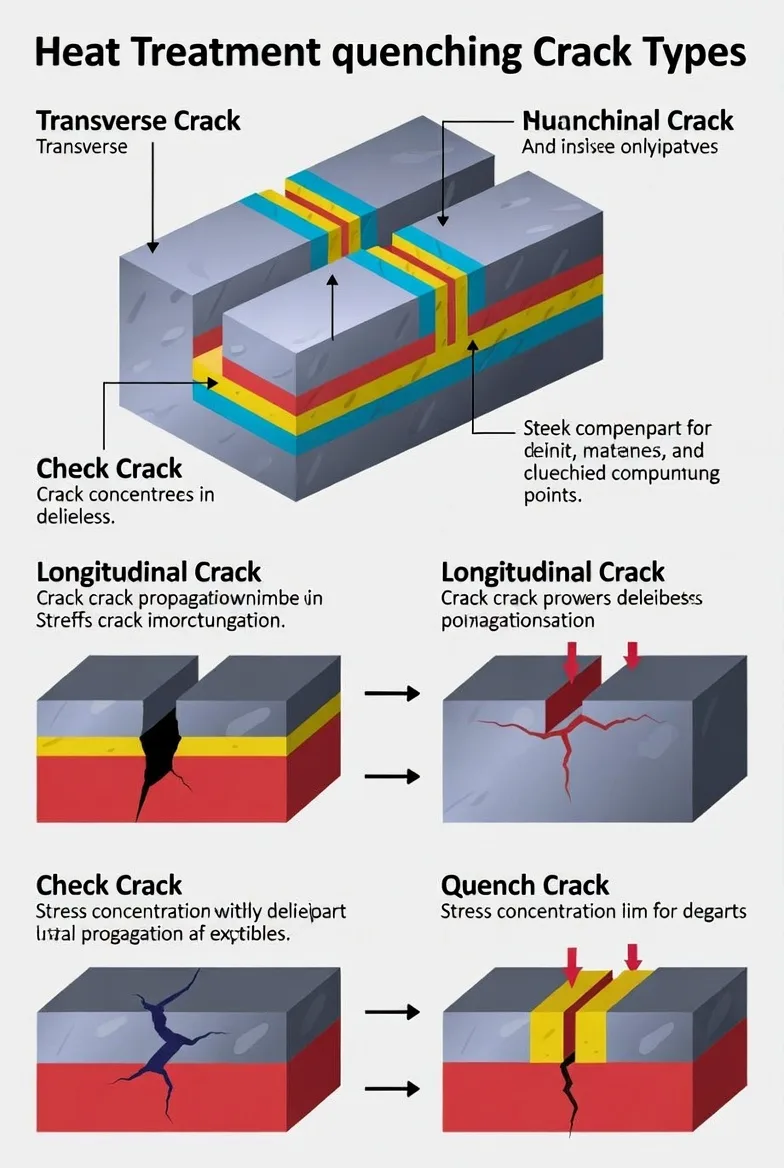
The formation of quenching cracks represents one of the most critical challenges in metallurgical processing, affecting both the structural integrity and performance characteristics of finished steel products. These cracks typically manifest in several distinct forms, each with unique formation mechanisms and characteristic features. The primary categories include longitudinal cracks, transverse and arc-shaped cracks, surface cracks, and spalling or subsurface cracks. Each type presents specific challenges for quality control and requires tailored prevention strategies.
FUSHUN SPECIAL STEEL’s extensive experience in manufacturing specialty steel products has provided valuable insights into the complex interplay between material properties, processing parameters, and crack susceptibility. The company’s comprehensive product range, including tool steel, mould steel, stainless steel, and nickel-based alloys, requires sophisticated understanding of crack prevention mechanisms to maintain the highest quality standards.
Longitudinal Cracks: Formation and Characteristics
Formation Mechanism and Stress Distribution
Longitudinal cracks represent deep fractures that propagate from the component surface toward the central core, distributed along the longitudinal direction of the workpiece or following the component’s geometric configuration. These cracks are particularly prevalent in components where the length significantly exceeds the diameter or thickness, and in geometrically complex workpieces with irregular shapes.
Production experience demonstrates that longitudinal cracks predominantly occur in fully quenched components, with crack formation tendency increasing proportionally to quenching temperature elevation. During complete through-hardening processes, both surface and core regions achieve martensitic microstructures with similar hardness values. However, the organizational transformation from austenite to martensite does not occur simultaneously throughout the cross-section.
The rapid surface cooling during quenching initiates the austenite-to-martensite transformation at the surface layer first. Once this transformation completes and establishes a hardened martensitic shell, the core region begins its own austenite-to-martensite transformation. The larger specific volume of martensite compared to austenite results in volumetric expansion. This core expansion subjects the surface layer to outward tensile stress while the core experiences compressive stress.
Characteristic Features and Identification
Longitudinal cracks exhibit distinctive characteristics that facilitate their identification and classification. These cracks typically present as deep, elongated fractures with clean, sharp edges resembling precise cuts through the material. The crack morphology appears similar to a knife cutting through soft material, creating well-defined boundaries with minimal plastic deformation at the crack edges.
The longitudinal distribution pattern follows the primary axis of the component, though it may deviate based on local geometric features and stress concentrations. In cylindrical components, these cracks typically run parallel to the axis of rotation, while in complex geometries, they may follow stress flow patterns determined by the component’s shape and loading conditions.
Technical Note: FUSHUN SPECIAL STEEL’s quality control procedures emphasize early detection of longitudinal crack formation through systematic inspection protocols during and after quenching operations.
Stress Analysis and Material Behavior
Steel components subjected to quenching develop three-dimensional residual stress states comprising longitudinal, circumferential, and radial stress components. In cylindrical workpieces, longitudinal residual stresses typically reach maximum values, followed by circumferential stresses, with radial stresses generally exhibiting the lowest magnitudes. This stress hierarchy significantly influences crack propagation patterns and failure modes.
The relationship between axial and circumferential stresses determines crack orientation and propagation direction. While theoretical considerations might suggest that high axial stresses could produce transverse cracks, practical experience with small, elongated components shows minimal transverse crack formation. Large components, however, demonstrate increased susceptibility to transverse internal cracking and complete fracture.
Material directional properties significantly influence crack formation patterns. Many industrial components are manufactured from rolled stock, which exhibits anisotropic properties with substantially different longitudinal and transverse characteristics. Transverse plasticity and strength values typically fall well below longitudinal properties. Consequently, even when circumferential stresses remain slightly below axial stress levels, circumferential stress action can still induce longitudinal crack formation due to reduced transverse material properties.
Transverse and Arc-Shaped Cracks
Formation in Large Forgings
Transverse cracks represent one of the most common fracture modes encountered during heat treatment of large forged components. These cracks develop perpendicular to the longitudinal axis of the component and often result in complete separation or significant structural compromise. The formation mechanism primarily involves thermal stress development during rapid cooling cycles inherent to quenching processes.
Large forged components present unique challenges due to their substantial thermal mass and inherent material heterogeneity. The extended roll, with a diameter of 450mm, exhibited transverse internal cracking that originated at the component center and propagated radially outward. Examination of the fracture surface revealed two distinct regions: a central zone with radial crack patterns emanating from the core, and an outer annular region where subsequent hot working caused crack extension to the surface.
The stress analysis perspective classifies transverse internal cracking and complete fracture as thermal stress-induced phenomena. These failures share formation mechanisms with arc-shaped cracks and occur predominantly in large forgings where central regions exhibit higher defect concentrations and reduced mechanical properties. Practical evidence indicates increased occurrence of such fractures in large forgings containing white spots or elevated hydrogen content levels.
| Component Type | Material Grade | Crack Location | Primary Cause |
|---|---|---|---|
| Extension Mill Roll | 35CrMo | Transverse Center | Thermal Stress |
| Blast Furnace Gear Rack | High Alloy Steel | Internal Radial | Core Defects |
| Heavy Forging | Various Grades | Cross-sectional | Hydrogen Content |
Arc-Shaped Crack Development
Arc-shaped cracks preferentially develop within component interiors or in proximity to sharp corners, holes, and other geometric features that promote stress concentration. When component thickness remains moderate, cracks distribute in arc patterns around corner regions within the steel interior. These arc-shaped formations occasionally extend to component surfaces, creating complex crack networks that compromise structural integrity.
Arc-shaped crack formation typically occurs in incompletely quenched components or those subjected to carburizing followed by quenching. High-carbon steel components with diameters or thicknesses exceeding 80-100mm frequently develop arc-shaped cracks when quenching heating temperatures are insufficient or cooling rates prove inadequate.
The formation mechanism involves differential specific volume changes between surface quenched layers and core regions retaining original microstructures. Surface layer expansion, constrained by the core region, results in surface compression with corresponding internal tensile stress development. Arc-shaped cracks originate at locations experiencing maximum tensile stress concentrations.
Sharp corners present particular susceptibility to arc-shaped crack formation due to three-dimensional tensile stress states developed during quenching. Under such triaxial tensile conditions, steel plasticity becomes severely limited, preventing stress relief through local plastic deformation. Consequently, these locations experience elevated crack formation probability, often resulting in edge chipping or corner fracture.
Surface Cracks: Types and Formation Mechanisms
Types and Distribution Patterns
Surface cracks constitute shallow fractures distributed across component surfaces with depths ranging from 0.01mm to 2mm, occasionally extending deeper under specific conditions. The distribution pattern of surface cracks demonstrates independence from component geometry but correlates strongly with crack depth relative to overall component dimensions. When crack depths remain minimal compared to component size, fine network crack patterns develop across the surface.
As crack depth approaches 1mm or greater, surface crack distribution patterns deviate from network configurations, presenting more irregular and localized crack formations. These deeper surface cracks often exhibit directional preferences aligned with principal stress orientations and material flow patterns established during processing.
Surface crack formation requires specific stress distribution conditions characterized by tensile stress development within shallow surface layers combined with reduced material plasticity that inhibits plastic deformation accommodation. These conditions frequently arise in components experiencing surface decarburization, flame hardening operations, or localized heating and cooling cycles.
Causative Factors and Process Parameters
Flame hardening operations present particular challenges for surface crack prevention, especially in large cylindrical components requiring selective hardening. A case study involving a 210mm diameter 40Cr piston subjected to flame hardening demonstrated multiple crack formation mechanisms. Surface cracks developed at flame nozzle junction points where overlapping heat-affected zones created complex thermal stress patterns.
Metallographic examination revealed unhardened zones with widths of 4-5mm between hardened layers, with quenching cracks penetrating to depths equivalent to hardened layer thickness. Research indicates that residual stress levels reach significant magnitudes when gaps of merely 1mm exist between hardened layers. In extreme cases, tensile stresses can reach 374MPa, substantially exceeding material yield strength.
Intermittent cooling strategies, while intended to optimize hardening patterns, can inadvertently promote surface crack formation. Water-air cooling sequences with inappropriate timing create complex thermal histories that subject surface layers to alternating expansion and contraction cycles. When previously transformed martensitic layers experience reheating from internal thermal energy during air cooling phases, subsequent water cooling induces surface contraction and tensile stress development in low-plasticity martensitic structures.
Decarburization Effects on Surface Integrity
Surface decarburization represents a primary mechanism for surface crack formation in carbon and low-alloy steels subjected to high-temperature processing. Decarburized surface layers exhibit reduced carbon content, resulting in martensite with lower specific volume compared to interior regions maintaining original carbon levels. During martensitic transformation, decarburized surfaces experience tensile stress due to constrained expansion from higher-carbon interior martensite.
When surface tensile stress magnitudes reach or exceed material fracture resistance, surface crack formation occurs within the decarburized depth. The crack penetration depth typically corresponds to decarburization depth, creating a direct correlation between surface carbon loss and crack severity. FUSHUN SPECIAL STEEL’s processing protocols emphasize controlled atmosphere heating to minimize decarburization and associated surface cracking risks.
Prevention strategies for decarburization-induced surface cracking include atmosphere control during heating, protective coatings application, and modified cooling procedures that accommodate differential specific volume changes. Advanced alloy steel compositions with enhanced hardenability reduce decarburization sensitivity while maintaining desired mechanical properties.
FUSHUN SPECIAL STEEL Technical Insight
Our experience with specialty steel processing has demonstrated that surface crack prevention requires integrated approaches combining material selection, process optimization, and quality control measures. The company’s comprehensive testing protocols ensure early detection and mitigation of surface cracking tendencies.
Spalling Cracks and Subsurface Phenomena
Formation Mechanism and Stress States
Surface-hardened steel components occasionally develop subsurface cracks that can progress to form circumferential subsurface cracks or complete surface layer spalling phenomena. These spalling cracks often remain undetected until service conditions reveal their presence through progressive surface layer deterioration or sudden catastrophic failure.
The formation mechanism involves complex three-dimensional stress states developing in thin hardened surface layers. Following carburizing quenching or surface hardening operations, surface layer specific volume changes exceed those of interior substrate materials. Surface layer expansion experiences constraint from the interior base material, resulting in biaxial compressive stress development in surface layers with corresponding tensile stress in the depth direction.
This stress configuration can be represented by stress components σz and σx in the z and x directions, respectively, while the y-axis direction experiences tensile stress σy with associated tensile deformation. Under tensile stress action, brittle fractures develop perpendicular to the tensile deformation direction, creating cracks parallel to the surface – designated as spalling or subsurface cracks.
Industrial Case Studies and Analysis
A comprehensive case study involving a 900mm diameter ZG55 crane traveling wheel subjected to flame hardening demonstrated the progression of spalling crack development. Following several days of service, extensive cracking and surface spalling became evident. Metallographic examination revealed quenching cracks penetrating the entire hardened layer depth, with crack propagation continuing past the hardened-unhardened interface due to radial tensile stress concentrations.
The crack development mechanism showed initial penetration through the hardened layer followed by interface-parallel propagation driven by stress concentrations at the hardened-unhardened boundary. This crack growth pattern ultimately resulted in complete surface layer separation and spalling. The failure progression highlighted the critical importance of interface stress management in surface-hardened components.
Preventive measures for spalling crack formation include gradient hardening techniques that reduce sharp property transitions, optimized cooling procedures that minimize interface stress concentrations, and material compositions that provide enhanced toughness at hardened-unhardened interfaces. FUSHUN SPECIAL STEEL’s advanced high-speed steel formulations incorporate these design principles to minimize spalling susceptibility.
| Crack Type | Stress State | Typical Location | Prevention Strategy |
|---|---|---|---|
| Longitudinal | Surface Tension | Along Length | Temperature Control |
| Transverse | Thermal Stress | Core Region | Hydrogen Control |
| Surface | Shallow Tension | Surface Layer | Atmosphere Control |
| Spalling | Biaxial Compression | Interface | Gradient Hardening |
Prevention and Mitigation Strategies
Effective prevention of quenching cracks requires comprehensive understanding of formation mechanisms combined with systematic implementation of control measures throughout the manufacturing process. FUSHUN SPECIAL STEEL’s approach to crack prevention integrates material design, process optimization, and quality assurance protocols to minimize crack formation probability while maintaining desired mechanical properties.
Material composition optimization represents the foundation of crack prevention strategies. Advanced alloy designs incorporate elements that enhance hardenability, reduce transformation temperature spreads, and improve high-temperature ductility. Careful control of impurity elements, particularly hydrogen, sulfur, and phosphorus, significantly reduces crack susceptibility in large forgings and complex geometries.
Process parameter optimization involves systematic control of heating rates, austenitizing temperatures, cooling rates, and tempering procedures. Gradient cooling techniques that minimize thermal shock, interrupted quenching methods that accommodate transformation stresses, and optimized tempering cycles that relieve residual stresses contribute to crack prevention effectiveness.
Component design considerations include stress concentration minimization through appropriate fillet radii, section thickness optimization to promote uniform cooling, and geometric features that accommodate thermal expansion during processing. Advanced finite element analysis capabilities enable prediction of stress distributions and optimization of component designs for reduced crack susceptibility.
Quality control protocols encompass pre-processing material inspection, in-process monitoring of critical parameters, and post-processing crack detection methods. Non-destructive testing techniques including ultrasonic inspection, magnetic particle testing, and penetrant testing ensure early detection of crack formation before component release.
Environmental control during processing includes atmosphere management to prevent decarburization, humidity control to minimize hydrogen absorption, and temperature uniformity maintenance to reduce thermal gradients. These environmental factors significantly influence crack formation tendencies and require careful management throughout processing operations.
FUSHUN SPECIAL STEEL Quality Standards
Our comprehensive quality management system ensures consistent crack prevention through systematic implementation of proven prevention strategies. The company’s ISO certification and adherence to international standards guarantee reliable crack-free products for critical applications.
Advanced testing facilities and experienced metallurgical teams provide continuous improvement in crack prevention techniques, ensuring our customers receive the highest quality specialty steel products available in the global market.
Conclusion and Future Perspectives
The comprehensive analysis of quenching crack types and characteristics reveals the complex interplay between material properties, processing parameters, and component geometry in determining crack formation susceptibility. Understanding these relationships enables development of effective prevention strategies that maintain desired mechanical properties while minimizing crack formation risks.
Longitudinal cracks, resulting from circumferential tensile stresses during martensitic transformation, require careful attention to heating and cooling procedures, particularly in fully hardened components. The tendency toward longitudinal crack formation increases with quenching temperature, necessitating optimized thermal cycles that balance hardness requirements with crack prevention needs.
Transverse and arc-shaped cracks, primarily associated with large forgings and components with stress concentrations, demand integrated approaches combining material cleanliness improvements, hydrogen control, and modified cooling procedures. The relationship between component size and crack susceptibility highlights the importance of size-appropriate processing techniques.
Surface cracks, often linked to decarburization and localized thermal effects, require environmental control during heating and optimized surface treatment procedures. The development of protective atmosphere technologies and advanced heating methods offers promising approaches for surface crack elimination.
Spalling cracks in surface-hardened components represent complex three-dimensional stress phenomena requiring sophisticated understanding of interface mechanics and stress distribution. Advanced gradient hardening techniques and improved material toughness offer potential solutions for spalling prevention.
Future developments in crack prevention will likely focus on advanced simulation techniques for process optimization, novel alloy compositions with enhanced crack resistance, and real-time monitoring systems for early crack detection. The integration of artificial intelligence and machine learning technologies promises improved prediction capabilities and automated process control for crack prevention.
FUSHUN SPECIAL STEEL’s commitment to continuous improvement in crack prevention technologies ensures our position as a leading supplier of high-quality specialty steel products. Our ongoing research and development efforts focus on advancing understanding of crack formation mechanisms while developing innovative solutions that meet evolving industry requirements for reliability and performance.
The successful prevention of quenching cracks requires systematic implementation of proven strategies combined with continuous monitoring and improvement of processing procedures. Through careful attention to material selection, process optimization, and quality control measures, manufacturers can significantly reduce crack formation risks while achieving desired performance characteristics in finished products.
As industry demands for higher performance materials continue to grow, the importance of crack prevention in heat treatment operations will only increase. The knowledge and experience gained from comprehensive crack analysis provide the foundation for continued advancement in specialty steel processing technologies and quality assurance methods.
FUSHUN SPECIAL STEEL
Professional Manufacturer of Special Steel
Committed to Excellence in Metallurgical Innovation and Quality Assurance