
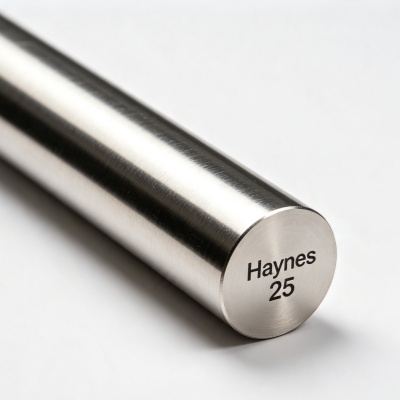
Haynes 25 (L-605, UNS R30605, W.Nr. 2.4964, commonly referred to as Haynes 605 in Chinese market parlance and codified as GH605/GH5605 under GB/T 14992) is a solid-solution strengthened cobalt-chromium-nickel-tungsten wrought superalloy containing nominally 20% Cr, 10% Ni, 15% W, and 0.10% C with cobalt as the balance. Originally developed by Haynes Stellite in the late 1940s as a wrought derivative of the cast Stellite 6 hardfacing alloy — retaining the Co-Cr-W solid-solution backbone while eliminating brittle primary carbides — Haynes 25 became an AMS-qualified standard (AMS 5537/5759) and was widely specified on first-generation military jet-engine combustors and afterburners throughout the 1950s–70s. It remains the baseline wrought cobalt alloy for MRO of legacy aero-engines, high-temperature springs, and ASTM F90 medical implants. Unlike precipitation-hardenable nickel-base grades, Haynes 25 derives its strength exclusively from substitutional solute atoms of tungsten and chromium in the FCC cobalt matrix, reinforced by grain-boundary M23C6 and M6C carbide networks formed during solution annealing at 1175–1230°C followed by rapid cooling. This mechanism delivers moderate creep-rupture capability to 815°C and outstanding oxidation resistance to 1095°C — the Cr2O3 scale regenerates reliably in both static and dynamic oxidizing environments. A hallmark of the cobalt matrix is exceptional sulfidation resistance that outperforms nickel-base alternatives in sulfur-bearing combustion gases, a decisive advantage for marine and industrial gas turbines burning low-grade fuels. It also exhibits a nil ductile-to-brittle transition — elongation remains above 30% at −196°C — qualifying it for LOX/LN2 cryogenic valve trim. Because it is not age-hardenable, elevated spring-temper strength is achieved through cold drawing, enabling wire with UTS up to 1500 MPa. At FUSHUN METAL, we melt Haynes 25 ingots via VIM for tight control of the Co-Cr-W-Ni quaternary base, refine with VAR to eliminate oxide inclusions and ensure Class-A cleanliness per AMS 5759 ultrasonic requirements, and apply PESR for homogeneous solidification in ingots exceeding 400 mm diameter. Because this alloy cannot be precipitation-hardened after welding to restore properties, the initial melt quality determines both service life and intermediate-temperature ductility — our triple-melt route minimises trace-element variance that accelerates Laves-phase (Co2W) precipitation in the 760–925°C embrittlement window. We control carbon within a narrow 0.08–0.11% band to optimise grain-boundary carbide density, achieving the ideal balance between high-temperature creep resistance and room-temperature ductility. FUSHUN METAL also applies precision hot-working between 1150–1200°C with a controlled finish above 900°C to avoid incipient grain-boundary melting, followed by solution annealing in calibrated roller-hearth furnaces with continuous temperature recording. Every heat ships with full ISO 9001 and AS9120B accredited documentation including chemical, tensile, hardness, ultrasonics, and microstructure certification per AMS 5537 / AMS 5759.
Haynes 25 / L-605 Equivalent Grades
| Standard System | Designation |
|---|---|
| UNS (USA) | R30605 |
| AMS (Sheet/Strip) | AMS 5537 |
| AMS (Bar/Forging) | AMS 5759 |
| AMS (Weld Wire) | AMS 5796 |
| ASTM (Medical/Implants) | ASTM F90 |
| DIN / EN | 2.4964 / CoCr20W15Ni |
| GB (China) | GH605 / GH5605 |
| BS (UK) | HR 5 |
| JIS (Japan) | G4902 Co-Cr-W-Ni |
| GOST (Russia) | GOST 25054 |
| ISO (Intl.) | ISO 5832-5 |
| Trade Names | Stellite 25, Alacrite |
Chemical Composition of Haynes 25 (AMS 5537/5759)
| Element | Min % | Max % | Metallurgical Role |
|---|---|---|---|
| Co | Balance | FCC matrix; sulfidation immunity | |
| Cr | 19.0 | 21.0 | Cr2O3 protective oxidation scale |
| W | 14.0 | 16.0 | Primary solid-solution strengthener |
| Ni | 9.0 | 11.0 | Stabilises FCC gamma-phase |
| C | 0.05 | 0.15 | M23C6/M6C grain-boundary carbides |
| Mn | 1.0 | 2.0 | Deoxidation & hot-workability |
| Fe | — | 3.0 | Incidental; minimised |
| Si | — | 0.40 | Deoxidant residual |
P ≤ 0.04%, S ≤ 0.03%. FUSHUN METAL targets mid-range Cr (~20.0%) and W (~15.0%) with tight C variance (0.08–0.11%) to optimise carbide network density at grain boundaries for maximum creep-ductility balance. The VIM+VAR+PESR triple-melt route ensures total inclusion content below the AMS 5759 Class-A threshold, verified by automated SEM-EDS inclusion analysis on every heat.
Applications of Haynes 25 / L-605
Gas Turbine Combustors
Combustion chambers, flame tubes, liners — AMS 5537 sheet to 980°C
Afterburner Components
Spray bars, flame holders, transition ducts in military engines
Turbine Seals & Shrouds
Seal rings, outer shrouds; anti-galling at dry sliding to 815°C
High-Temperature Springs
Cold-drawn spring temper; UTS to 1500 MPa at 20°C, service to 900°C
Bearings & Wear Surfaces
Ball/roller bearings, races; self-mating anti-galling capability
Medical Implants
Bone screws, plates, dental prosthetics — ASTM F90 biocompatible
Cryogenic Valves
LOX/LN2 trim & seats; no DBTT, El >30% at −196°C
Furnace Hardware
Muffles, retorts, radiant tubes — oxidation limit 1095°C; sulfidation-resistant
Supply Range — Haynes 25 / L-605 from FUSHUN METAL
| Product Form | Dimension Range | Condition | Standard |
|---|---|---|---|
| Hot-Rolled Round Bar | Ø6 – 200 mm | Solution Annealed | AMS 5759 |
| Forged Round Bar | Ø50 – 800 mm | Open-Die Forged + SA | AMS 5759, ASTM B670 |
| Forged Flat / Block | T 10–300 x W max 1200 mm | Open-Die Forged + SA | ASTM B564 / B446 |
| Forged Rings (Ring-Rolled) | OD 150 – 2500 x H max 400 mm | Ring-Rolled + SA | AMS 5759, ASTM B637 |
| Cold-Rolled Sheet / Strip | T 0.05 – 3.0 mm | Solution Annealed | AMS 5537 |
| Hot-Rolled Plate | T 3.0 – 50 x W max 2000 mm | Solution Annealed | AMS 5537 |
| Cold-Drawn Wire | Ø0.10 – 8.0 mm | Spring Temper / Annealed | AMS 5796, ASTM F90 |
| Seamless Tube | OD 3 – 114 x WT 0.5–15 mm | Cold-Drawn + Annealed | ASTM B626 |
All products manufactured from FUSHUN METAL VIM+VAR ingots with optional PESR refinement. EN 10204 3.1 certification standard; 3.2 witness-tested certification available on request. Custom forging profiles, ring-rolled components, and non-standard section sizes quoted on inquiry. We maintain strategic ex-stock positions in AMS 5537 sheet (0.5–2.0 mm) and AMS 5759 bar (Ø12–Ø80 mm) to support urgent MRO turnaround.

Mechanical & Physical Properties of Haynes 25 / L-605
| Condition / Temperature | UTS (MPa) | 0.2% YS (MPa) | Elong. (%) | Hardness |
|---|---|---|---|---|
| SA, 20°C (AMS 5759 min.) | ≥895 | ≥310 | ≥30 | ≤282 HB |
| SA, 20°C (typical) | 960–1040 | 420–480 | 38–50 | 98 HRB |
| SA Sheet, 540°C (typical) | 760–830 | 310–370 | 33–42 | — |
| SA Sheet, 760°C (typical) | 550–610 | 240–290 | 30–38 | — |
| SA Sheet, 870°C (typical) | 400–450 | 195–235 | 27–35 | — |
| SA Sheet, 980°C (typical) | 280–330 | 145–180 | 25–32 | — |
| Cold-Drawn Spring Temper, 20°C | 1300–1500 | — | 2–8 | 40–45 HRC |
| Physical Constant | Value |
|---|---|
| Density | 9.13 g/cm³ |
| Melting Range | 1330–1410°C |
| Elastic Modulus at 20°C | ~225 GPa |
| Elastic Modulus at 1000°C | ~158 GPa |
| CTE, 20–100°C | 12.9 x 10⁻⁶/°C |
| CTE, 20–1000°C | 16.5 x 10⁻⁶/°C |
| Thermal Conductivity at 100°C | ~10.5 W/m·K |
| Electrical Resistivity | ~1.12 microohm·m |
| Magnetic Permeability | Non-magnetic (mu ~ 1.001) |
| Cryogenic DBTT | None: El ≥ 30% at −196°C |
Solution annealing: 1175–1230°C, rapid cool (water quench or fast air cool). Stress relief after cold work: 400–450°C / 2 h / air cool. Caution: Prolonged exposure in the 760–925°C range may precipitate Co2W Laves phase, reducing room-temperature ductility — this embrittlement is reversible through re-solution annealing above 1175°C. FUSHUN METAL verifies microstructure stability and carbide morphology via in-house metallography on every production lot under ISO 9001 and AS9120B accredited protocols. For spring-temper applications, we certify the full cold-work hardening curve from annealed to maximum draw strength. Weld procedures use matching AMS 5796 filler (GTAW/GMAW recommended; SAW not recommended); post-weld annealing restores full ductility.