
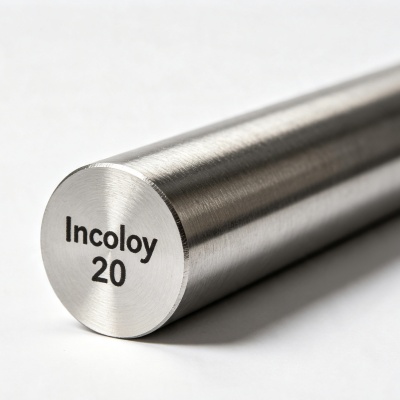
Equivalent Grades of Incoloy 20 Across International Standards
Incoloy 20 is codified under multiple national and international specification systems. The table below maps its designations and governing standards across major markets. Fushun Metal certifies to all listed specifications and can dual-certify heats where required.
| Country / System | Designation | Key Standards |
|---|---|---|
| USA (ASTM/ASME) | N08020 / Alloy 20 / 20Cb-3 | ASTM B463, B473, B729, B464, B366, B462; ASME SB-463, SB-473, SB-464 |
| Germany (DIN/W.Nr.) | 2.4660 / X1NiCrMoCu32-28-7 | DIN 17744, EN 2.4660 |
| France (AFNOR) | Z2NCDU31-27 | NF A54-401 |
| China (GB) | NS1403 / 00Cr20Ni35Mo3Cu4Nb | GB/T 15007 |
| International (ISO) | NiFe30Cr21Mo3Cu | ISO 9723, ISO 9724 |
| Cast Equivalent | CN7M (ACI) | ASTM A743, ASTM A744 |
Applications of Incoloy 20
Incoloy 20 is the established workhorse for equipment handling sulfuric acid at concentrations and temperatures that aggressively attack 304/316L stainless steels. Its copper-modified chemistry also provides outstanding resistance to phosphoric acid, nitric-sulfuric mixed acids, and chloride-bearing process streams. Typical maximum continuous service temperature in sulfuric acid environments is ~93°C, with short-term excursions to higher temperatures permissible depending on concentration and flow conditions.
Sulfuric Acid Processing
Acid coolers, dilution tanks, pickling bath heaters, acid regeneration columns, spent-acid recovery piping, and circulation pump casings for 10–40% H2SO4 service up to ~93°C.
Chemical & Petrochemical
Alkylation unit reactor internals, synthetic rubber manufacturing equipment, organic esterification reactors, solvent extraction columns, and heat exchangers for mixed-acid and chlorinated organic process streams.
Pharmaceutical & Food Processing
API synthesis reactor vessels, food-grade phosphoric acid evaporators, citric and lactic acid process piping, dye and pigment production tanks, and clean-in-place (CIP) system components.
Metal Finishing & Pickling
Steel and titanium pickling tank liners, acid-recovery evaporator tubes, rinse-water heat exchangers, electroplating rack components, and fume-scrubber internals for mixed HCl/H2SO4/HF acid vapors.
Pollution Control
SO2 scrubber quench sections, hazardous-waste incinerator off-gas quench piping, acid-mist eliminators, and wastewater neutralization tank agitators handling fluctuating pH from acidic to alkaline.
Valves, Pumps & Fittings
Gate, globe, and ball valve bodies and trim; centrifugal pump casings, impellers, and wear rings; butt-weld and threaded fittings; flanges, gaskets, and fasteners for sulfuric acid and mixed-acid piping systems.
Incoloy 20 — Supply Range by Fushun Metal
Fushun Metal stocks and processes Incoloy 20 across all major mill forms from a single integrated facility. Our in-house 6000-ton hydraulic open-die press, 1800-ton precision radial forger (GFM), and multi-stand 850/550/350/250 rolling mills enable a broad dimensional envelope without outsourcing—ensuring uninterrupted lot traceability from melt to delivery under ISO 9001 and AS9120B. All material is supplied in the solution-annealed condition per ASTM B463 / B473 (typical 982–1010°C, rapid air cool or water quench), fully recrystallized and verified free of sensitization. Intergranular corrosion testing per ASTM A262 Practice C is performed on each heat. Products are accompanied by mill test certificates to EN 10204 3.1 or 3.2 as required. Welding consumable recommendation: ERNiCrMo-3 (AWS A5.14) filler; ENiCrMo-3 (AWS A5.11) electrode.
Rolled Round Bar
Diameter 5 mm – 300 mm. Length 2,000 – 6,000 mm. Solution-annealed per ASTM B473. Peeled, centerless ground, or hot-rolled finish. Supplied as straight random lengths or precision cut-to-order.
Rolled Plate & Sheet
Thickness 0.5 mm – 60 mm. Width up to 2,500 mm, length up to 8,000 mm. Solution-annealed and descaled per ASTM B463. Surface: No.1, 2B, or 2D. Plasma/laser/waterjet cut-to-size available.
Forged Bar & Flanges
Forged bar OD 80 mm – 600 mm. Weld-neck, slip-on, and blind flanges to ASTM B462, Class 150–2500. Forged discs up to 1,000 mm OD. Rough-turned or finish-machined. UT inspected.
Seamless Tube & Butt-Weld Fittings
Tube OD 6 mm – 300 mm, wall 0.8 mm – 35 mm. Length up to 12 m per ASTM B729. Welded tube per ASTM B464. Fittings: elbows, tees, reducers per ASTM B366. Hydrostatic tested.
Chemical Composition of Incoloy 20 — ASTM B463 / ASTM B473
All heats produced by Fushun Metal are melted via VIM+VAR or VIM+PESR and verified against the composition limits below by optical emission spectrometry and LECO combustion analysis. Full chemical certificates are issued with every shipment under ISO 9001 and AS9120B quality management. The copper (3–4%) and niobium (≥8xC) contents are the alloy’s compositional signatures—copper suppresses active dissolution in hot dilute sulfuric acid, while niobium preferentially forms stable NbC carbides that prevent chromium depletion at grain boundaries during welding and elevated-temperature service.
| Element | Ni | Cr | Fe | Cu | Mo | C | Mn |
|---|---|---|---|---|---|---|---|
| Wt.% | 32.0–38.0 | 19.0–21.0 | Bal. | 3.0–4.0 | 2.0–3.0 | ≤0.07 | ≤2.0 |
| Element | Si | Nb+Ta | P | S | |||
| Wt.% | ≤1.0 | ≥8xC & ≤1.0 | ≤0.045 | ≤0.035 |
Mechanical Properties of Incoloy 20 — Per Product Form
Incoloy 20 is a solid-solution-strengthened austenitic alloy; all mechanical properties are developed through solution annealing at 982–1010°C followed by rapid air cooling or water quenching. The alloy is not hardenable by heat treatment. Its fully austenitic microstructure (stabilized by 32–38% nickel) provides exceptional ductility, toughness, and formability in the annealed condition, with cold-working being the only mechanism for increasing strength. The niobium stabilization ensures that mechanical properties at grain boundaries are maintained after welding without the need for post-weld heat treatment.
Fushun Metal performs all solution annealing in-house under calibrated furnace controls. For cold-formed components where residual stresses may promote stress corrosion cracking in service, a stress-relief anneal at 870–900°C for 1–2 hours followed by air cooling can be applied. Higher-temperature annealing must be followed by rapid cooling to avoid sensitization in the 540–815°C range. The recommended maximum continuous service temperature in oxidizing atmospheres is approximately 760°C, though in aggressive sulfuric acid environments the practical limit is determined by corrosion rate rather than mechanical strength and is typically below 100°C.
Physical constants: Density 8.08 g/cm³; Melting range 1370–1420°C; Hardness ≤217 HB (annealed condition, typical 170–200 HB); Modulus of elasticity 195 GPa at 20°C; Thermal conductivity ~12 W/m·K at 20°C; Coefficient of thermal expansion ~15 μm/m·°C (20–100°C). The alloy is non-magnetic due to its fully austenitic structure.
| Product Form | Condition | Tensile Strength (MPa) | Yield Strength (MPa) | Elongation (%) | Hardness (HB) |
|---|---|---|---|---|---|
| Bar (B473) | Annealed | ≥551 (typ. 600–750) | ≥241 (typ. 300–380) | ≥30 (typ. 35–45) | ≤217 |
| Plate & Sheet (B463) | Annealed | ≥551 (typ. 620) | ≥241 (typ. 300) | ≥30 (typ. 41) | ≤217 |
| Seamless Tube (B729) | Annealed | ≥551 | ≥241 | ≥30 | ≤217 |
| Welded Tube (B464) | Annealed | ≥551 | ≥241 | ≥30 | ≤217 |
| Forgings & Fittings (B462/B366) | Annealed | ≥551 | ≥241 | ≥30 | ≤217 |