
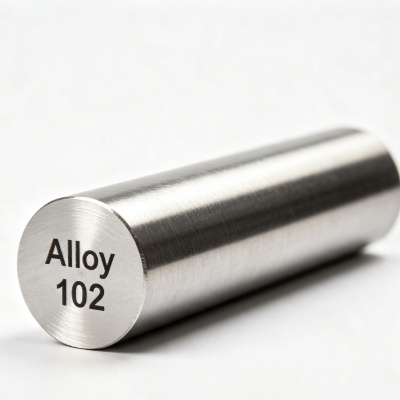
Equivalent Grades & Applicable Standards of Alloy 102
Alloy 102 (IN-102) is primarily a U.S.-origin alloy codified under ASTM/AMS specifications and major OEM standards. No direct European DIN/EN, French AFNOR, Japanese JIS, or Chinese GB registered equivalents exist for this grade. The table below documents the applicable specifications to which Fushun Metal certifies. All material can be dual-certified where overlapping specifications permit.
| System / Source | Designation | Key Standards |
|---|---|---|
| USA (UNS) | N06102 / IN-102 / Alloy 102 | AMS 5758 (Bar, Forgings, Rings); ASTM B637 / ASME SB637; ISO 9724 |
| GE Aviation | IN-102 | S106M, S506M |
| Pratt & Whitney | IN-102 | PWA 1104 |
| Europe (EN/DIN) | No direct equivalent | Certified to AMS 5758 / ASTM B637 composition and properties |
| China (GB) | No direct equivalent | Certified to UNS N06102 composition per AMS 5758 |
Applications of Alloy 102
Alloy 102 is specified for the most demanding hot-section components in gas turbine engines—both aero and industrial—where the simultaneous requirements of creep-rupture life, low-cycle fatigue resistance, and oxidation resistance at metal temperatures approaching 980°C exceed the capability of lower-gamma-prime-volume-fraction alloys such as Inconel 718 and Waspaloy. It is typically supplied in forged and heat-treated condition for machining into finished rotating and static components.
Turbine Blades & Vanes
High-pressure turbine blades, nozzle guide vanes, and stator segments in aero-derivative and industrial gas turbines operating at metal temperatures up to 980°C with combustion gas exposure.
Turbine Discs & Rotors
High-pressure compressor and turbine discs, rotor forgings, shaft components, and integrally bladed rotor (IBR/blisk) preforms requiring high burst strength and low-cycle fatigue resistance.
Combustion & Afterburner
Combustion chamber liners and structural components, afterburner spray-bar assemblies, flame holders, transition ducts, and exhaust-section structural rings for military and commercial engines.
Industrial Gas Turbines
Power-generation turbine wheels and shafts, hot-gas-path structural casings, first-stage nozzle support rings, and mechanical-drive turbine components for long-duration base-load and peaking service.
Rocket & Hypersonic
Liquid-fueled rocket engine turbopump rotors and stators, thrust chamber structural rings, nozzle throat inserts, and high-temperature structural hardware for hypersonic vehicle thermal protection.
Oil & Gas Downhole
High-temperature downhole drilling and completion tools, measurement-while-drilling (MWD) chassis, wellhead components in extreme geothermal wells, and subsea equipment for high-pressure/high-temperature reservoirs.
Alloy 102 — Supply Range by Fushun Metal
Fushun Metal produces Alloy 102 across forged and rolled product forms from a single integrated facility. Our in-house 6000-ton hydraulic open-die press and 1800-ton precision radial forger (GFM) are the primary production routes for this alloy, as its high gamma-prime content makes it inherently suited to forging rather than extensive rolling. All material is supplied in the fully heat-treated condition per AMS 5758—solution-annealed at 1150°C and triple-aged at 1080°C + 845°C + 760°C—unless the customer specifies solution-annealed-only for subsequent forming and in-house heat treatment. The four-step cycle is executed under full time-temperature logging. Ultrasonic inspection per AMS 2375 Class A, dye-penetrant testing, and mechanical test coupons at room and elevated temperature are standard. Mill test certificates to EN 10204 3.1 or 3.2. Matching filler metals available for weld repair.
Forged Round Bar & Billet
Diameter 80 mm – 600 mm. Length 1,000 – 6,000 mm. Open-die forged on 1800t/6000t presses with controlled reduction ratios. Rough-turned or finish-machined per AMS 5758. UT inspected to AMS 2375 Class A.
Forged Discs & Rings
Discs up to 1,200 mm OD x 500 mm thick. Contour-forged rings up to 1,500 mm OD. Single-piece weight up to 5,000 kg. Rough-machined with UT and dye-penetrant inspection. Full heat treatment certification.
Rolled Round Bar
Diameter 10 mm – 150 mm. Length 2,000 – 6,000 mm. Hot-rolled, solution-annealed, and aged per AMS 5758. Peeled or centerless ground. Limited diameter range due to high flow stress of the alloy in hot-working.
Investment Castings (On Request)
Near-net-shape investment castings for turbine blades, vanes, and complex thin-walled components. Vacuum-cast and hot-isostatic-pressed (HIP). Full AMS 5758 chemical and mechanical property certification. Partner foundry qualified.
Chemical Composition of Alloy 102 — AMS 5758 / ASTM B637
All heats produced by Fushun Metal are melted via VIM+VAR or VIM+PESR and verified against the composition limits below by optical emission spectrometry and LECO combustion analysis. Full chemical certificates are issued with every shipment under ISO 9001 and AS9120B quality management. The defining compositional characteristic of IN-102 is the high combined aluminum-plus-titanium content (5–7% total), which drives a gamma-prime volume fraction that places this alloy in the upper tier of wrought superalloy performance. Boron (0.005–0.015%) and zirconium (0.05–0.10%) are present as deliberate grain-boundary-strengthening microalloying additions that improve creep ductility and notch rupture life.
| Element | Ni | Cr | Co | Mo | Al | Ti | C |
|---|---|---|---|---|---|---|---|
| Wt.% | Bal. | 13.0–16.0 | 8.0–10.0 | 8.0–10.0 | 2.5–3.5 | 2.5–3.5 | 0.05–0.10 |
| Element | Fe | B | Zr | Mn | Si | P | S |
| Wt.% | ≤1.0 | 0.005–0.015 | 0.05–0.10 | ≤0.75 | ≤0.40 | ≤0.015 | ≤0.015 |
Mechanical Properties of Alloy 102 — Fully Heat-Treated Condition
Alloy 102 achieves its design properties through a precisely controlled four-step heat treatment: solution annealing at 1150°C ± 10°C (air cool), primary aging at 1080°C ± 10°C for 4 hours (air cool), secondary aging at 845°C ± 10°C for 24 hours (air cool), and tertiary aging at 760°C ± 10°C for 16 hours (air cool). This multi-step sequence optimizes the gamma-prime size distribution into a bimodal population—coarse primary gamma-prime for creep resistance and fine secondary/tertiary gamma-prime for tensile strength—while also developing the grain-boundary carbide network that provides creep ductility and notch-rupture resistance.
Fushun Metal executes the full heat treatment cycle in-house under calibrated furnace controls per AMS 2750 pyrometry requirements. Forging is performed at 1050–1150°C. The alloy requires specialized machining practices typical of high-strength nickel superalloys: rigid setups, sharp carbide tooling, low cutting speeds, and abundant coolant. All mechanical testing is conducted on specimens heat-treated with their parent production lot to ensure representative results. Stress-rupture testing at 815°C / 310 MPa is a standard quality-assurance test for rotating-grade material.
Physical constants: Density 8.10 g/cm³; Melting range 1260–1340°C; Hardness 34–42 HRC (fully aged condition); Modulus of elasticity 215 GPa at 20°C; Thermal conductivity 14.2 W/m·K at 800°C; Coefficient of thermal expansion 13.8 μm/m·°C (20–1000°C). Continuous maximum service temperature: 980°C; oxidation resistance rated to 1100°C. The alloy is essentially non-magnetic.
| Product Form | Test Temp. (°C) | Tensile Strength (MPa) | Yield Strength (MPa) | Elongation (%) | Red. of Area / Notes |
|---|---|---|---|---|---|
| Bar & Forgings | 20 | 1240–1380 | 1030–1170 | 12–18 | RA 15–22% |
| Bar & Forgings | 815 | 890–980 | 720–820 | 10–15 | RA 10–18% |
| Stress-Rupture (Typ.) | 815 | 310 MPa stress | — | — | Life 200–300 h |
| Solution Annealed Only | 20 | ≥860 (typ. 900–1050) | ≥480 (typ. 550–650) | ≥20 (typ. 25–35) | For subsequent forming/aging |