
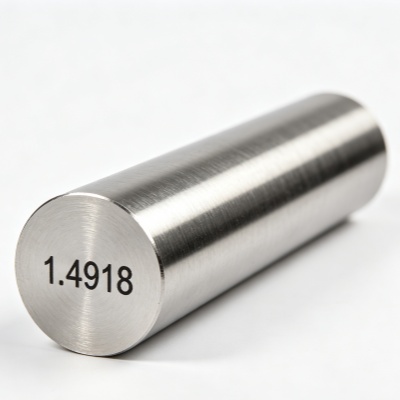
X6CrNiMo17-13-2, designated as EN 1.4918 (commercially known as Alleima® 8R61), is a molybdenum-alloyed austenitic creep-resisting stainless steel that uniquely combines elevated-temperature structural performance with superior pitting and crevice corrosion resistance in chloride-bearing environments. FUSHUN METAL supplies this advanced grade under ISO 9001:2015 and AS9120B certified quality systems with full material traceability from melt to shipment. Unlike the stabilized 300-series heat-resistant grades (321H, 347H) that rely on titanium or niobium for intergranular corrosion immunity, X6CrNiMo17-13-2 takes a fundamentally different approach: its 2.0–2.5% molybdenum content delivers solid-solution strengthening that measurably elevates creep-rupture life at temperature while simultaneously raising the PREN to approximately 24–26—a 30%+ improvement over the PREN ~18–19 of Mo-free grades (304H, 321H, 347H). This dual capability makes 1.4918 the material of choice for components that face hot corrosive media simultaneously with mechanical load: superheater tubing in waste-to-energy and biomass boilers where flue-gas chlorides drive pitting attack, nuclear steam generator tubing exposed to aggressive water chemistry, chemical reactor vessels handling hot sulfuric or phosphoric acid under pressure, and gas turbine combustion hardware operating in sulfur-containing fuel gas environments. The 12.0–14.0% nickel content—matched with 16.0–18.0% chromium—ensures a fully stable austenitic matrix resistant to sigma-phase embrittlement during extended service in the 500–700°C band. The carbon range is tightly controlled at 0.04–0.08% to provide adequate creep strength without excessive carbide precipitation at grain boundaries after welding.
X6CrNiMo17-13-2 (1.4918) Overview
X6CrNiMo17-13-2 is classified under EN 10088-1 (stainless steels list) and EN 10216-5 (seamless tubes for pressure purposes) as an austenitic creep-resisting grade. It is the premium European evolution of the 316H concept—retaining the molybdenum-enhanced corrosion resistance that defines the 316 family, but with elevated nickel (12–14%) and a tightly specified carbon band (0.04–0.08%) purpose-built for predictable long-term creep performance under pressure-equipment codes. At FUSHUN METAL, every heat of X6CrNiMo17-13-2 is verified by optical emission spectroscopy with independent molybdenum and nickel quantification, then solution-annealed at 1050–1150°C with controlled rapid cooling to produce a fully recrystallized, equiaxed austenitic microstructure. The Mo atoms sit substitutionally in the FCC lattice, pinning dislocations at elevated temperature and contributing directly to the grade’s impressive creep-rupture strength: approximately 250 MPa at 550°C for 10,000-hour life, 175 MPa at 600°C, and 111 MPa at 650°C per published data from leading tube manufacturers. These values place 1.4918 comfortably between unstabilized 316H and the stabilized 347H/321H grades in high-temperature mechanical performance, while surpassing all of them in pitting and crevice corrosion resistance. Unlike stabilized grades, 1.4918 does not contain titanium or niobium—in applications where welding is extensive, this means the grade relies on its moderate carbon level and high nickel content to manage sensitization risk, and post-weld solution annealing may be specified for the most demanding service environments. Key industries served include thermal power generation (conventional and waste-to-energy), nuclear engineering, chemical and petrochemical processing, gas turbine manufacturing, and food/pharmaceutical processing where combined temperature and corrosion resistance is required.
Typical Applications by Industry
Power Generation
- Waste-to-energy superheater tubes
- Biomass boiler reheater tubing
- High-temperature steam piping
- Boiler header stubs
- Soot-blower lance tubes
Nuclear Engineering
- Steam generator heat exchanger tubes
- Pressurizer piping systems
- Reactor coolant loop components
- Safety injection system piping
Chemical Processing
- Sulfuric acid reactor vessels
- Phosphoric acid piping & heat exchangers
- Hot chloride-bearing process lines
- Acid regeneration plant tubing
Petrochemical
- Catalytic cracking unit piping
- Hydroprocessing heat exchangers
- Sour gas processing equipment
- Refinery fired heater tubes
Gas Turbines
- Combustion chamber liners
- Transition duct assemblies
- Fuel gas preheater tubing
- Exhaust diffuser components
Aerospace
- Engine exhaust system components
- Afterburner spray rings
- Thrust reverser hot-section parts
- APU exhaust ducting
Pharmaceutical & Food
- High-temperature sterilizer vessels
- Clean steam distribution piping
- Hot CIP (clean-in-place) systems
- Fermentation reactor jackets
Thermal Processing
- Industrial furnace radiant tubes
- Heat treatment retorts
- High-temperature kiln muffles
- Burner flame tubes
X6CrNiMo17-13-2 Supply Range — FUSHUN METAL
FUSHUN METAL stocks and processes X6CrNiMo17-13-2 (1.4918) in an extensive dimensional range, manufactured under ISO 9001:2015 quality management and AS9120B aerospace distribution protocols. Every shipment includes MTC 3.1 documentation with heat number, full optical emission spectroscopy (with independent Mo and Ni verification), mechanical test results (tensile, yield, elongation, impact energy), and dimensional conformance. Third-party inspection, PMI with molybdenum confirmation, and intergranular corrosion testing per ISO 3651-2 Method C are available on request.
| Product Form | Process | Diameter / Thickness Range | Width / Length Range |
|---|---|---|---|
| Round Bar | Hot-Rolled | Φ10mm – Φ500mm | L: 3000 – 12000mm |
| Round Bar | Forged | Φ50mm – Φ800mm | L: 2000 – 12000mm |
| Flat Bar | Hot-Rolled | T: 5 – 100mm | W: 10 – 610mm |
| Flat Bar | Forged | T: 20 – 300mm | W: 50 – 800mm |
| Plate / Sheet | Hot-Rolled / Cold-Rolled | T: 0.5 – 100mm | W: 1000 – 2500mm; L: up to 12000mm |
| Seamless Tube | Cold-Drawn / Hot-Finished | OD: 6 – 610mm | WT: 0.5 – 60mm; L: up to 24000mm |
| Forging / Flange | Open-Die / Closed-Die | Custom: shafts, discs, rings, flanges, tube sheets, valve bodies — to customer drawing per EN 10222-5 | |
Chemical Composition — X6CrNiMo17-13-2 per EN 10216-5
At FUSHUN METAL, each incoming heat is verified by optical emission spectroscopy, with molybdenum content independently confirmed by XRF. The composition below conforms to EN 10216-5 for grade 1.4918. The defining compositional features versus standard 316/316H are the elevated nickel floor (12.0%) and the tightly bracketed carbon range (0.04–0.08%), both optimized for long-term creep ductility under European pressure-equipment design codes.
| Element | C | Si | Mn | P | S | Cr | Ni | Mo | N |
|---|---|---|---|---|---|---|---|---|---|
| Min (%) | 0.04 | — | — | — | — | 16.0 | 12.0 | 2.0 | — |
| Max (%) | 0.08 | 0.75 | 2.00 | 0.035 | 0.015 | 18.0 | 14.0 | 2.5 | 0.11 |
Iron (Fe) balance. The 2.0–2.5% Mo is the key performance element: it raises the PREN to approximately 24–26 (versus ~18 for Mo-free grades), provides solid-solution strengthening at elevated temperature, and confers resistance to reducing acids (H₂SO₄, H₃PO₄). The C max of 0.08% is deliberately lower than 304H/321H/347H (0.10%) to reduce sensitization risk in the absence of stabilizing elements.
Mechanical Properties — X6CrNiMo17-13-2 in Solution-Annealed Condition (+AT)
Values below represent properties after solution annealing at 1050–1150°C with rapid cooling, per EN 10216-5. Elevated-temperature yield strength and creep-rupture data are from published manufacturer datasheets for 1.4918-compliant material. FUSHUN METAL’s heat treatment furnaces are instrumented with embedded thermocouples and logged continuously, with cycle records archived for ISO 9001 and AS9120B traceability.
| Property | Metric Value | Imperial Value | Remarks |
|---|---|---|---|
| Tensile Strength (Rm) | 490–690 MPa | 71–100 ksi | Solution annealed; nominal ~17.5Cr/12Ni/2.2Mo |
| Yield Strength (Rp0.2) | ≥205 MPa | ≥30 ksi | At 20°C; see below for elevated-temp. values |
| Yield at 500°C | ≥108 MPa | ≥15.7 ksi | Rp0.2 per EN 10216-5 data |
| Yield at 550°C | ≥103 MPa | ≥14.9 ksi | Rp0.2 per EN 10216-5 data |
| Elongation (A) | ≥35% (long.) | ≥35% | Transverse: ≥30% per EN 10216-5 |
| Impact Energy (KV, +20°C) | ≥100 J (long.) | ≥74 ft·lbf | Transverse: ≥60 J; indicates excellent toughness |
| Density | 8.0 g/cm³ | 0.289 lb/in³ | Ambient temperature |
| Creep Strength (600°C) | 175 / 120 MPa | 25 / 17 ksi | 10,000h / 100,000h rupture (published data) |
| Creep Strength (650°C) | 111 / 69 MPa | 16 / 10 ksi | 10,000h / 100,000h rupture (published data) |
| Max. Service Temp | ~700°C (creep) | ~1290°F | Oxidation resistance up to ~850°C continuous |
Frequently Asked Questions on X6CrNiMo17-13-2 / 1.4918
What makes 1.4918 different from standard 316H?
While both are molybdenum-bearing austenitic stainless steels in the 316 family, 1.4918 (X6CrNiMo17-13-2) is the European creep-resisting specification with tighter compositional control. Three differences matter: the nickel floor is elevated to 12.0% (versus 10.0% for 316H), providing enhanced austenite stability and improved sigma-phase resistance during prolonged high-temperature exposure; the carbon range is narrowed to 0.04–0.08% (versus 0.04–0.10% for 316H), which reduces the upper bound and associated sensitization risk in the absence of stabilizing elements; and sulfur is capped at 0.015% (versus 0.030% for ASTM 316H), yielding cleaner grain boundaries and superior creep ductility. In practice, for standard applications below 500°C where pitting resistance is the only requirement, standard 316/316L is more economical; for pressure-boundary components operating above 500°C under European codes (EN 13445, EN 12952), 1.4918 is the specified grade.
Why is molybdenum important in a creep-resisting steel?
Molybdenum serves a dual role in X6CrNiMo17-13-2. Mechanically, the oversized Mo atoms in the FCC lattice act as potent solid-solution strengtheners, impeding dislocation climb and glide at elevated temperature—this directly elevates creep-rupture life compared to Mo-free equivalents at the same temperature and stress. Chemically, Mo dramatically improves resistance to pitting and crevice corrosion in chloride-containing environments, which is the dominant failure mode in waste-to-energy boilers (flue-gas HCl), biomass combustion (alkali chlorides), and chemical process equipment (hot acidic chlorides). The PREN of 24–26 for 1.4918 is a 30–40% improvement over the PREN ~18 of 304H/321H/347H—this is the difference between a tube lasting a full maintenance interval versus perforating prematurely through pitting attack.
Does 1.4918 require special welding procedures?
X6CrNiMo17-13-2 welds readily using standard austenitic stainless steel practices (GTAW/TIG is preferred, GMAW/MIG and SMAW are also suitable). No preheating is required, and post-weld heat treatment is generally not needed for most applications. Recommended filler metals are AWS ER316H / ISO 14343 S 19 12 3 H for TIG/GMAW, and AWS E316H / ISO 3581 E 19 12 2 R for SMAW. Heat input should be controlled below 2.0 kJ/mm, and interpass temperature should be maintained at or below 150°C to minimize grain growth and carbide precipitation in the heat-affected zone. Because 1.4918 is not stabilized with Ti or Nb, for the most demanding service conditions (prolonged exposure between 450–850°C in corrosive media), post-weld solution annealing may be specified by the governing construction code. FUSHUN METAL can supply matching filler materials with base metal shipments and provide welding procedure guidance for specific applications.
How does 1.4918 compare to 347H for waste-to-energy boiler tubing?
This is a critical application-specific trade-off. 347H (1.4912 / 1.4961) offers superior creep-rupture strength at temperatures above 600°C due to niobium stabilization and the associated NbC precipitation strengthening, and is immune to intergranular corrosion after welding regardless of thickness. However, 347H has no molybdenum (PREN ~18) and is susceptible to pitting attack from the condensed chlorides and sulfates present in waste-to-energy and biomass flue gas. 1.4918, with its 2.0–2.5% Mo, resists this pitting attack far more effectively and will often outlast 347H in these environments despite having marginally lower creep strength at equal temperature. The decision hinges on the dominant failure mode: if metal wastage by hot corrosion/pitting is the tube-life limiter, 1.4918 is the correct choice; if creep rupture at the highest possible steam temperature is the design driver, 347H or 1.4961 may be preferred. FUSHUN METAL’s technical team can provide comparative data for specific fuel chemistries and operating conditions.
What certifications accompany FUSHUN METAL shipments of 1.4918?
Every shipment of X6CrNiMo17-13-2 from FUSHUN METAL is supplied with an EN 10204 Type 3.1 Mill Test Certificate bearing heat number, full chemical analysis by optical emission spectroscopy (with independent Mo and Ni verification by XRF), mechanical property results (tensile, yield at room and elevated temperatures per EN 10216-5, elongation, impact energy), and dimensional conformance report. The material is produced and verified under our ISO 9001:2015 registered quality management system, with AS9120B protocols governing traceability, storage, handling, and documentation retention. For critical applications, FUSHUN METAL offers supplementary testing including intergranular corrosion resistance per ISO 3651-2 Method C, pitting corrosion testing per ASTM G48, creep-rupture testing at the customer’s design temperature and stress level, third-party witnessed testing, PMI with molybdenum confirmation, and custom test protocols defined at the time of order placement. All test equipment is calibrated to national standards and all records are archived for the full product lifecycle.