
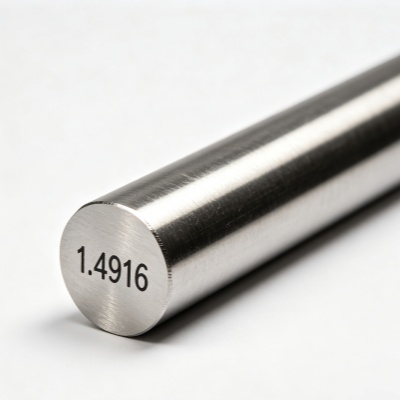
X18CrMnMoNbVN12 (EN 1.4916 / JIS SUH600 / GB 18Cr12MoVNbN, ISC S46250), is a martensitic heat-resistant steel engineered for high-temperature mechanical service up to 650°C — not a corrosion-grade stainless, but a load-bearing alloy for steam turbine blades, high-temperature bolting, and gas turbine internals. The alloy design follows a deliberate “tungsten-free economy” strategy: 12% Cr provides oxidation resistance, 0.30–0.90% Mo delivers solid-solution strengthening, and a triple micro-alloying package of V (0.10–0.40%) + Nb (0.20–0.60%) + N (0.05–0.10%) forms finely dispersed V(C,N) and Nb(C,N) precipitates that pin grain boundaries and resist creep deformation at 580–600°C. The absence of tungsten and high nickel keeps raw material cost significantly below flagship W-bearing turbine grades (e.g., 14Cr11W2MoNiVNbN), while still delivering >80% strength retention at 600°C — the hallmark of a proven 600°C-class turbine blade material. At FUSHUN METAL, X18CrMnMoNbVN12 / 1.4916 is produced under ISO 9001 and AS9120B certified quality systems, with optional ESR/VAR refining for critical rotating applications. Every heat is verified by OES with full EN 10204 Type 3.1 traceability.
Equivalent Grades of X18CrMnMoNbVN12 / SUH600 Across International Standards
| Standard Body | Designation |
|---|---|
| EN (Europe) | X18CrMnMoNbVN12 / 1.4916 |
| ISO | X18CrMnMoNbVN12 / 4916-600-77-J |
| JIS (Japan) | SUH600 |
| GB (China) | 18Cr12MoVNbN / 2Cr12MoVNbN (S46250) |
| AFNOR (France) | Z20CDNbV11 |
| KS (Korea) | STR600 |
| ASTM (USA) | No direct equivalent |
FUSHUN METAL supplies X18CrMnMoNbVN12 / 1.4916 certified to JIS G 4311, EN 10088-3 (martensitic heat-resisting grades) and GB/T 1221 — EN 10204 3.1 certification per shipment. No UNS number exists for this grade; it is ordered by EN or JIS designation.
FUSHUN METAL
Alloy Design — Multi-Element Micro-Alloying in X18CrMnMoNbVN12 / SUH600
Cr 10–13%
12% Cr baseline: forms Cr2O3 passive film for oxidation resistance in steam and combustion gas up to 650°C. The martensitic matrix provides the strength backbone.
Mo 0.3–0.9%
Solid-solution strengthening: Mo atoms distort the martensite lattice, retarding dislocation climb — the primary creep mechanism at 500–600°C. Also suppresses temper embrittlement.
V 0.1–0.4% + N 0.05–0.1%
V(C,N) precipitation: vanadium carbonitrides nucleate as nano-scale particles during tempering, pinning dislocations and grain boundaries for sustained creep resistance.
Nb 0.2–0.6%
Nb(C,N) grain-boundary pinning: niobium carbonitrides are thermally stable up to ~650°C, preventing austenite grain coarsening during solution treatment and prolonged service.
W-Free / Low-Ni
No tungsten, no intentional nickel (Ni ≤ 0.60%). This is the deliberate cost-control strategy vs W-bearing flagship grades — sufficient for 600°C-class turbines at lower alloy cost.
This multi-element approach is the defining philosophy of 12%Cr martensitic heat-resistant steels: Cr provides the oxidation-resistant platform, Mo+V+Nb+N collectively deliver the creep strength — without relying on expensive tungsten or nickel. FUSHUN METAL verifies all five micro-alloying elements (Mo, V, Nb, N, C) on every heat by OES with LECO combustion for C/S/N, ensuring the precipitation-hardening chemistry is precisely within specification.
Industrial Applications of X18CrMnMoNbVN12 / SUH600
Steam Turbine Blades
Supercritical & ultra-supercritical (USC) power plant moving and stationary blades — 600°C-class steam service with centrifugal stress + thermal cycling.
High-Temp Bolting
Turbine casing studs, flange bolts, valve bonnet fasteners — requires high yield strength (≥685 MPa) at temperature with relaxation resistance over 100,000-hour service.
Gas Turbine Components
Compressor blades, seal rings, shroud segments in land-based gas turbines — moderate inlet temperatures with good fatigue resistance and dimensional stability.
Valves & Shafts
Steam stop/control valve spindles, high-temperature pump shafts, turbine rotor components — martensitic hardness (≥321 HBW) resists wear and galling in sliding contact.
Chemical & Process
High-temperature reactor internals, furnace tube supports, reformer components — moderate oxidation resistance with the mechanical strength to carry structural loads at 500–600°C.
Aerospace & Engine
Aero-engine compressor blades & discs, combustion chamber structural parts, high-temperature fasteners — where 12%Cr martensitic grades compete with titanium alloys on cost.
FUSHUN METAL supplies X18CrMnMoNbVN12 / 1.4916 to power generation OEMs and maintenance workshops — ISO 9001 & AS9120B certified, EN 10204 3.1 per shipment, ESR/VAR refined option for critical rotating-grade material.
Supply Range — X18CrMnMoNbVN12 / 1.4916 at FUSHUN METAL
Hot-Rolled / Forged Round Bar
Diameter: 10–1,200 mm
Length: 2,000–12,000 mm
Condition: Annealed / Q+T
Standard: JIS G 4311, EN 10088-3
ESR / VAR Refined Bar
Diameter: 50–800 mm
Purity: Low S (≤0.005%), low inclusion
Application: Rotating turbine blades
UT per EN 10228-3 / ASTM A388
Forged Disc / Ring / Shaft
OD: up to 2,000 mm
Max single pc: ~10,000 kg
Open-die / ring-rolled
Grain flow per customer forging map
Flat / Square / Hex Bar
Thickness: 10–300 mm
Width: 20–800 mm
Hex: 10–100 mm (across flats)
For bolting and fastener blanks
FUSHUN METAL supplies X18CrMnMoNbVN12 / 1.4916 in annealed condition (≤269 HBW, ready for machining) or quenched-and-tempered to customer-specified mechanical properties. ESR/VAR refining is available for rotating-grade applications requiring elevated cleanliness and fatigue performance — all under ISO 9001 & AS9120B quality assurance with EN 10204 3.1 certification.
Chemical Composition of X18CrMnMoNbVN12 per JIS G 4311
| C | Si | Mn | Cr | Mo | V | Nb | N | Ni |
|---|---|---|---|---|---|---|---|---|
| 0.15–0.20 | ≤ 0.50 | 0.50–1.00 | 10.0–13.0 | 0.30–0.90 | 0.10–0.40 | 0.20–0.60 | 0.05–0.10 | ≤ 0.60 |
All values in weight %. This is a 12%Cr martensitic composition — deliberately balanced for hardenability and temper response, not for ambient-temperature corrosion resistance. The carbon level (0.15–0.20%) is high enough to form a fully martensitic structure on oil/water quenching, while the V+Nb+N package provides secondary hardening during tempering at ≥600°C. At FUSHUN METAL, chemistry verification uses OES for metallic elements (Cr, Mo, V, Nb, Mn, Si, Ni) and LECO combustion for C, S, and N — the nitrogen content (0.05–0.10%) is a critical quality checkpoint, as insufficient N reduces precipitation hardening and excessive N risks porosity. Each delivery is accompanied by EN 10204 Type 3.1 certification signed by our ISO 9001 / AS9120B authorized inspector.
Mechanical Properties of X18CrMnMoNbVN12 — Quench + Temper vs Annealed
| Property | Q+T (d ≤ 75 mm) | Annealed | Standard |
|---|---|---|---|
| Tensile Strength, Rm | ≥ 830 MPa | — | JIS G 4311, bar d≤75mm |
| Yield Strength, Rp0.2 | ≥ 685 MPa | — | ~3× 316L yield; turbine bolting grade |
| Elongation A | ≥ 15% | — | JIS G 4311 |
| Reduction of Area, Z | ≥ 30% | — | JIS G 4311 |
| Hardness | ≥ 321 HBW | ≤ 269 HBW | JIS G 4311 / EN ISO 6506 |
| Density | ~7.75 g/cm³ | Magnetic (martensitic) | |
| Elastic Modulus | ~218 GPa at 20°C | JIS reference | |
| Thermal Expansion | 9.3 × 10⁻⁶/K (0–100°C) | Low; critical for turbine blade clearances | |
| Thermal Conductivity | 27.2 W/(m·K) at 500°C | Higher than austenitic grades | |
| 600°C Strength Retention | > 80% of room-temp. yield | Key differentiator for turbine service | |
| Max Service Temp. | 600°C continuous / 650°C short-term | Oxidizing atmosphere | |
Heat treatment protocol: Annealing at 850–950°C, slow cool → delivers machinable condition (≤269 HBW). Quenching at 1,100–1,170°C in oil or water → forms fully martensitic structure. Tempering at ≥600°C, air cool → precipitates V(C,N) and Nb(C,N) for secondary hardening, achieving the final Q+T properties (≥830 MPa tensile, ≥685 MPa yield). FUSHUN METAL can supply material in either annealed or Q+T condition as specified. Per-heat mechanical testing includes tensile per ISO 6892-1, hardness per EN ISO 6506, and Charpy impact per ISO 148-1 (on request for critical rotating components). ESR/VAR refined material achieves S ≤ 0.005% and inclusion ratings to customer specification.
Frequently Asked Questions — X18CrMnMoNbVN12 / 1.4916 / SUH600
Is X18CrMnMoNbVN12 a stainless steel or a heat-resistant steel?
It is classified primarily as a martensitic heat-resistant steel, not a corrosion-grade stainless. The 12% Cr content provides moderate oxidation resistance in steam and combustion gas up to 650°C — but it will rust in ambient atmospheric exposure if not protected (oil, coating, or continuous elevated-temperature operation that maintains the oxide film). Unlike the 400-series ferritic stainless grades, SUH600 is selected for high-temperature mechanical strength, not ambient corrosion resistance. Do not specify it for decorative, food-contact, or wet-corrosion applications — for those, choose 430, 439, or 444.
How does SUH600 compare with other 12%Cr turbine blade steels?
SUH600 sits in the middle tier of the 12%Cr martensitic heat-resistant family: (1) Budget tier: 2Cr13 (0.20C-13Cr, no Mo/V/Nb) — 450°C max, low creep strength; (2) SUH600 tier: 0.18C-12Cr-Mo-V-Nb-N — 600°C class, W-free, economy choice for USC turbines; (3) Premium tier: 14Cr11W2MoNiVNbN (W2+Ni) — 620°C class, flagship for highest creep resistance. SUH600’s value proposition is delivering 600°C capability at significantly lower alloy cost than W-bearing grades — making it the workhorse for high-volume turbine blade production where W2-flagship grades are over-specified on cost. FUSHUN METAL can advise on grade selection based on your turbine inlet temperature and stress requirements.
What is ESR/VAR refining and when is it required?
ESR (Electroslag Remelting) and VAR (Vacuum Arc Remelting) are secondary refining processes that remelt the already-cast ingot under controlled conditions to remove non-metallic inclusions, reduce sulfur to ≤0.005%, and eliminate centerline segregation. For SUH600, ESR/VAR is specified when the component is a rotating turbine blade or disc — where a single inclusion-initiated fatigue crack could cause catastrophic failure. For static applications (valve bodies, bolting, casing components), air-melt + forged quality is generally sufficient. FUSHUN METAL offers both air-melt and ESR/VAR routes — specify your application criticality when inquiring.
How does FUSHUN METAL ensure X18CrMnMoNbVN12 / 1.4916 quality?
FUSHUN METAL applies an eight-stage protocol for this heat-resistant grade: (1) incoming electrode/billet chemistry by OES + LECO C/S/N — nitrogen verification is mandatory; (2) microstructure audit — martensite lath structure after Q+T confirmed by metallography; (3) grain size per ASTM E112 (target ASTM 5–8 for turbine applications); (4) in-process dimensional checks; (5) post-heat-treatment mechanical testing: tensile (ISO 6892-1), hardness (EN ISO 6506), Charpy impact (ISO 148-1, on request); (6) ultrasonic testing per EN 10228-3 / ASTM A388 for forged products; (7) ESR/VAR route: inclusion rating per ASTM E45 Method A; (8) final visual/dimensional inspection and heat-number stamping. Full chain under ISO 9001 & AS9120B, EN 10204 3.1 documentation, 100% traceable to melt.
Why is there no UNS or AISI number for this grade?
The UNS (Unified Numbering System) and AISI (American Iron and Steel Institute) systems are North American standards that primarily catalog grades commonly specified in the US market. X18CrMnMoNbVN12 / SUH600 is a Japanese-European turbine steel grade — it is widely used in Asian and European power generation but has never been adopted into ASTM/AISI/UNS nomenclature because the US turbine industry historically used proprietary or different alloy families (e.g., AISI 422, 616). The grade is ordered by its EN designation (1.4916) or JIS designation (SUH600). FUSHUN METAL supplies to both European and Asian specifications — our certificates cite the EN or JIS standard as applicable.