
1. Specifications & Capability
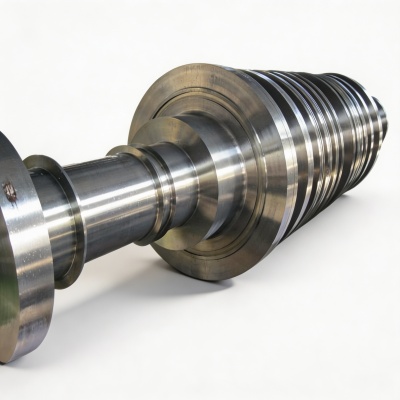
FUSHUN METAL forges turbo-generator rotor bodies to ASTM A469 and ASTM A471, 1200-1600 mm in diameter, from vacuum-degassed ingots on a 20/80 MN fast forging press. These are the single-piece shafts that carry the generator field winding, so they must combine high mechanical strength with high magnetic permeability.
Vacuum treatment lowers hydrogen and controls inclusions to secure a low FATT, while the magnetic properties are verified after heat treatment. Properties are tested on body samples or separately forged prolonged test pieces.
| Grade | Standard | Typical Use |
|---|---|---|
| 25Cr2Ni4MoV / 3.5NiCrMoV | ASTM A469 | Vacuum-treated generator rotor |
| 3.5NiCrMoV | ASTM A471 | Turbine and generator rotor steel |
| 26NiCrMoV14-5 / 1.6957 | EN 10250-3 | European equivalent |
2. Components & Service Conditions
The generator rotor is the forged shaft that carries the field winding of a turbo-generator, transmitting turbine torque at 3000 or 3600 rpm. Its body doubles as part of the magnetic circuit, so the steel must offer high magnetic permeability and low loss in addition to strength and toughness.
In thermal and nuclear power stations the rotor runs for tens of thousands of hours, so internal soundness and a low FATT are critical to avoid brittle fracture and to limit magnetic core losses. Forging the body as a single piece, combined with vacuum degassing to remove inclusions, delivers the uniform properties and magnetic performance the generator requires.
3. Grade Equivalents – ASTM A469 / A471
| Designation | Standard | Notes |
|---|---|---|
| 25Cr2Ni4MoV | ASTM A469 | Vacuum-treated generator rotor steel |
| 3.5NiCrMoV | ASTM A471 | Turbine and generator rotor steel |
| 26NiCrMoV14-5 / 1.6957 | EN 10250-3 | European equivalent |
| 25Cr2Ni4MoV | GB/T 8732 | Reference only, not used in certification |
| Grade | C | Si | Mn | Cr | Mo | Ni | V |
|---|---|---|---|---|---|---|---|
| 26NiCrMoV14-5 (1.6957) | 0.22-0.30 | 0.35 max | 0.20-0.50 | 1.20-1.80 | 0.30-0.60 | 3.30-3.80 | 0.05-0.15 |
The 3.3-3.8% nickel lowers the FATT for fracture-safe operation, while the low impurity content maintains high magnetic permeability and low core loss.
4. Manufacturing Process
Steelmaking. FUSHUN METAL melts in an electric arc furnace with ladle refining and vacuum degassing to lower hydrogen and remove inclusions, both essential for a low FATT and high magnetic permeability.
Forging. The rotor is forged as a single body on a 20/80 MN fast forging press with a minimum 4:1 reduction ratio, closing central porosity and aligning grain flow along the axis.
Heat treatment. Quenching and tempering set the strength and FATT; magnetic permeability is verified after heat treatment.
Testing. Full-section UT, MT, mechanical, FATT and magnetic property tests, with body sampling where specified and full traceability.
5. Standards & Certification
Generator rotors are supplied to ASTM A469 (vacuum-treated generator rotor forgings) and ASTM A471, with inspection certificates under EN 10204 3.1 and optional 3.2 third-party inspection. FUSHUN METAL holds ISO 9001 and AS9120B certification.
Related forgings: HP/IP rotors, LP rotors and retaining rings.
6. Typical Applications
Thermal generators
Rotor bodies for fossil-fired turbo-generators.
Nuclear generators
Rotor bodies for nuclear power station generators.
Hydro generators
Rotor shafts for large hydro-electric generators.
Refurbishment
Replacement rotors for life-extension programs.
7. Inquiry Essentials
To quote your generator rotor, please provide the rotor drawing, the magnetic permeability and FATT requirements, the applicable standard or class, and any body sampling or witness requirements.