
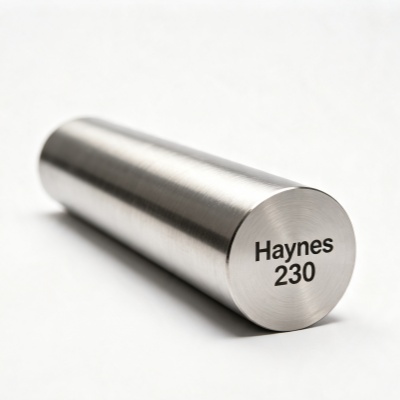
Equivalent Grades of Haynes 230 Across International Standards
Haynes 230 is codified under multiple national and international specification systems. The table below maps its designations and governing standards across major markets. Fushun Metal certifies to all listed specifications and can dual-certify heats where required.
| Country / System | Designation | Key Standards |
|---|---|---|
| USA (ASTM/AMS/ASME) | N06230 / Haynes 230 / Alloy 230 | AMS 5878 (Sheet/Strip/Plate), AMS 5839 (Bar/Forgings); ASTM B435, B572, B622, B564; ASME SB-435, Code Case 2063-3 (Section I & VIII Div I to 900°C) |
| Germany (DIN/W.Nr.) | 2.4733 / NiCr22W14Mo | DIN 17744, VdTUEV |
| France (AFNOR) | NC22W14Mo | NF A54-401 |
| China (GB) | GH3230 | GB/T 14992, GJB |
| Japan (JIS) | NCF 230 | JIS G 4901 |
Applications of Haynes 230
Haynes 230 is the alloy of choice when long-term creep life, oxidation resistance, and microstructural stability must all be simultaneously maximized at temperatures above 980°C—a regime where most commercial heat-resistant alloys fail through a combination of oxide spallation, grain coarsening, and precipitate over-aging. Its ASME code qualification makes it the only non-age-hardenable wrought alloy legally permissible for pressure-boundary components above 900°C in many jurisdictions.
Gas Turbine Hot Section
Combustion cans and liners, transition ducts, flame holders and stabilizers, afterburner spray-bar assemblies, and exhaust nozzle structural components in aero-derivative and heavy-frame industrial gas turbines up to 1150°C.
Industrial Furnace Hardware
Furnace retorts and muffles, radiant tubes, strand-annealing tubes, conveyor chains and belts, heat-treating baskets, grates and trays, burner flame shrouds, recuperator internals, dampers, and nitriding furnace fixtures rated to 1150°C continuous.
Nitric Acid & Chemical Processing
Ammonia oxidation catalyst grids and support baskets, high-temperature heat exchangers and ducting, process-gas bellows, cyclone separators, and sparger tubes in nitric acid, caprolactam, and hydrogen cyanide plants.
ASME Pressure Vessels
High-temperature pressure-boundary components to ASME Section VIII Div I and Section I Code Case 2063-3 up to 900°C, including superheater headers, hot-gas duct pressure shells, and proprietary high-temperature reactor vessels.
Power Generation
Solid-oxide fuel cell (SOFC) interconnects and hot-box components, nuclear-grade high-temperature instrumentation tubes, thermocouple protection sheaths, and structural hardware for advanced ultra-supercritical steam cycles.
Vacuum & Controlled-Atmosphere
Vacuum furnace hot-zone structural components, heating element supports and fixtures, carburizing and carbonitriding furnace internals, and brazing furnace retorts requiring low outgassing and dimensional stability.
Haynes 230 — Supply Range by Fushun Metal
Fushun Metal stocks and processes Haynes 230 across all major mill forms from a single integrated facility. Our in-house 6000-ton hydraulic open-die press, 1800-ton precision radial forger (GFM), and multi-stand 850/550/350/250 rolling mills enable a broad dimensional envelope without outsourcing—ensuring uninterrupted lot traceability from melt to delivery under ISO 9001 and AS9120B. All material is supplied in the solution-annealed condition per AMS 5878 / AMS 5839 (typically 1177–1246°C, rapid water quench) to dissolve all carbides and produce optimal grain structure. The alloy’s lower-than-average coefficient of thermal expansion (CTE ~12.4 μm/m·°C) reduces thermal stress in fabricated assemblies compared to most nickel alloys. Hot-working: 1177°C; cold-working requires intermediate annealing. Welding: ERNiCrMo-1 (230-W) filler, GTAW/GMAW/resistance welding. Mill test certificates to EN 10204 3.1 or 3.2.
Sheet & Plate
Thickness 0.5 mm – 60 mm. Width up to 2,500 mm, length up to 8,000 mm. Solution-annealed per AMS 5878 / ASTM B435 / ASME SB-435. Surface: No.1, 2B, or 2D. Plasma/laser/waterjet cut-to-size. ASME Code Case 2063-3 qualified material available.
Rolled & Forged Bar
Rolled bar OD 5 mm – 250 mm per ASTM B572. Forged bar OD 80 mm – 600 mm per AMS 5839. Solution-annealed, pickled, and centerless ground or rough-turned. Cut-to-order lengths. UT inspected for forged grades.
Seamless & Welded Tube
Seamless tube OD 6 mm – 200 mm per ASTM B622. Welded tube OD up to 1,200 mm per ASTM B619/B626. Solution-annealed. Hydrostatic and eddy-current tested. Thermocouple protection tube and furnace radiant-tube grades available.
Forgings & Fabricated Assemblies
Forged rings, discs, and flanges to ASTM B564. Custom-fabricated furnace retorts, radiant tube assemblies, catalyst support grids, and high-temperature bellows. All with EN 10204 3.1 certification and full ASME material traceability.
Chemical Composition of Haynes 230 — AMS 5878 / ASTM B435
All heats produced by Fushun Metal are melted via VIM+VAR or VIM+PESR and verified against the composition limits below by optical emission spectrometry and LECO combustion analysis. Full chemical certificates are issued with every shipment under ISO 9001 and AS9120B quality management. The four defining compositional features are: 14% tungsten for solid-solution strengthening retained to temperatures exceeding 1000°C; 22% chromium for chromia-scale oxidation protection to 1150°C; lanthanum (0.005–0.05%) as a reactive-element dopant that anchors the chromia scale and eliminates oxide spallation during thermal cycling; and controlled carbon (0.05–0.15%) that forms a thermally stable, uniformly distributed M6C/M23C6 carbide network at grain boundaries during service, pinning grain boundaries against coarsening for tens of thousands of hours.
| Element | Ni | Cr | W | Mo | Co | Fe | C |
|---|---|---|---|---|---|---|---|
| Wt.% | Bal. | 20.0–24.0 | 13.0–15.0 | 1.0–3.0 | ≤5.0 | ≤3.0 | 0.05–0.15 |
| Element | Mn | Si | Al | La | B | P | S |
| Wt.% | 0.30–1.00 | 0.25–0.75 | 0.20–0.50 | 0.005–0.050 | ≤0.015 | ≤0.030 | ≤0.015 |
Mechanical Properties of Haynes 230 — Per Product Form & Temperature
Haynes 230 is a solid-solution and carbide-strengthened alloy; all properties are developed through solution annealing at 1177–1246°C followed by rapid water quenching. The alloy is not hardenable by precipitation heat treatment. At room temperature, the values below represent minimum guaranteed properties per AMS 5878 (sheet) and AMS 5839 (bar). The elevated-temperature tensile data and stress-rupture data are typical values for design reference. Haynes 230’s exceptional long-term creep strength relative to other non-age-hardenable alloys derives from the dense, thermally stable M6C carbide distribution that develops progressively at grain boundaries during elevated-temperature service—a self-optimizing microstructure that improves with time rather than degrading through over-aging.
Fushun Metal performs all solution annealing in-house under calibrated furnace controls with rapid water-quench capability. Annealing at temperatures below the solution range produces partial carbide precipitation that marginally affects strength and ductility. The alloy’s lower CTE (~12.4 μm/m·°C, versus ~15 μm/m·°C for most austenitic grades) is a significant design advantage, reducing thermal stress in constrained components. Welding: ERNiCrMo-1 (AWS A5.14 / 230-W) filler wire for GTAW; matching electrodes for SMAW. Post-weld solution annealing is recommended for ASME pressure-boundary service to restore full creep properties across the weld joint.
Physical constants: Density 8.97 g/cm³; Melting range 1301–1371°C; Hardness ≤25 HRC (annealed condition); Modulus of elasticity 211 GPa at 20°C; Thermal conductivity 8.9 W/m·K at 20°C; Coefficient of thermal expansion 12.4 μm/m·°C (20–100°C). Continuous maximum service temperature: 1150°C in oxidizing atmospheres. ASME Code Case 2063-3 design stress allowables available to 900°C. The alloy is non-magnetic.
| Product Form | Test Temp. (°C) | Tensile Strength (MPa) | Yield Strength (MPa) | Elongation (%) | 10,000h Rupture / Notes |
|---|---|---|---|---|---|
| Sheet/Plate (AMS 5878) | 20 | ≥793 (typ. 841) | ≥345 (typ. 421) | ≥40 (typ. 47) | Max hardness ≤25 HRC |
| Sheet/Plate (Typ.) | 760 | ~605 | ~290 | ~53 | 10,000h rupture ≈82 MPa |
| Sheet/Plate (Typ.) | 870 | ~435 | ~255 | ~65 | 10,000h rupture ≈34 MPa |
| Sheet/Plate (Typ.) | 980 | ~240 | ~145 | ~83 | 10,000h rupture ≈13 MPa |
| Sheet/Plate (Typ.) | 1150 | ~91 | ~47 | ~106 | Oxidation rated to 1150°C continuous |