
How to drill chrome steel
Equipment you’ll need; suitable drilling bit , cutting fluid, eye protection, ear defenders, heavy duty tape, marker pen or 3 corner pyramid punch, sturdy clamp, and felt or plastic to guard work piece within the clamp.
Begin by clearing your workspace to make sure there’s nothing which will catch within the drill once you start working. confirm you’ve got everything handy so you’ll consider getting the work avoided interruption. this is often an honest time to line up your drill and ensure all cables are in fitness .
The correct PPE is of paramount importance when drilling; chips and are sharp and travel at speed so confirm your eyes are well protected. If you wear prescription glasses confirm you wear additional goggles designed to wear over the highest as regular glasses won’t provide adequate protection. Gloves aren’t recommended when drilling as they pose a risk to becoming entangled within the drill; the acute forces, rotation, and speed encountered when drilling can easily break a finger or wrist. Ear defenders are recommended to guard your hearing, exposure to loud machining noise can permanently damage your hearing and contribute to developing tinnitus.
- Mark the position of the opening with a marker pen, or if preferred, tap alittle indent with a 3-corner pyramid punch. If you’re concerned about the damaging the encompassing area because it furls out of the drilling bit you’ll use heavy-duty tape round the drill mark as protection.
- If the metal to be drilled is a smaller amount than 3mm thick it’s going to be possible to use one bit to realize the specified size hole, however, if the metal is thicker it’s recommended to start out with a touch half the dimensions of the specified hole diameter for an initial hole then intensify to the ultimate size drill for a second drilling.
- Firmly clamp the work piece into position ensuring it’s secure. If the drilling bit grabs during operation, or when the drill exits on the side , it can spin the work piece which may cause bad cuts, broken bones and damage to equipment.
- If drilling with hand tools, drop a liberal amount of cutting fluid/ lubricant onto the marked metal. If you’re employing a coolant delivery system, set that up as per the manufacturer’s guidelines. Coolant are often sprayed, dripped, or flooded, but it’s important to use a liberal amount which there’s good contact between the fluid and therefore the tool interface. Using cutting fluid will help to clear the faraway from the drilling bit to scale back the danger of becoming friction welded and reduces work hardening.
- You are now able to start drilling. The table below shows suggested speed and feed rates for drilling different grades of chrome steel .
- When drilling chrome steel , one among the simplest indicators of whether the speed, pressure and feed rates are correct is to observe the ; the should cleanly exit the opening and be helical in shape and short long . Stainless should resemble the first colour of the stock metal or have a yellow tinge thereto . If it’s darker or not helical, back the drill out, apply more coolant and check your machine settings. Then simply try again.
- Once the opening has been made confirm you are doing not touch the bit or the opening as they’re going to be hot enough to cause a burn. Care should be taken when wiping the coolant off the metal because the held within the coolant may scratch the surface.
These steps should have you ever drilling through chrome steel sort of a professional in no time, however, below is more information to offer you a way deeper knowledge of the way to drill chrome steel to urge the absolute best results whenever .
The problem is not hardness, it is work hardening
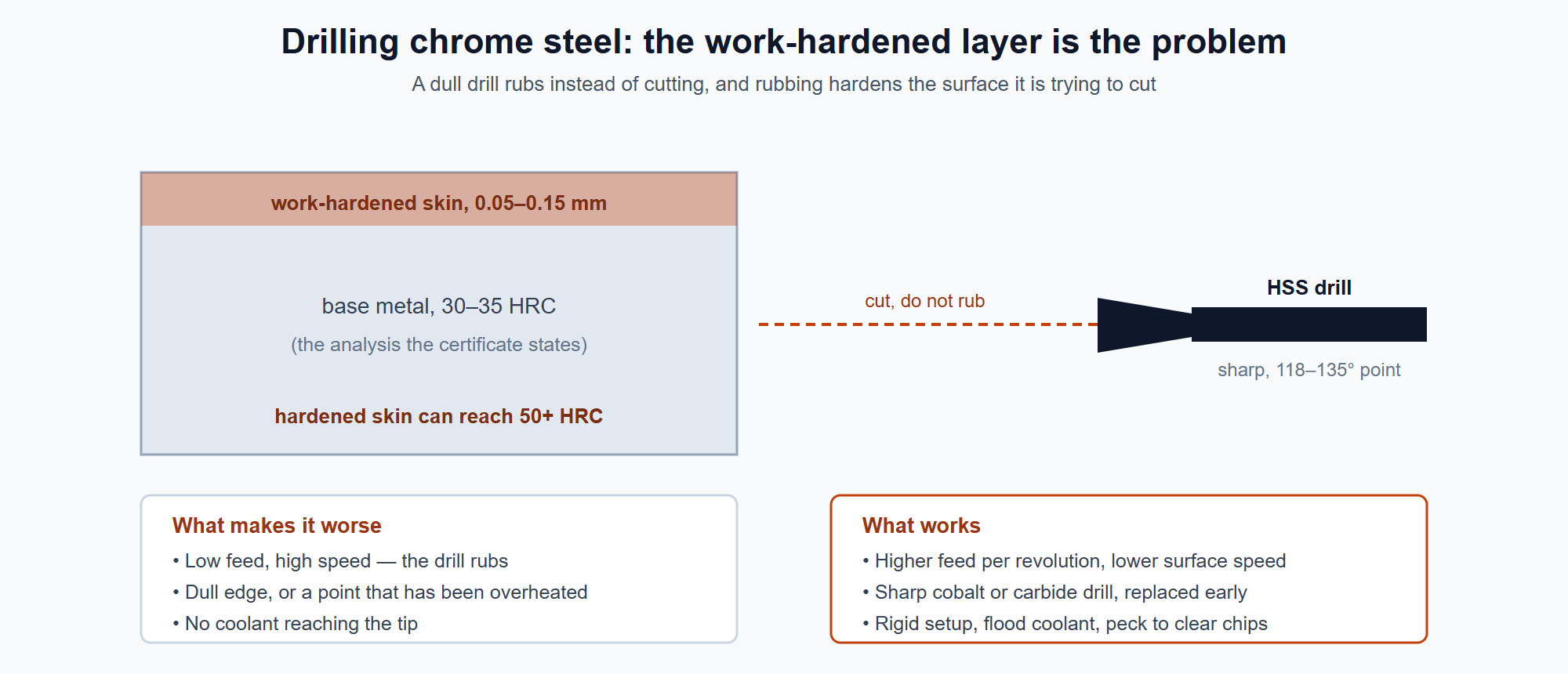
Chrome steel at 30 HRC is not difficult to drill. The difficulty comes from what happens when the edge stops cutting cleanly: the drill rubs, the surface work-hardens to 50 HRC or more in a skin a few hundredths of a millimetre deep, and the next revolution is cutting hardened steel instead of soft steel.
That is why a hole that starts easily can stop dead halfway through, and why the same drill that worked on the first part fails on the fifth.
Speed and feed, in the order that matters
Feed first, then speed. A low feed with high spindle speed is the classic way to rub rather than cut: the edge skates, the material hardens, and the drill dulls. Increase the feed per revolution until the chips come off as continuous curls, then set the surface speed to whatever the drill material allows.
Cobalt HSS or carbide helps, but only if the feed is right — a carbide drill run at rubbing feed will fail faster than HSS, because it is more brittle.
What to control on the shop floor
- Sharp, correctly ground point — 118° for general work, 135° split point for harder material.
- Rigid setup — any vibration converts to rubbing at the margin.
- Coolant at the tip, not just on the outside of the drill.
- Peck drilling to clear chips; packed chips re-cut and harden the hole.
- Replace the drill early. A dull drill costs more in scrapped parts than a new drill costs.