
Incoloy 907 (UNS K90907, N19907, W.Nr. 2.4665) is a precipitation-hardenable nickel-iron-cobalt low-expansion superalloy strengthened by niobium and titanium additions. Developed as a second-generation CTX alloy, its defining metallurgical advantage is an exceptionally low coefficient of thermal expansion — approximately 7.6 μm/m·K from 20–400°C — coupled with UTS exceeding 1350 MPa in the aged condition. The alloy belongs to the Incoloy 900-series family (903/907/909), where each successive grade trades off thermal expansion against high-temperature capability; 907 bridges the gap, improving notch-rupture ductility over 903 while retaining a CTE well below conventional nickel superalloys such as Inconel 718 (which expands at ~13.0 μm/m·K). This balance makes Incoloy 907 the established choice for gas turbine components where thermal mismatch control directly translates into fuel efficiency — tighter tip clearances in seals and shrouds, dimensionally stable casings, and lightweight structural parts with superior strength-to-density ratios. Notably chromium-free, the alloy achieves its oxidation resistance through a tightly controlled silicon-aluminum surface layer rather than a chromia scale; as a result, protective coatings are recommended for continuous service above 650°C. At FUSHUN METAL, we produce Incoloy 907 via VIM for precise chemistry control of the narrow Co-Nb-Ti window, followed by VAR for superior inclusion cleanliness, and optionally PESR to refine the solidification structure in large-section ingots exceeding 400 mm diameter. Boron, present at a tightly managed 0.003–0.012% range, segregates to grain boundaries during solidification where it suppresses oxygen embrittlement under sustained creep loading — a trace-element sensitivity FUSHUN METAL monitors with every heat lot released. Two distinct aging routes are available: a tensile-limited schedule (720°C/8h + FC 55°C/h to 620°C/8h) yielding maximum strength above 1350 MPa, and a rupture-limited schedule (775°C/12h + 620°C/8h) trading approximately 10% of tensile strength for significantly improved creep-rupture life at 540°C — we work with each customer to select the heat treatment that best matches their service condition. All material ships under our ISO 9001 and AS9120B accredited quality management system with full melt-route traceability, and each shipment includes chemical analysis, room-temperature and elevated-temperature tensile, hardness, and ultrasonic inspection data per AMS 5917 and ASTM B637.
Equivalent Grades for Incoloy 907 / K90907
| UNS | K90907 / N19907 |
| AMS | 5916 (Sheet/Strip/Plate), 5917 (Bar/Forging/Ring), 5918 |
| ASTM | B637, B670, B564, B446 |
| ASME | SB-637, SB-670 |
| EN | NiCr15Fe7NbTi |
| DIN / W.Nr. | 2.4665 |
| GB | GH2907 |
| ISO | 6207 |
K90907 is the UNS designation actively used by FUSHUN METAL per ferrous alloy classification; N19907 appears in nickel-alloy-sourced literature and in Carpenter Technology documentation (CTX-3). Both reference the same chemical composition and are interchangeable for procurement purposes.
Chemical Composition of Incoloy 907
| Ni | 35.0–40.0 | Co | 12.0–16.0 | |
| Fe | Bal. (~42) | Nb | 4.3–5.2 | |
| Ti | 1.3–1.8 | Si | 0.07–0.35 | |
| Al | max 0.20 | C | max 0.05 | |
| Mn | max 0.50 | S | max 0.015 | |
| B | 0.003–0.012 |
Per AMS 5917 / ASTM B637. The Nb + Ti + Al system precipitates gamma-prime (Ni3Al,Ti) and gamma-double-prime (Ni3Nb) phases during aging — the source of the alloy’s extreme strength. Boron at grain boundaries suppresses oxygen embrittlement under creep loading. No chromium is present; its addition would raise thermal expansion unacceptably. FUSHUN METAL verifies every element via optical emission spectroscopy, with carbon and sulfur by dedicated combustion analysis on each heat.
Incoloy 907 is also available in Cr-bearing variants for applications where oxidation resistance must be improved, though this increases CTE to approximately 8.3–8.8 μm/m·K — contact FUSHUN METAL technical support to determine the correct chemistry for your thermal environment.
Typical Applications
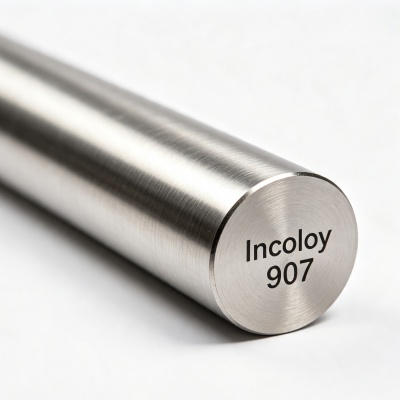
Supply Range — Incoloy 907 / K90907
| Rolled Round Bar | Dia. 5–150 mm x L 2–6 m; hot-rolled, solution-annealed or aged per order |
| Rolled Flat Bar | Thk. 5–100 mm x W 20–300 mm x L 2–6 m |
| Forged Round Bar | Dia. 100–800 mm x L up to 6 m; open-die forged from VIM+VAR ingot, rough-turned or finish-machined |
| Forged Rings & Discs | OD up to 2000 mm, rolled-ring or pancake-forged; as-forged, proof-machined, or finish-machined |
| Sheet & Plate | Sheet: 0.5–6.0 mm; Plate: 6–80 mm; W 600–2000 mm; hot-rolled and solution-annealed |
| Strip & Wire | Strip: 0.05–2.0 mm thick; Wire: dia. 0.5–10 mm, spring temper available |
| Seamless Tube | OD 6–250 mm x WT 1–25 mm; cold-drawn or hot-extruded from pierced billet |
FUSHUN METAL supplies every form from VIM+VAR ingots, with PESR refinement recommended for large-section forgings exceeding 400 mm diameter where centerline solidification quality is critical. Custom heat treatment — solution-annealed at 980°C, or fully aged to either tensile-limited or rupture-limited schedules — is applied in our in-house furnaces with chart-recorded temperature profiles. All products ship with EN 10204 Type 3.1 mill certificates; Type 3.2 witness-tested certification by Lloyd’s Register, Bureau Veritas, or SGS is available on request.
Mechanical Properties — Incoloy 907
| Condition | UTS (MPa) | YS (MPa) | Elong. (%) | Hardness |
| Sol. Annealed 980°C/1h | ~850 | ~550 | ~30 | HB ~250 |
| Aged — Tensile-Limited* | >=1350 | >=1100 | >=10 | HRC 38–44 |
| Aged — Rupture-Limited** | >=1200 | >=1000 | >=12 | HB 375–430 |
| Aged — Bar (ASTM B637) | >=1310 | >=1030 | >=8 | HB 380–430 |
| Aged — Sheet (AMS 5916) | >=1280 | >=1000 | >=12 | HRC 36–42 |
*720°C/8h + FC 55°C/h to 620°C/8h, AC | **775°C/12h + FC 55°C/h to 620°C/8h, AC | All conditions: solution anneal 980°C/1h, AC prior to aging. Rupture-limited schedule provides ~30% improvement in creep life at 540°C/1000h with ~10% tensile strength trade-off. FUSHUN METAL validates mechanical properties on every heat lot with room-temperature tensile (ASTM E8), hardness (ASTM E18), and elevated-temperature creep-rupture testing where specified.
| Density | 8.33 g/cm³ | Elastic Modulus | 165 GPa |
| Melting Range | 1335–1400°C | CTE (20–400°C) | ~7.6 μm/m·K |
| Curie Temp. | 400–455°C | Shear Modulus | 61 GPa |
| Thermal Cond. (200°C) | 15.6 W/m·K | Poisson’s Ratio | 0.36 |