
Invar 36 (UNS K93600): Low-Expansion Nickel-Iron Alloy
A 36 % nickel–iron alloy with a coefficient of expansion about one tenth that of carbon steel. It is bought for one reason — a dimension that has to stay a dimension — and it is unforgiving about everything else.
Invar 36 is the original low-expansion alloy, and it is still the reference against which every other one is measured. Between room temperature and about 200 °C it expands by roughly 1.2 µm per metre per kelvin, against 12 for carbon steel and 17 for 304 stainless. Over a 300 mm instrument frame that is the difference between a dimension that holds and one that does not.
The trade is real. Invar is soft, it is difficult to machine cleanly, it rusts in a humid room, and it loses its low expansion above about 230 °C. It is specified where dimensional stability matters more than strength, corrosion resistance or cost — and nowhere else.
Why 36 % nickel
The iron–nickel system has an anomaly. Across most of the composition range, adding nickel to iron changes the expansion only gently. Around 36 % nickel the curve falls into a sharp minimum, and the alloy becomes almost dimensionally inert at room temperature. The cause is magnetic: below its Curie point the alloy is ferromagnetic, and the alignment of magnetic moments contracts the lattice as temperature rises, cancelling most of the normal thermal expansion.
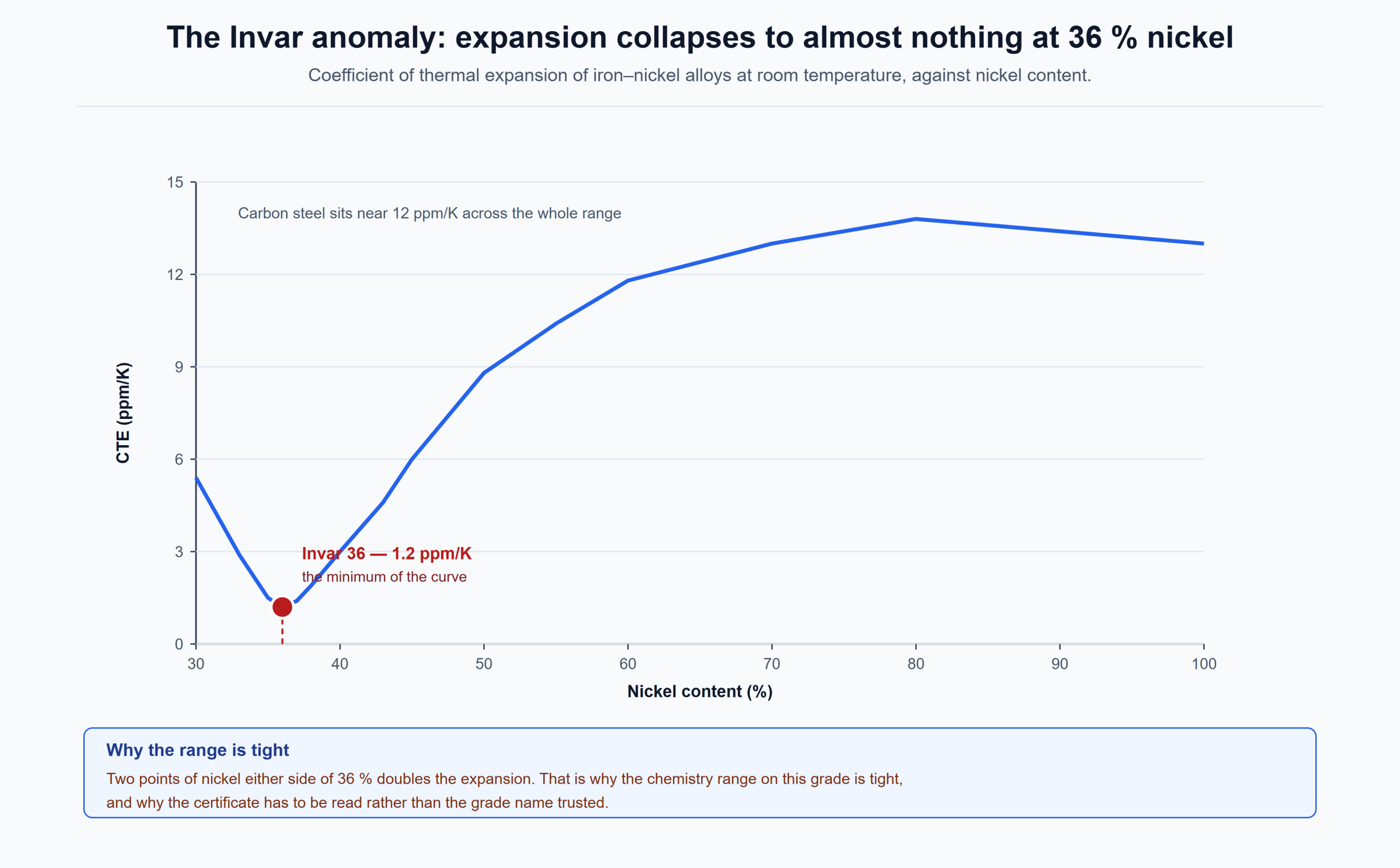
That mechanism also sets the limit. Above the Curie temperature of about 230 °C the magnetic contribution disappears and the alloy expands like an ordinary iron–nickel solid — about 8 µm/m·K. A part that is expected to hold tolerance at 300 °C is being asked for something Invar cannot deliver, and the drawing should be challenged before the material is ordered.
Expansion in practice
The coefficient is not a constant, and quoting a single figure without a temperature range is meaningless. The table below is the mean coefficient over the range that matters for most instrument work.
Table 1. Mean coefficient of thermal expansion of Invar 36 over successive ranges, typical values.
| Range | Mean CTE | Expansion over the range | Comment |
|---|---|---|---|
| 20–100 °C | 1.2 × 10⁻⁶/K | 0.10 mm/m | The design figure for instrument work |
| 20–200 °C | 1.6 × 10⁻⁶/K | 0.29 mm/m | Still well below the Curie point |
| 20–300 °C | 4.0 × 10⁻⁶/K | 1.12 mm/m | Past the Curie point; expansion accelerates |
| 20–400 °C | 6.5 × 10⁻⁶/K | 2.47 mm/m | About half of carbon steel, not a tenth |
| 20–500 °C | 8.5 × 10⁻⁶/K | 4.08 mm/m | The low-expansion property is effectively gone |
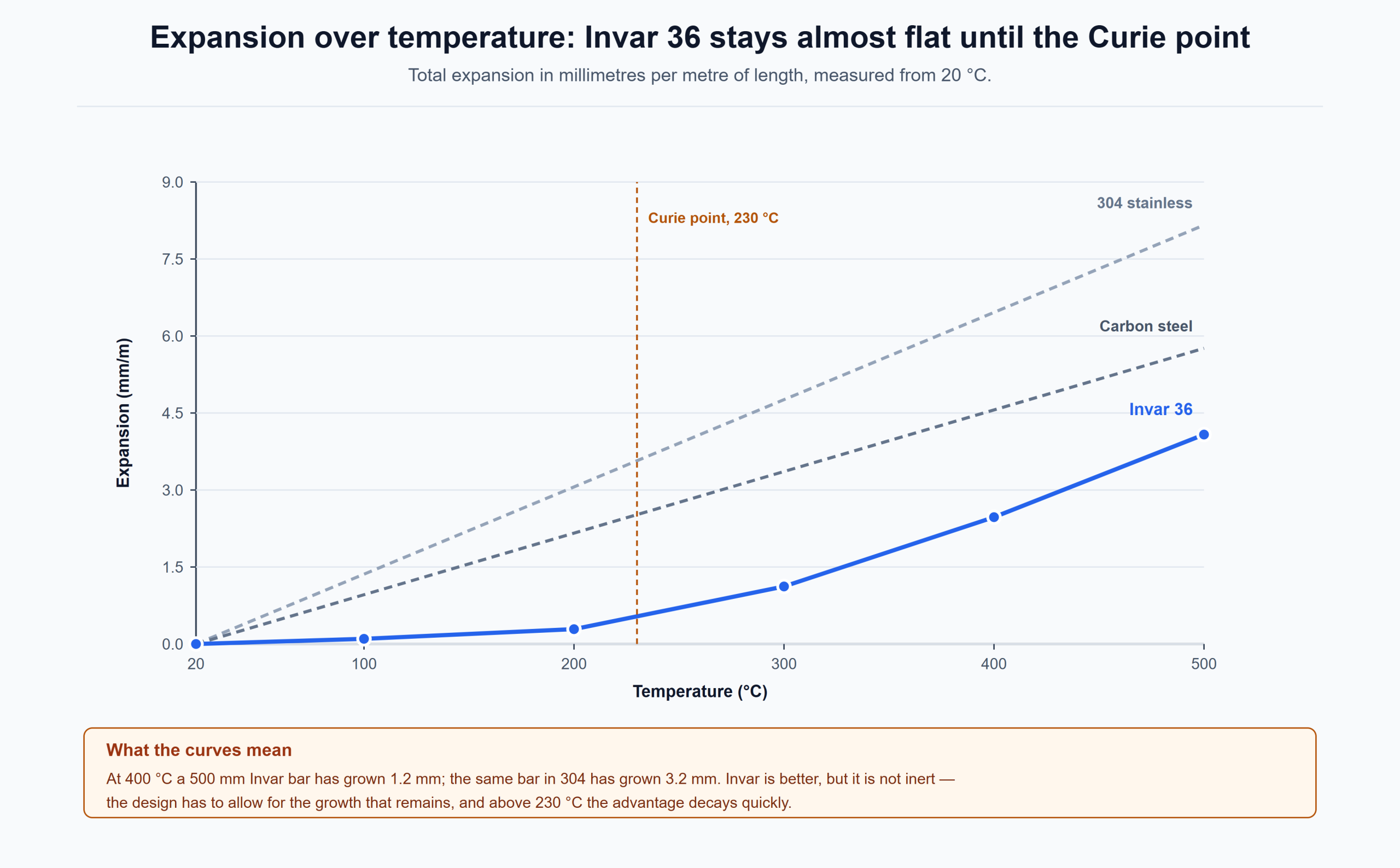
Read the third column rather than the second. A 500 mm bar taken from 20 °C to 400 °C grows about 1.2 mm. The same bar in 304 grows about 3.2 mm. Invar is still the better choice, but it is not five times better over that range — it is about 2.5 times better, and the difference has to be designed for.
Chemical composition
Table 2. Chemical composition of Invar 36, mass fraction in percent. Iron balance.
| Ni | C | Mn | Si | P | S | Fe |
|---|---|---|---|---|---|---|
| 35.0–37.0 | ≤0.05 | ≤0.60 | ≤0.30 | ≤0.020 | ≤0.020 | Balance |
The nickel range is deliberately tight. Two points off 36 % moves the expansion coefficient by roughly 1 µm/m·K, which is more than the whole tolerance on some instrument specifications. That is why Invar is bought against a chemistry certificate rather than a generic “low expansion alloy” description. The carbon limit is equally functional: carbon forms carbides that pin the lattice and raise the expansion.
Mechanical and physical properties
Table 3. Typical properties of Invar 36 in the mill-annealed condition.
| Property | Value | Note |
|---|---|---|
| 0.2 % proof strength | 240 MPa | At 20 °C |
| Tensile strength | 490 MPa | At 20 °C |
| Elongation | 42 % | On 50 mm |
| Reduction of area | 70 % | Very ductile |
| Hardness | about 160 HV | Soft; galls easily |
| Density | 8.05 g/cm³ | |
| Young’s modulus | 141 GPa | Lower than steel |
| Curie temperature | about 230 °C | Above this the expansion rises sharply |
| Thermal conductivity | 10.4 W/m·K | About a quarter of carbon steel |
The low modulus and the low conductivity are the two properties that catch people out in manufacture. Invar deflects more than steel under the same load, and it conducts heat away slowly, so a machining operation puts more heat into the workpiece than the same operation on steel.
Where it is used
- Precision instruments and metrology frames, where a 1 °C change must not move a measurement.
- Laser and optical benches, telescope structures and satellite payload supports.
- Bimetallic thermostats and temperature regulators, where Invar is paired with a high-expansion alloy to make a part move by a controlled amount.
- Composite tooling and moulds, where the tool has to match the expansion of the carbon-fibre part it produces.
- Cryogenic pipework and LNG handling, where the alloy keeps useful toughness at low temperature.
- Shadow masks and electronic components that must stay registered through a thermal cycle.
Machining, welding and forging
Invar is tough, ductile and gummy. Chips come off stringy and work-harden the surface behind the tool, so a cut that rubs rather than cuts will wear the edge out in minutes. Machine it in the annealed condition, keep the tool sharp, use high-speed steel or carbide, take a depth of cut deep enough to get under the work-hardened skin, and keep the speed down — not because the material is hard, but because the heat generated will change the expansion of the part under the tool and the finish will suffer.
Welding is possible with conventional processes, but the weld pool must not be overheated: superheating causes spatter and porosity. Matching Invar filler is used where the joint has to keep the expansion property; a nickel-base filler gives a stronger joint at the cost of local expansion mismatch. Forging is done at 1100–1180 °C with a short soak, because a long soak at temperature picks up sulphur from the furnace atmosphere and produces a checked surface.
What to watch
- Stress relief after machining. Rough machine, stress relieve, then finish. A part machined to size in one pass will move when the residual stress relaxes, and the movement is larger than the expansion the alloy was bought to avoid.
- Temperature above the Curie point. The low-expansion property is a room-temperature property. Above 230 °C it decays quickly.
- Corrosion. Invar is not stainless. It rusts in humid air and needs a coating, a dry environment or a plated finish.
- Magnetic attraction. The alloy is ferromagnetic below 230 °C, which matters in instruments that sit near a magnetic field.
- Chemistry, not just grade name. Ask for the nickel analysis on the certificate, not just the grade.
Specifications and supply
Table 4. Standards and designations Invar 36 is bought against.
| Reference | What it covers |
|---|---|
| UNS K93600 | The US designation for the 36 % nickel iron alloy |
| UNS K93603 | The controlled-expansion variant with tighter limits on carbon and other residuals |
| Werkstoff 1.3912 / EN | The European designation, chemistry and delivery condition |
| ASTM F1684 | Chemistry, expansion and mechanical property requirements for the strip and bar |
| AFNOR NF A54-301 | French standard, chemistry only |
Table 5. Supply forms and typical size ranges.
| Form | Size range | Condition |
|---|---|---|
| Round bar | Ø10–300 mm | Forged, hot rolled or cold drawn; annealed |
| Strip and sheet | Thickness 0.1–3.0 mm, width 10–300 mm | Cold rolled, annealed and pickled, or bright annealed |
| Plate | Thickness 3–60 mm | Hot rolled, annealed |
| Wire | Ø0.5–8.0 mm | Cold drawn, annealed or as drawn |
| Forgings and machined parts | To drawing | Annealed, or finished to drawing |
Each heat is issued with a certificate to EN 10204 3.1 carrying the chemical analysis, the mechanical properties and, where the application is dimensional, the measured coefficient of expansion of that heat rather than a generic table value. Incoming material is visually inspected and PMI tested before processing; finished parts are checked dimensionally and by PMI before despatch.
Inspection, certification and services
For instrument work the certificate matters more than the grade name: two heats both called Invar 36 can differ by 1 µm/m·K, which is the whole tolerance on a 300 mm frame. Ask for the measured expansion over the range you will use, not just the chemistry.
Table 6. Workshop and commercial services offered with Invar 36.
| Service | Detail |
|---|---|
| Cutting | Saw-cut blanks, waterjet or laser cut plate to drawing |
| Machining | CNC turning, milling and grinding to drawing, with stress relief between rough and finish |
| Packing | Bare, nylon wrap, wooden case; export seaworthy packing |
| Payment | T/T, L/C at sight, or O/A against approved credit |
| Delivery terms | FOB, CFR, CIF, DDU or DDP by sea, rail, air or road |
Related reading
- Common types of nickel alloys — where Invar sits among the seven nickel alloy families
- Monel 400 — the nickel–copper answer when corrosion, not expansion, is the problem
- Inconel 625 — the other end of the family: high strength with corrosion resistance
- Incoloy 800 / 800H — nickel–iron–chromium for high-temperature service
- Nickel 200 — commercially pure nickel, the baseline for the alloy family
You get chemical composition, mechanical properties and a price — with inspection certificates to EN 10204 3.1 issued against the heat number.