
1. Specifications & Capability
FUSHUN METAL open-die forges low-pressure (LP) steam turbine rotors in 3.5NiCrMoV steel to ASTM A470 Class 2/3 and ASTM A471, 1500-2500 mm in diameter and up to 100 t single weight. These are the largest rotating forgings in a steam turbine, produced from vacuum-degassed ingots cast up to 114 t.
The FATT is controlled to -18 C or lower to guarantee fracture-safe operation in the wet, low-temperature LP environment, with properties verified on body samples.
| Grade | Standard | Typical Use |
|---|---|---|
| 3.5NiCrMoV | ASTM A470 Cl.2/3 | LP rotor bodies, monobloc |
| 3.5NiCrMoV | ASTM A471 | Turbine and generator rotors |
| 26NiCrMoV14-5 / 1.6957 | EN 10250-3 | European equivalent |
2. Components & Service Conditions
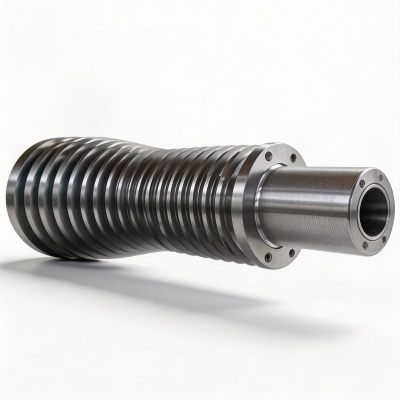
These forgings are the monobloc LP rotors of large steam turbines, also supplied as welded rotor bodies. The LP rotor carries the final stages of blading – the longest, heaviest blades – and operates at the highest centrifugal stress on the machine, yet in comparatively cool, wet steam.
The controlling design requirement is therefore not creep but brittle fracture resistance, measured by the FATT. The 3.5% nickel in the steel lowers the transition temperature so the rotor remains tough at operating temperature and during cold start. Forging a single body with integral wheel discs, and controlling segregation through vacuum treatment, keeps the core sound and the FATT uniform through the 2500 mm section.
3. Grade Equivalents – 3.5NiCrMoV / 1.6957
| Designation | Standard | Notes |
|---|---|---|
| 3.5NiCrMoV | ASTM A470 Cl.2/3 | LP rotor steel, FATT controlled |
| 3.5NiCrMoV | ASTM A471 | Turbine and generator rotor steel |
| 26NiCrMoV14-5 / 1.6957 | EN 10250-3 | European equivalent |
| 25Cr2Ni4MoV | GB/T 8732 | Reference only, not used in certification |
| Grade | C | Si | Mn | Cr | Mo | Ni | V |
|---|---|---|---|---|---|---|---|
| 26NiCrMoV14-5 (1.6957) | 0.22-0.30 | 0.35 max | 0.20-0.50 | 1.20-1.80 | 0.30-0.60 | 3.30-3.80 | 0.05-0.15 |
The 3.3-3.8% nickel is the key alloying element, lowering the FATT so the rotor remains tough at the low temperatures of LP service.
4. Manufacturing Process
Steelmaking. FUSHUN METAL melts in an electric arc furnace with ladle refining and vacuum degassing, then casts large ingots up to 114 t. Vacuum treatment lowers hydrogen to prevent flaking and controls segregation, which is essential for a uniform FATT in the largest sections.
Forging. The rotor is forged as a monobloc body with integral wheel discs on a 20/80 MN fast forging press, using multiple upsetting and drawing operations to close central porosity and refine the grain.
Heat treatment. Normalizing refines the grain; quenching and tempering set the strength and the FATT, which is verified by Charpy transition curves at body locations.
Testing. Full-section UT, MT, mechanical and FATT tests with body sampling, and full traceability from ingot to final machining.
5. Standards & Certification
LP rotors are supplied to ASTM A470 and ASTM A471 (vacuum-treated turbine and generator rotor forgings) and EN 10250-3, with inspection certificates under EN 10204 3.1 and optional 3.2 third-party inspection. FUSHUN METAL holds ISO 9001 and AS9120B certification.
Related forgings: HP/IP rotors and generator rotors.
6. Typical Applications
LP cylinders
Monobloc LP rotors for large steam turbine low-pressure cylinders.
Welded rotors
Rotor bodies for welded rotor construction.
Nuclear LP sections
LP rotors for nuclear steam turbine sections.
Life extension
Replacement rotors for refurbishment programs.
7. Inquiry Essentials
To quote your LP rotor, please provide the rotor drawing, the required strength class, the FATT requirement, the applicable standard or class, and any body sampling or witness requirements.