
NiFe25Cr20NbTi (EN 2.4955 / NF EN 10090), is a nickel-based precipitation-hardening superalloy engineered for the most extreme internal combustion engine valve and gas turbine hot-section service — a material where nickel is the balance element (not iron), placing it in the same metallurgical class as Inconel 751 and Nimonic 80A. The chemistry is a precisely balanced precipitation-hardening system: ~Ni-balance (nickel matrix), 18–21% Cr for oxidation/sulfidation resistance, 23–28% Fe as the solute diluent, and a critical triple-microalloy package of Ti (1.0–2.0%) + Al (0.30–1.00%) + Nb+Ta (1.0–2.0%). During the signature double-aging heat treatment (720°C/8 h furnace-cool to 620°C/8 h air-cool), Ti and Al combine with Ni to precipitate coherent γ’-Ni3(Ti,Al) particles — the identical strengthening mechanism used in the most advanced nickel superalloys — while Nb and Ta form complementary γ”-Ni3Nb disc-shaped precipitates that further impede dislocation motion. Boron (≤0.008%) segregates to grain boundaries where it suppresses creep cavity nucleation. The result: room-temperature tensile strength 900–1,100 MPa, 600°C tensile still ~790 MPa, 800°C yield ~250 MPa, and creep rupture at 650°C/1,000 h of ~180 MPa — performance that makes this alloy the definitive choice for aircraft engine exhaust valves, industrial gas turbine blades, and high-temperature bolting where 21-4N valve steels reach their thermal limit. At FUSHUN METAL, NiFe25Cr20NbTi / 2.4955 is produced under ISO 9001 and AS9120B certified quality systems, with VIM + ESR double-melt refining for the highest cleanliness requirements. Every heat is verified by OES with full EN 10204 Type 3.1 traceability per NF EN 10090.
Positioning of NiFe25Cr20NbTi / 2.4955 in the Valve & Hot-Section Material Hierarchy
| Tier | Grade / EN | Matrix | Max Service | Strengthening Mechanism |
|---|---|---|---|---|
| Martensitic Valve | X45CrSi9-3 (1.4718) | Fe | ~600°C | Quench + temper (carbide) |
| Austenitic Valve | 21-4N / 1.4871 (EV8) | Fe | ~800°C | C+N solid-solution + carbonitride |
| Austenitic Valve + Nb | 21-43N / 1.4870 | Fe | ~850°C | C+N + Nb(C,N) grain pinning |
| Fe-Ni Superalloy | A286 / 1.4980 (660) | Fe-Ni | ~700°C | γ’-Ni3(Ti,Al) precipitation |
| Ni-Base Superalloy | 2.4955 (NiFe25Cr20NbTi) | Ni (bal.) | ~850°C | γ’ + γ” dual precipitation |
| Ni-Base Superalloy | Inconel 751 / 2.4952 | Ni (bal.) | ~870°C | γ’-Ni3(Ti,Al) optimized |
FUSHUN METAL supplies the complete valve material range from martensitic (1.4718) through austenitic (1.4870/1.4871) and iron-nickel (1.4980) to nickel-base (2.4955). 2.4955 is specified when exhaust gas temperatures exceed 850°C and iron-based valves can no longer maintain seat-face hardness and creep resistance — the definitive upgrade to nickel for extreme thermal service.
Equivalent Grades of NiFe25Cr20NbTi / 2.4955
| Standard Body | Designation |
|---|---|
| EN / DIN (Europe) | NiFe25Cr20NbTi / 2.4955 |
| AFNOR (France) | NiFe25Cr20NbTi / 2.4955 |
| ISO | NiFe25Cr20NbTi |
| Standard Reference | NF EN 10090 (Valve steels and alloys) |
| Related Ni-Base Valve Alloy | NiCr20TiAl / 2.4952 (Nimonic 80A class) |
FUSHUN METAL supplies NiFe25Cr20NbTi / 2.4955 certified to NF EN 10090 — the European standard for valve steels and alloys for internal combustion engines. This is a specialist nickel-base valve superalloy with no direct AISI/SAE equivalent. The related grade 2.4952 (NiCr20TiAl / Nimonic 80A) represents the next tier in nickel-base valve alloys. EN 10204 3.1 certification per shipment.
FUSHUN METAL
Dual Precipitation Hardening — γ’ + γ” in NiFe25Cr20NbTi / 2.4955
γ’-Ni3(Ti,Al): the Primary Strengthener
Ti (1.0–2.0%) + Al (0.30–1.00%) combine with nickel during aging to form coherent, ordered γ’ precipitates — spherical L12-structure particles ~20–50 nm in diameter, uniformly distributed in the austenite matrix. These particles are the same phase that strengthens Inconel 751 and Nimonic 80A.
γ”-Ni3Nb: the Secondary Hardener
Nb+Ta (1.0–2.0%) forms disc-shaped γ” precipitates — body-centered tetragonal Ni3Nb — that create a coherency strain field. This is the same mechanism that gives Inconel 718 its exceptional strength. Dual γ’+γ” gives 2.4955 its high-temp advantage over γ’-only alloys.
Boron: Grain-Boundary Guardian
B ≤0.008% segregates to grain boundaries, filling atomic vacancies that would otherwise nucleate creep cavities. This trace addition dramatically improves stress-rupture ductility — without B, nickel superalloys fail by intergranular cavitation with near-zero creep elongation.
Double Aging: 720°C → 620°C
The two-step aging is critical: 720°C/8h nucleates a high density of fine γ’ particles; furnace cooling to 620°C/8h grows them to optimal size (~30 nm) and precipitates γ”. Single-step aging cannot reproduce this bimodal size distribution that maximizes both strength and ductility.
This dual-precipitation architecture is what separates nickel-base superalloys from iron-base grades. FUSHUN METAL verifies Ti (1.0–2.0%), Al (0.30–1.00%), Nb+Ta (1.0–2.0%), and B (≤0.008%) on every heat by OES + ICP–OES, with LECO for C/S. The Ti:Al ratio and Nb+Ta sum directly control γ’ volume fraction and γ” morphology — both are checked against NF EN 10090 tolerance bands.
Industrial Applications of NiFe25Cr20NbTi / 2.4955
Aircraft Engine Valves
Piston aero-engine exhaust valves — sustained 800°C+ with leaded AVGAS corrosion. γ’+γ” dual precipitation retains seat-face hardness where 21-4N valves soften and tulip within hours.
Gas Turbine Hot Section
Rotor blades, guide vane supports, blade lock plates, combustion chamber components — industrial and aero-derivative gas turbines at 650–850°C with thermal cycling and centrifugal stress.
Aerospace Fasteners
High-temperature engine bolts, turbine casing studs — requires strength + stress-rupture certification. 2.4955 bolts maintain preload at 650°C where A286 fasteners begin to relax.
High-Performance Racing
Formula 1 / MotoGP exhaust valves — 19,000 RPM thermal cycling, leaded-race-fuel corrosion, titanium valve incompatibility with steel seats. Nickel-base is the only viable exhaust valve material.
Petrochemical Hot Valves
High-temperature pressure vessel valve internals, reformer tube supports, hydrocracker valve stems — resists sulfidation and carburization in hydrogen-rich hydrocarbon streams at 650–800°C.
Marine & Power Gen
Heavy-fuel-oil marine diesel exhaust valves, waste-to-energy plant turbine blades — vanadium-sodium hot corrosion resistance superior to iron-based valve steels.
FUSHUN METAL delivers NiFe25Cr20NbTi / 2.4955 to aerospace, motorsport, and power generation clients — ISO 9001 & AS9120B certified, NF EN 10090 compliant, EN 10204 3.1 per shipment. VIM + ESR double-melt refining for the highest cleanliness and microstructural uniformity in rotating-grade applications.
Supply Range — NiFe25Cr20NbTi / 2.4955 at FUSHUN METAL
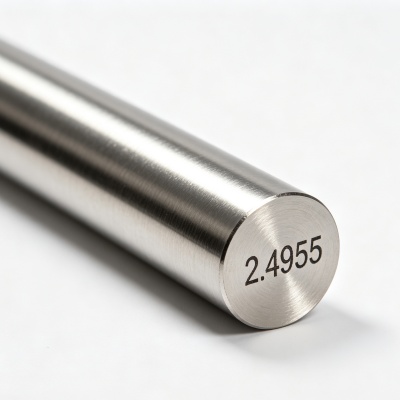
VIM + ESR Round Bar
Diameter: 20–500 mm
Length: 2,000–8,000 mm
Condition: Sol. Annealed / Aged
Standard: NF EN 10090, VIM+ESR
Forged Disc / Ring / Blade Blank
OD: up to 1,500 mm
Max weight: ~5,000 kg
Grainflow per forging map
UT per EN 10228-3 / AMS-STD-2154
Valve Bar (Small Dia.)
Diameter: 5–60 mm
Length: 2,000–6,000 mm
Ground / Peeled surface
For direct valve forging
Sheet / Plate / Forged Block
Sheet: 1–6 mm
Plate: 6–100 mm
Forged block: up to 10,000 kg
For ring-rolling / disc machining
FUSHUN METAL supplies NiFe25Cr20NbTi / 2.4955 in solution-annealed condition (950–980°C, oil quenched) as standard — suitable for machining, forging, or ring-rolling prior to client-side aging. Pre-aged material (720°C/8h FC → 620°C/8h AC) available to final mechanical property requirements. Full ISO 9001 & AS9120B quality assurance, EN 10204 3.1/3.2 certification, VIM + ESR melt traceability documentation per shipment.
Chemical Composition of NiFe25Cr20NbTi per NF EN 10090
| C | Ni | Cr | Fe | Ti | Al | Nb+Ta | B | Si | Mn |
|---|---|---|---|---|---|---|---|---|---|
| 0.04–0.10 | Balance | 18.0–21.0 | 23.0–28.0 | 1.0–2.0 | 0.30–1.00 | 1.0–2.0 | ≤ 0.008 | ≤ 1.00 | ≤ 1.00 |
All values in weight %. The defining feature of this composition is nickel as the balance element — this is a nickel-base alloy with ~23–28% Fe as the solute, not an iron-base alloy with nickel added. The precipitation-hardening elements (Ti 1.0–2.0%, Al 0.30–1.00%, Nb+Ta 1.0–2.0%) form an integrated system: Ti+Al control γ’-Ni3(Ti,Al) volume fraction; Nb+Ta form the separate γ”-Ni3Nb phase. The Ti:Al ratio (~2:1 to 3:1) is critical — too much Al increases γ’ solvus temperature and risks incipient melting during solution treatment; too little reduces γ’ volume fraction and high-temperature strength. At FUSHUN METAL, VIM + ESR double-melt processing ensures precise control of all reactive elements (Ti, Al, B) that would be lost or oxidized in air-melt. Chemistry verification uses OES + ICP–OES for metallic elements and boron, with LECO combustion for C/S. Each shipment carries EN 10204 Type 3.1 certification signed by our ISO 9001 / AS9120B authorized metallurgist.
Mechanical Properties of NiFe25Cr20NbTi — Solution Annealed + Aged
| Property | Room Temp. (20°C) | 600°C | 800°C | Standard / Condition |
|---|---|---|---|---|
| Tensile Strength, Rm | 900 – 1,100 MPa | ~790 MPa | ~340 MPa | Sol. annealed + double-aged |
| Yield Strength, Rp0.2 | ≥ 500 MPa | — | ~250 MPa | NF EN 10090 |
| Elongation A5 | ≥ 12% | — | NF EN 10090 | |
| Reduction of Area, Z | ≥ 50% | — | High ductility for a superalloy | |
| Impact Energy, KV | ≥ 47 J | — | NF EN 10090 | |
| Hardness | ~28 HRC (aged) | NF EN 10090 | ||
| Density | ~8.1 g/cm³ | ~5% heavier than iron-based grades | ||
| Elastic Modulus | ~215 GPa at RT | Nickel-base reference | ||
| Thermal Conductivity | ~13 W/(m·K) at RT | Lower than iron-base; typical for Ni alloys | ||
| Thermal Expansion | ~14 × 10-6/K (20–600°C) | Lower than austenitic stainless | ||
| Melting Range | ~1,330 – 1,400°C | Nickel-base characteristic | ||
| Max Service Temp. | 850°C continuous / 900°C intermittent | Oxidation resistance limit | ||
| Creep 650°C / 1,000 h | ~180 MPa (Rp1.0) | NF EN 10090 reference | ||
Heat treatment protocol: Solution anneal at 950–980°C (for discs: 950–980°C/1 h, oil quench; for sheet/weldments: 940–960°C, air cool). Double aging: 720°C/8 h → furnace cool to 620°C → 620°C/8 h → air cool. This two-step aging is mandatory — single-step aging produces a monomodal γ’ size distribution with ~10–15% lower strength. The furnace-cool step between 720°C and 620°C allows controlled coarsening of primary γ’ while nucleating secondary γ’ and γ”. FUSHUN METAL conducts per-heat tensile testing per ISO 6892-1 (room temp.) with optional high-temperature tensile at 600°C/700°C/800°C. Hardness per EN ISO 6508 (Rockwell C). For rotating-grade components: stress-rupture testing per ASTM E139, ultrasonic per EN 10228-3 / AMS-STD-2154, and VIM + ESR inclusion rating per ASTM E45.
Frequently Asked Questions — NiFe25Cr20NbTi / 2.4955
Is 2.4955 a valve steel or a superalloy? What’s the difference?
Both classifications are correct — and the distinction is critical for specification. 2.4955 is catalogued under NF EN 10090 (Valve steels and alloys for internal combustion engines), so it IS a valve material. However, its metallurgy — nickel matrix, γ’+γ” dual precipitation hardening, VIM+ESR melting — places it squarely in the nickel-base superalloy class. The practical distinction: when ordering as a “valve steel” from a standard steel mill, you may get air-melt quality. When ordering as a “nickel superalloy” from a VIM+ESR facility like FUSHUN METAL, you get aerospace-grade cleanliness, inclusion control, and traceability. For aircraft engine and gas turbine applications, always specify VIM+ESR. For standard automotive valves where cost is the primary driver, air-melt may be sufficient — discuss your application with FUSHUN METAL’s technical team to determine the appropriate melt route.
How does 2.4955 compare with Inconel 751 (2.4952 / NiCr20TiAl)?
Both are nickel-base γ’-strengthened valve alloys, but with different alloy design philosophies: 2.4955 uses Fe 23–28% as a deliberate solute addition to reduce raw material cost while maintaining nickel-base properties — it also adds Nb+Ta (1.0–2.0%) for γ” hardening, giving it a dual-precipitation advantage at intermediate temperatures (600–750°C). 2.4952 (Inconel 751 / Nimonic 80A) is a purer Ni-Cr-Ti-Al system with lower Fe (~5% max), optimized for maximum γ’ volume fraction and highest creep strength above 800°C. In practice: 2.4955 offers 90–95% of 751’s performance at 70–80% of the alloy cost — making it the economic choice for production exhaust valves. Choose 751 only when the application demands the absolute maximum creep life at >800°C. FUSHUN METAL stocks both grades and can advise on selection.
Why is VIM + ESR melting necessary for 2.4955?
VIM (Vacuum Induction Melting) is required because Ti, Al, and B are highly reactive with atmospheric oxygen and nitrogen — air-melt would oxidize these elements, destroying the γ’ precipitation-hardening capability. VIM melts under vacuum, precisely controlling the reactive element chemistry. ESR (Electroslag Remelting) follows as a secondary refining step: it removes non-metallic inclusions (oxides, sulfides), eliminates centerline segregation, and produces a directionally-solidified ingot with uniform chemistry and fine grain structure. For critical rotating components (turbine blades, discs), VIM+ESR is mandatory. For non-rotating components (valve stems, bolting), VIM-only may be acceptable. FUSHUN METAL’s standard 2.4955 production route is VIM+ESR — we do not air-melt this grade due to the risk of Ti/Al loss and property degradation.
How does FUSHUN METAL quality-control 2.4955 nickel superalloy?
FUSHUN METAL’s nickel superalloy protocol exceeds standard valve steel QA: (1) VIM melting under vacuum with real-time chemistry monitoring; (2) ESR remelting — S reduced to ≤0.003%, inclusion control; (3) full chemistry: OES + ICP–OES for Ti, Al, Nb, B at ppm accuracy; LECO C/S; (4) solution anneal at 950–980°C with furnace chart recording; (5) grain size per ASTM E112 (ASTM 4–7); (6) tensile (ISO 6892-1 at RT), Rockwell C hardness (EN ISO 6508); (7) optional high-temperature tensile at 600/700/800°C, stress-rupture at 650°C/1000h per ASTM E139; (8) ultrasonic per EN 10228-3 Class AAA for rotating components; (9) inclusion rating per ASTM E45 Method A; (10) final inspection + heat stamping. Full chain under ISO 9001 & AS9120B, EN 10204 3.1/3.2, VIM+ESR melt certificates.
Can 2.4955 valves be hardfaced? What about welding?
Yes — and hardfacing is standard practice for exhaust valve seat faces. The typical procedure: (1) solution anneal the valve blank; (2) machine the seat face profile; (3) apply Stellite (Co-Cr-W-C) or Tribaloy hardfacing by TIG or plasma transferred arc (PTA) welding; (4) solution re-anneal to relieve weld stresses; (5) double-age to final hardness. The key precaution: 2.4955 is susceptible to strain-age cracking in the HAZ if welded in the aged condition. Always hardface/weld in the solution-annealed state, then age afterward. For repair welding of service-exposed components, a full re-solution + re-age cycle is recommended rather than localized weld repair. FUSHUN METAL can supply Stellite 6 and Stellite 12 hardfacing rod alongside 2.4955 base material for a complete valve production package.