

- Chemical Composition: The chemical composition of 1.2436 tool steel is as follows:
- Carbon (C) – 2.00-2.30%
- Chromium (Cr) – 11.00-13.00%
- Molybdenum (Mo) – 0.50-0.80%
- Silicon (Si) – 0.10-0.40%
- Manganese (Mn) – 0.10-0.50%
- Phosphorus (P) – 0.030% max
- Sulfur (S) – 0.030% max
- Hardness: The hardness of 1.2436 tool steel ranges from 58-62 HRC (Rockwell hardness).
- Wear Resistance: 1.2436 tool steel exhibits excellent wear resistance due to the high carbon and chromium content in its chemical composition. It can withstand high temperatures and high-speed applications without losing its hardness and wear resistance.
- Toughness: 1.2436 tool steel exhibits good toughness, which makes it ideal for applications that require high impact resistance.
- Cutting Tools: 1.2436 tool steel is widely used in the manufacturing of cutting tools such as knives, saw blades, and other cutting tools that require high wear resistance and toughness. It is suitable for applications that involve cutting hard materials such as wood, plastics, and metals.
- Dies: 1.2436 tool steel is also used in the manufacturing of dies for the production of components that require high precision and durability. It is ideal for the production of stamping dies, extrusion dies, and forging dies.
- Other Tools: 1.2436 tool steel is used in the manufacturing of various other tools that require high wear resistance and toughness. These include shear blades, punches, and other industrial components.
- High Wear Resistance: 1.2436 tool steel exhibits high wear resistance due to the presence of high carbon and chromium content in its chemical composition. This makes it ideal for applications that require high durability and long service life.
- High Toughness: 1.2436 tool steel exhibits good toughness, which makes it ideal for applications that require high impact resistance. This also helps to prevent the steel from cracking or breaking under high stress or pressure.
- Excellent Machinability: 1.2436 tool steel is easy to machine and can be shaped into various forms without losing its properties. This makes it an ideal material for manufacturers and engineers looking for a material that is easy to work with and can be shaped into complex forms.
- Good Dimensional Stability: 1.2436 tool steel exhibits good dimensional stability, which means it maintains its shape and size even under high stress or pressure. This makes it an ideal material for applications that require high precision and accuracy.
What 2 % carbon buys
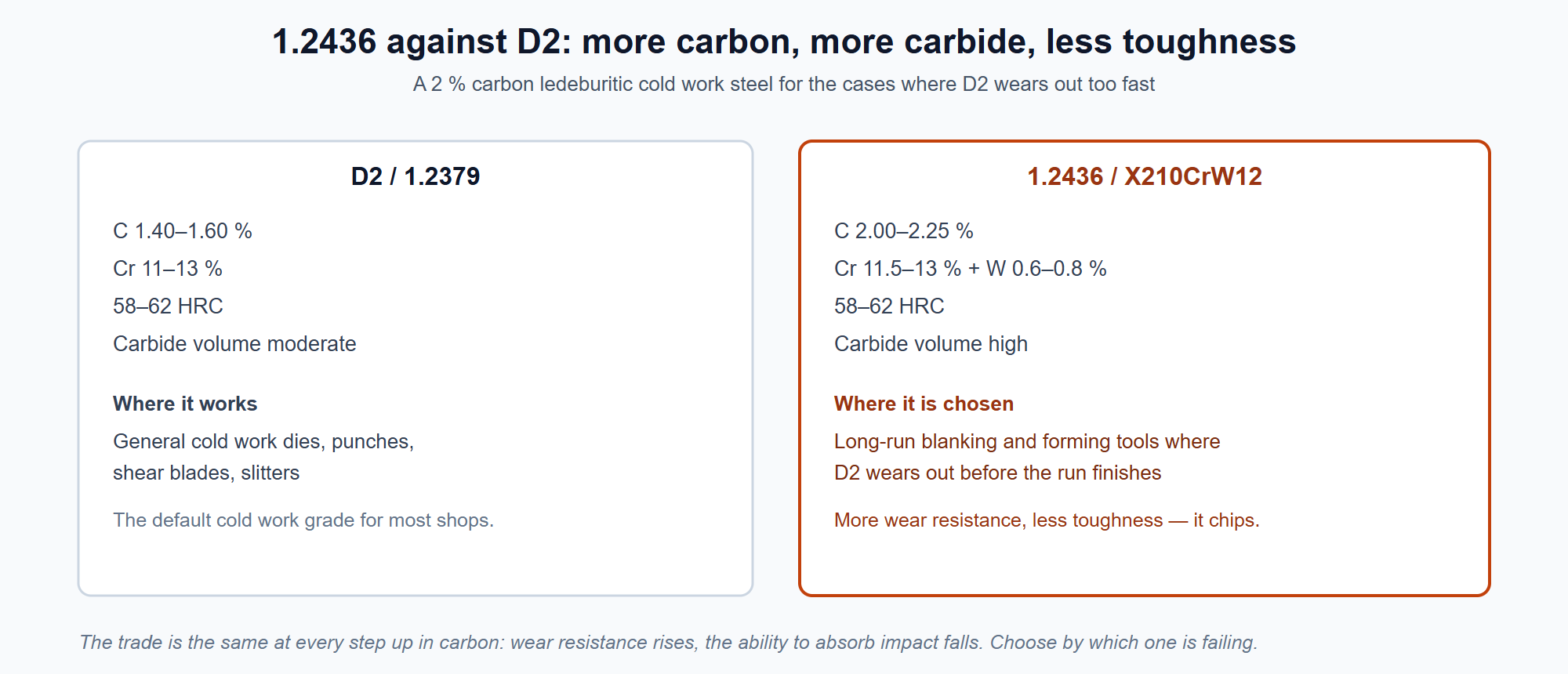
1.2436 (X210CrW12) carries 2.00–2.25 % carbon against D2’s 1.4–1.6 %. That extra carbon forms more chromium carbides, and carbide volume is what resists abrasive wear.
The trade is the same one that runs through the whole cold work family: as carbide volume rises, wear resistance improves and the ability to absorb impact falls. A die in 1.2436 will outlast D2 in a long blanking run, and it will chip where D2 would have survived.
When to move up
Move to 1.2436 when D2 dies are wearing out before the production run finishes and the failure is genuine wear — a polished, gradually enlarging edge — rather than chipping or cracking. If the D2 die is chipping, the answer is a tougher grade, not a harder one.
The heat treatment is less forgiving
Higher carbon means a narrower hardening window and more sensitivity to overheating. The austenitising temperature must be controlled, and the tempering schedule is the same two-window pattern as D2 but with less margin.