1. Specifications & Capability
FUSHUN METAL open-die forges wind turbine main shafts in 42CrMo4 (1.7225) and 34CrNiMo6 (1.6582), 400-1000 mm in diameter and 2000-4000 mm long, with proven 1.5 MW and 2 MW production track records. Shafts are supplied tapered or cylindrical, in the quenched and tempered (QT) condition, with 100% ultrasonic testing and low-temperature impact verification for cold-climate sites.
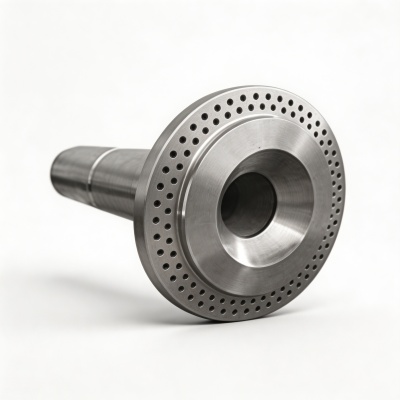
Tapered and stepped shafts are forged close to final contour, conserving material and reducing machining while keeping the grain flow aligned with the load path.
| Grade / Section (mm) | Rm (MPa) | Rp0.2 (MPa) | A (%) | KV (J) at -40 C |
|---|---|---|---|---|
| 42CrMo4, up to 250 | 750-950 | 520 min | 14 | 27 min |
| 34CrNiMo6, up to 250 | 900-1100 | 700 min | 12 | 40 min |
| 34CrNiMo6, 250-500 | 800-950 | 600 min | 13 | 35 min |
| 500-1000 | – | – | – | Verified per spec |
Values follow EN 10250-3; Charpy requirements are verified at -40 C for cold-climate sites. FUSHUN METAL applies 100% ultrasonic testing and documents every heat for full traceability.
2. Components & Service Conditions
The wind turbine main shaft is the most highly stressed forged component in a drivetrain, transmitting the full rotor torque from the hub to the gearbox. Service conditions combine bending, torsion and highly variable wind loads across millions of load cycles, so fatigue resistance is the controlling design requirement.
FUSHUN METAL forges the shaft in tapered or cylindrical form close to final contour, so the continuous grain flow follows the load path and reduces machining. The QT treatment provides the strength and low-temperature impact toughness required for onshore and offshore installations, while low sulfur and controlled residual content support the impact values demanded by cold-climate sites.
3. Grade Equivalents – 42CrMo4 / 34CrNiMo6
| Designation | Standard | Notes |
|---|---|---|
| 42CrMo4 / 1.7225 | EN 10250-3 | Standard main shaft steel |
| 34CrNiMo6 / 1.6582 | EN 10250-3 | Higher toughness option |
| AISI 4140 | SAE J404 | US equivalent of 42CrMo4 |
| AISI 4340 | SAE J404 | US equivalent of 34CrNiMo6 |
| SCM440 / SNCM439 | JIS G4053 | Japanese equivalents |
| 40CrNiMoA | GB/T 3077 | Reference only, not used in certification |
| Grade | C | Si | Mn | Cr | Ni | Mo |
|---|---|---|---|---|---|---|
| 42CrMo4 (1.7225) | 0.38-0.45 | 0.40 max | 0.60-0.90 | 0.90-1.20 | – | 0.15-0.30 |
| 34CrNiMo6 (1.6582) | 0.30-0.38 | 0.40 max | 0.50-0.80 | 1.30-1.70 | 1.30-1.70 | 0.15-0.30 |
The 1.3-1.7% nickel in 34CrNiMo6 improves low-temperature toughness, making it the choice for cold-climate and offshore installations.
4. Manufacturing Process
Steelmaking. FUSHUN METAL melts in an electric arc furnace with ladle refining and vacuum degassing, keeping sulfur and residual elements low to secure the low-temperature impact values cold-climate sites demand.
Forging. The shaft is forged on a 20/80 MN fast forging press with a minimum 4:1 reduction ratio, with tapered and stepped shapes forged close to final contour.
Heat treatment. Quenching and tempering are controlled to achieve uniform strength plus low-temperature impact toughness through the section.
Testing. 100% UT, low-temperature Charpy verification, and hardness checks, with every heat fully traceable from ingot to final machining.
5. Standards & Certification
Wind turbine main shafts are supplied to EN 10250-3 and to the wind turbine OEM’s specification, with inspection certificates under EN 10204 3.1. FUSHUN METAL holds ISO 9001 and AS9120B certification and can provide body sampling and third-party inspection on request.
Related products: gearbox shafts, slewing rings and wind turbine flanges.
6. Typical Applications
Onshore turbines
Main shafts for 1.5 MW, 2 MW and larger onshore drivetrains.
Offshore turbines
Corrosion-controlled shafts for higher-rated offshore units.
Tapered shafts
Tapered main shafts forged close to final contour.
Cylindrical shafts
Parallel shafts for gearbox-coupled drivetrain layouts.
7. Inquiry Essentials
To quote your wind turbine main shaft, please provide the turbine rating or shaft drawing, the required strength grade, the ultrasonic testing acceptance level, and any low-temperature impact or surface finish requirements.