
X2CrMoTi18-2 (EN 1.4521 / UNS S44400 / JIS SUS444), designated AISI 444, is the highest-performing ferritic stainless steel in the 400 series — an 18% Cr + 2% Mo + Ti-stabilized grade engineered to outperform 304 and rival 316L in chloride-containing environments, while remaining completely immune to stress-corrosion cracking (SCC). The defining chemistry is the 1.75–2.50% molybdenum addition: Mo raises the PREN to ~25–27, surpassing 304 (PREN ~19) and approaching 316L (PREN ~26) — but without a single percent of nickel. Combined with ultra-low carbon (C ≤ 0.025%) and titanium stabilization (Ti ≥ 6 × (C+N)), 444 delivers pitting resistance, weld integrity, and SCC immunity that no other ferritic grade can match. At FUSHUN METAL, X2CrMoTi18-2 / 1.4521 is produced and inventoried under ISO 9001 and AS9120B certified quality — every heat verified by OES with full EN 10204 Type 3.1 traceability.
Equivalent Grades of X2CrMoTi18-2 / S44400 Across International Standards
| Standard Body | Designation |
|---|---|
| EN (Europe) | X2CrMoTi18-2 / 1.4521 |
| ASTM (USA) | AISI 444 / UNS S44400 |
| JIS (Japan) | SUS444 |
| GB (China) | 019Cr19Mo2NbTi / S11972 / 10Cr18MoTi |
| DIN (Germany) | X2CrMoTi18-2 / 1.4521 |
| BS (UK) | 444S19 |
| GOST (Russia) | 08Х17М2Т |
FUSHUN METAL supplies X2CrMoTi18-2 / 1.4521 certified to EN 10088-2, ASTM A240, and JIS G4305 — EN 10204 3.1 mill certification with Mo content verification per heat.
FUSHUN METAL
The Mo Advantage — Why X2CrMoTi18-2 / 444 Outranks All Ferritic Grades
| Grade | Cr% | Mo% | PREN* | SCC | Positioning |
|---|---|---|---|---|---|
| 430 (1.4016) | 16–18 | — | ~16 | Resistant | Basic indoor corrosion; no stabiliz. |
| 439 (1.4510) | 16–18 | — | ~16 | Resistant | Ti-stabilized; better weld corrosion |
| 441 (1.4509) | 17.5–18.5 | — | ~18 | Resistant | Ti+Nb; superior creep resistance |
| 304 (1.4301) | 18–20 | — | ~19 | Vulnerable | Austenitic benchmark; Ni 8–10.5% |
| 444 (1.4521) | 17.5–19.5 | 1.75–2.50 | ~26 | Immune | Mo-bearing ferritic; PREN = 316L level |
| 316L (1.4404) | 16.5–18.5 | 2.0–2.5 | ~26 | Vulnerable | Austenitic premium; Ni 10–13% |
*PREN = %Cr + 3.3 × %Mo + 16 × %N. The Mo addition is decisive: it shifts the pitting potential by ~400 mV in chloride solutions, making 444 the only ferritic grade that reliably matches 316L in saltwater, hot-water, and weak-acid service — while remaining completely immune to SCC, a failure mode that afflicts both 304 and 316L. FUSHUN METAL verifies Mo content on every heat by OES, confirming the 1.75–2.50% range essential for PREN performance.
Industrial Applications of X2CrMoTi18-2 / S44400
Water & Desalination
Hot-water storage tanks, solar collector panels, desalination evaporator shells, reverse-osmosis pressure vessels — PREN ~26 resists chloride pitting without nickel SCC risk.
Heat Exchangers & Boilers
Condensing boiler shells, flue-gas recuperators, steam generator tubes, waste-heat boilers — low thermal expansion + high conductivity + Mo corrosion barrier.
Chemical Processing
Dilute sulfuric/phosphoric/acetic acid vessels, agro-chemical spray tanks, chloride-bearing reactor jackets — Ti-stabilized weld zones resist intergranular attack.
Food & Beverage
Sanitary processing tanks, brewery piping, dairy pasteurizers, juice storage — nickel-free for strict food-contact regulation; resists organic acid cleaning cycles.
Automotive Exhaust
Premium exhaust systems, SCR dosing lines, diesel particulate filter housings — Mo resists ammonium bisulfate/condensate attack in post-treatment systems.
Coastal & Marine
Coastal building cladding, photovoltaic panel frames, marina handrails, seawater piping (moderate velocity) — atmospheric chloride resistance without nickel cost.
FUSHUN METAL serves these demanding sectors with full-traceability X2CrMoTi18-2 / 1.4521 — ISO 9001 & AS9120B certified, EN 10204 3.1 per shipment, Mo content verified on every heat certificate.
Supply Range — X2CrMoTi18-2 / 1.4521 at FUSHUN METAL
Cold-Rolled Sheet / Coil
Thickness: 0.3–6.0 mm
Width: up to 1,540 mm
Finish: 2B / 2R / BA / No.4
Standard: EN 10088-2, ASTM A240
Hot-Rolled Plate
Thickness: 3–100 mm
Width: 1,000–2,000 mm
Length: up to 12,000 mm
Standard: EN 10088-2, ASTM A240
Welded Tube / Pipe
OD: 6–3,000 mm
WT: 1–100 mm
Length: up to 12,000 mm
Standard: EN 10296-2, ASTM A268
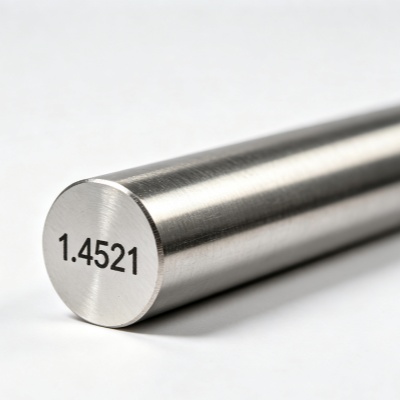
Round / Flat / Forged Bar
Round: 1–800 mm Ø
Flat: 3–60 × 20–800 mm
Forged: up to 1,200 mm
Standard: EN 10088-3, ASTM A276
Additional forms: hot-rolled coil (3–14 mm), slit strip (0.3–10 mm × 7–600 mm), precision strip (0.06–2.5 mm), circles/blanks, and custom-cut sizes for OEM production. FUSHUN METAL holds strategic inventory of X2CrMoTi18-2 / 1.4521 sheet and tube — all under ISO 9001 & AS9120B with EN 10204 3.1 certification.
Chemical Composition of X2CrMoTi18-2 per EN 10088-2
| C | Cr | Mo | Ti | N | Ni | Si | Mn | P | S |
|---|---|---|---|---|---|---|---|---|---|
| ≤ 0.025 | 17.5–19.5 | 1.75–2.50 | ≥ 6×(C+N) – 0.80 | ≤ 0.030 | ≤ 0.50 | ≤ 1.00 | ≤ 1.00 | ≤ 0.040 | ≤ 0.015 |
All values in weight %, Fe = balance. The three critical control points that define 444’s performance: (1) Mo 1.75–2.50% — drives PREN to ~26, the fundamental differentiator from all non-Mo ferritics; (2) C ≤ 0.025% + N ≤ 0.030% — ultra-low interstitials prevent 475°C embrittlement during long-term service; (3) Ti ≥ 6 × (C+N) — stoichiometric stabilization ensures weld-zone immunity to intergranular corrosion without post-weld heat treatment. At FUSHUN METAL, every heat undergoes OES full-spectrum analysis with LECO C/S combustion cross-check. Mo and Ti are individually verified against EN 10088-2 tolerances. Each shipment is accompanied by EN 10204 Type 3.1 certification signed by our ISO 9001 / AS9120B authorized inspector.
Mechanical Properties of X2CrMoTi18-2 in Annealed Condition (+A)
| Property | Value | Standard / Condition |
|---|---|---|
| Tensile Strength, Rm | 410 – 550 MPa | EN 10088-2, +A, annealed 750–900°C |
| Yield Strength, Rp0.2 | ≥ 275 MPa | EN 10088-2; higher than 304 (≥ 190 MPa) |
| Elongation A | ≥ 20% | EN 10088-2, proportional gauge |
| Hardness | ≤ 217 HBW | EN ISO 6506, annealed |
| Density | ~7.70 g/cm³ | Physical; magnetic (ferritic) |
| Thermal Conductivity | ~26.8 W/(m·K) at 20°C | ~75% higher than 304 (~15 W/m·K) |
| Modulus of Elasticity | ~220 GPa at 20°C | EN 10088-1 |
| Thermal Expansion Coeff. | ~10.5 × 10⁻⁶/K (20–200°C) | ~40% lower than 304 |
| Specific Heat Capacity | 460 J/(kg·K) at 20°C | EN 10088-1 |
| PREN | 25 – 27 | Superior to 304 (~19), close to 316L (~26) |
| Service Temperature | -20 to 600°C continuous | Annealed; avoid >850°C grain coarsening |
| SCC Resistance | Immune | Ni-free ferritic; key advantage over 304/316L |
Annealing at 750–900°C (or 850–950°C for heavy sections) followed by air cooling — rapid cool through 475°C avoids embrittlement. This grade cannot be hardened by heat treatment. Hot working at 800–1,100°C (uniform heating essential to prevent grain coarsening). Welding: TIG/MIG with ER444 or ER316L filler; pre-heating and post-weld heat treatment are generally not required due to Ti stabilization. FUSHUN METAL performs per-heat tensile testing per ISO 6892-1, Brinell hardness per EN ISO 6506, and optional intergranular corrosion testing per EN ISO 3651-2 on request. Forged products can be ultrasonically tested per EN 10228-3.
Frequently Asked Questions — X2CrMoTi18-2 / 1.4521
Can 444 really replace 316L? What are the limits?
In many chloride-bearing environments — yes, with significant advantages. 444 matches 316L’s PREN (~26), making it equivalent in pitting resistance. It outperforms 316L in stress-corrosion cracking (SCC) immunity: 316L can fail catastrophically by SCC above ~60°C in chloride solutions, while 444’s nickel-free ferritic structure is inherently immune. Additionally, 444’s thermal conductivity is ~75% higher and thermal expansion ~40% lower — beneficial in heat-exchanger and cyclic-temperature service. Limits: 444 is not suitable for cryogenic service (toughness drops below -20°C), not recommended for strong reducing acids (HCl, HF), and has lower formability in deep-drawing compared to austenitic 316L. For welded pressure vessels per PED 2014/68/EU, 444 is fully approved.
What does the Mo addition actually do at the microstructural level?
Molybdenum enriches the passive chromium-oxide film, forming a mixed Cr-Mo oxyhydroxide layer that is far more resistant to chloride-ion breakdown than a pure Cr2O3 film. In practical terms: in a 3.5% NaCl solution at 50°C, the pitting potential of 444 shifts positively by ~400 mV compared to Mo-free 439. This means chlorides that would initiate pits on 439 or 304 simply cannot penetrate the passive film on 444. Mo is also soluble in the ferrite matrix up to ~2.5%, so it does not form brittle secondary phases — provided the grade is properly annealed and cooled through the 475°C embrittlement range rapidly.
Can X2CrMoTi18-2 be welded? Is post-weld treatment required?
Yes — and it welds better than most ferritic grades thanks to Ti stabilization. Use TIG or MIG with ER444 or ER316L filler; pure argon shielding. Unlike unstabilized grades, post-weld annealing is generally not required because Ti binds free carbon/nitrogen, preventing sensitization in the HAZ. However, for heavy-gauge sections (>6 mm) or code-governed fabrication, a brief stress-relief anneal at 750–850°C helps restore full HAZ toughness. Avoid hydrogen or nitrogen in shielding gas — both embrittle ferritic weld metal. FUSHUN METAL can supply matching ER444 filler wire for complete metallurgical compatibility.
How does FUSHUN METAL ensure X2CrMoTi18-2 / 1.4521 quality?
FUSHUN METAL applies a seven-stage quality protocol for this premium Mo-bearing grade: (1) incoming chemistry by OES with LECO C/S; (2) Mo content verification — Mo 1.75–2.50% individually confirmed as the critical PREN driver; (3) Ti stabilization ratio audit — Ti ≥ 6 × (C+N); (4) in-process dimensional checks during rolling/forming; (5) post-annealing mechanical testing (tensile ISO 6892-1, hardness EN ISO 6506 on each bar/sheet end); (6) intergranular corrosion test per EN ISO 3651-2 (optional, recommended for welded-fabrication orders); (7) final dimensional/visual inspection. Full chain under ISO 9001 & AS9120B, EN 10204 3.1 documentation, traceable to melt. For critical applications, we offer pitting corrosion testing per ASTM G48 Method A.
Is 444 cost-competitive with 304 and 316L?
Yes — and the economics become increasingly favorable as nickel prices rise. 444 contains no intentional nickel (Ni ≤ 0.50%), while 304 contains 8–10.5% Ni and 316L contains 10–13% Ni. The Mo content (2%) adds modest alloy cost but nowhere near the cost of 10% nickel at current LME prices. Typical pricing: 444 is ~15–20% cheaper than 304 and ~30–35% cheaper than 316L in sheet/coil form. When you factor in the elimination of SCC-related failures (a common warranty cost driver for 304/316L equipment), the total-lifecycle cost advantage is even greater. FUSHUN METAL provides competitive quotations with short lead times — inquire with your required dimensions for a current price.