
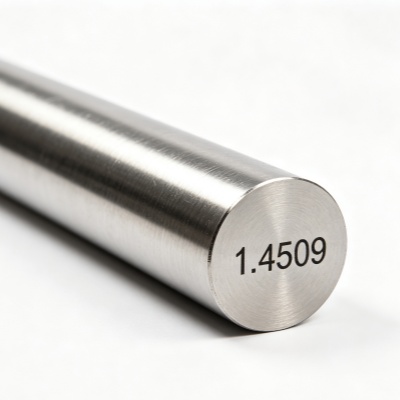
X2CrTiNb18 (EN 1.4509 / UNS S43940 / JIS SUS430LX), commercially designated AISI 441, is a dual-stabilized ferritic stainless steel containing 17.5–18.5% chromium with both titanium (Ti: 0.10–0.60%) and niobium (Nb: (3 × C) + 0.30 to 1.00%). This dual-stabilization is the defining metallurgical feature: Ti binds interstitial carbon, while Nb pins grain boundaries at elevated temperature — together they suppress sensitization during welding and resist creep deformation in high-temperature service. The result is a nickel-free, 18% Cr ferritic grade that outperforms single-stabilized 439 (1.4510, Ti-only) in thermal fatigue, hot strength, and oxidation resistance — making it the preferred material for heavy-gauge exhaust manifolds, turbo flanges, and EGR systems where temperatures routinely exceed 800°C. At FUSHUN METAL, X2CrTiNb18 / 1.4509 is produced and stocked under ISO 9001 and AS9120B certified quality systems — every heat verified by OES spectrometry with full traceability to EN 10204 Type 3.1.
Equivalent Grades of X2CrTiNb18 / S43940 Across International Standards
| Standard Body | Designation |
|---|---|
| EN (Europe) | X2CrTiNb18 / 1.4509 |
| ASTM (USA) | AISI 441 / UNS S43940 |
| JIS (Japan) | SUS430LX |
| GB (China) | 022Cr18NbTi / S11873 |
| DIN (Germany) | X2CrTiNb18 / X6CrTiNb18 / 1.4509 |
| AFNOR (France) | Z3CTNb18 |
| ISO | X2CrTiNb18 / 4509-439-40-X |
| KS (Korea) | STS430LX |
| BS (UK) | X2CrTiNb18 |
FUSHUN METAL supplies X2CrTiNb18 / 1.4509 certified to EN 10088-2, ASTM A240, and EN 10095 (heat-resisting applications) — EN 10204 3.1 documentation per shipment.
FUSHUN METAL
Why Dual Stabilization — Ti + Nb in X2CrTiNb18 / 441
Ti: Interstitial Scavenger
Titanium preferentially binds carbon and nitrogen to form stable Ti(C,N) precipitates, preventing chromium carbide/nitride formation at grain boundaries during welding — the same sensitization-resistance mechanism as 439.
Nb: Grain-Boundary Pinner
Niobium forms finely dispersed Nb(C,N) particles that exert a Zener pinning effect on grain boundaries, resisting grain coarsening at sustained high temperature — giving 441 superior creep strength and thermal fatigue resistance.
Combined Effect
Ti handles short-range chemical stabilization (weld HAZ); Nb handles long-range microstructural stability (creep, thermal cycling). Together they deliver oxidation resistance and mechanical integrity at temperatures where single-stabilized grades degrade.
FUSHUN METAL’s technical team verifies the Ti/Nb stabilization ratio on every heat — Nb ≥ (3 × C) + 0.30% and Ti within 0.10–0.60% — ensuring the dual-stabilization metallurgy is correctly executed in every delivered bar, sheet, and tube.
Industrial Applications of X2CrTiNb18 / S43940
Automotive Exhaust
Exhaust manifolds, turbocharger flanges, EGR cooler housings, catalytic converter shells, flex couplings — sustained service at >800°C with superior creep resistance vs 439.
Heat Exchangers
High-temperature recuperators, waste-heat recovery units, flue-gas coolers, condensing boiler heat cells — Nb pinning maintains tube-bundle dimensional stability through repeated thermal cycles.
Chemical Processing
Nitric acid pipelines, acid storage/transport tanks, NOx scrubbing ductwork — excellent resistance to oxidizing acids and stress-corrosion cracking, PREN 16–18.
Power Generation
Gas turbine exhaust ducting, HRSG casing panels, biomass boiler flue components — replaces 304 in dry, high-temperature oxidizing service at lower cost.
Food & Dairy
Brewery piping, fruit-juice processing tanks, vegetable-wash lines — resists organic acid attack with no nickel leaching; suitable where 304 is over-specified on cost.
Appliance & Textile
Oven burner tubes, textile dyeing vessels, industrial dryer drums — good oxidation resistance at sustained mid-range temperatures with no nickel surcharge in raw material cost.
FUSHUN METAL delivers X2CrTiNb18 / 1.4509 to demanding thermal-cycling applications worldwide — ISO 9001 & AS9120B certified, full EN 10204 3.1 traceability, optional third-party NDT per order.
Supply Range — X2CrTiNb18 / 1.4509 at FUSHUN METAL
Hot-Rolled Round Bar
Diameter: 10–800 mm
Length: 2,000–12,000 mm
Surface: Black / Peeled / Ground
Standard: EN 10088-3, ASTM A276
Cold-Rolled Sheet / Coil
Thickness: 0.3–6.0 mm
Width: 20–1,540 mm
Finish: 2B / BA / No.4 / HL
Standard: EN 10088-2, ASTM A240
Forged Round Bar
Diameter: 100–1,200 mm
Length: 1,000–8,000 mm
Process: Open-die forged 1130–750°C
UT tested per EN 10228-3
Welded Tube / Pipe
OD: 6–630 mm
WT: 0.5–40 mm
Length: up to 12,000 mm
Standard: EN 10296-2, ASTM A268
Additional forms: hot-rolled flat bar (3–120 × 20–800 mm), hot-rolled plate (4–200 mm), bright-drawn bar (h9/h11), wire rod (ø5.5–20 mm), custom-cut blanks and slit strip. FUSHUN METAL maintains strategic stock of X2CrTiNb18 / 1.4509 in standard gauge/thickness for rapid dispatch — all products under ISO 9001 & AS9120B quality assurance.
Chemical Composition of X2CrTiNb18 per EN 10088-2
| C | Si | Mn | P | S | Cr | Nb | Ti | Fe |
|---|---|---|---|---|---|---|---|---|
| ≤ 0.030 | ≤ 1.00 | ≤ 1.00 | ≤ 0.040 | ≤ 0.015 | 17.5–18.5 | (3×C)+0.30 – 1.00 | 0.10 – 0.60 | Balance |
All values in weight %. The dual-stabilization formula operates on two independent stoichiometric rules: (1) Nb ≥ 3 × C + 0.30% provides high-temperature grain-boundary pinning against creep; (2) Ti = 0.10–0.60% scavenges interstitial C and N to prevent weld sensitization. This combined chemistry gives 441 its signature performance advantage over single-stabilized grades. At FUSHUN METAL, OES spectrometry verifies all elements including Nb and Ti on every heat, with LECO combustion for carbon/sulfur cross-check. Each shipment carries EN 10204 Type 3.1 certification signed by our ISO 9001 / AS9120B authorized quality representative.
Mechanical Properties of X2CrTiNb18 in Annealed Condition (+A)
| Property | Value | Standard / Condition |
|---|---|---|
| Tensile Strength, Rm | 420 – 620 MPa | EN 10088-2, +A, all thicknesses |
| Yield Strength, Rp0.2 | ≥ 200 MPa | EN 10088-2, +A, longitudinal |
| Elongation A80 | ≥ 18% (L + T) | EN 10088-2, gauge 80 mm |
| Hardness | ≤ 200 HBW | EN ISO 6506, annealed |
| Density | ~7.70 g/cm³ | Physical; magnetic (ferritic) |
| Thermal Conductivity | ~25 W/(m·K) at 20°C | EN 10088-1 reference |
| Modulus of Elasticity | ~220 GPa at 20°C | EN 10088-1 |
| Thermal Expansion Coeff. | 10.0 × 10⁻⁶/K (20–200°C) | Lower than austenitic grades |
| Specific Heat Capacity | 460 J/(kg·K) at 20°C | EN 10088-1 |
| Melting Range | 1,425 – 1,530°C | Typical for 18% Cr ferritic |
| PREN | 16.0 – 18.0 | PREN = %Cr + 3.3 × %Mo |
Solution annealing at 750–850°C followed by air cooling — this grade cannot be hardened by quench-and-temper. Hot forming is performed at 1,100–800°C (air cool). Forging starts at 1,100–1,130°C and finishes above 750°C. Note: due to the Ti+Nb content, this grade does not achieve a high-gloss mirror polish — applications should prioritize thermal-mechanical performance over decorative surface finish. FUSHUN METAL conducts per-heat tensile testing per ISO 6892-1 and Brinell hardness per EN ISO 6506 on every bar end, with optional ultrasonic inspection per EN 10228-3 for forged products.
Frequently Asked Questions — X2CrTiNb18 / 1.4509
What is the difference between 441 (X2CrTiNb18) and 439 (X3CrTi17)?
The critical difference is niobium. 439 (1.4510) uses Ti-only stabilization, which effectively prevents weld sensitization but offers limited high-temperature grain-boundary pinning. 441 adds Nb at Nb ≥ 3 × C + 0.30%, which forms stable Nb(C,N) precipitates that resist grain coarsening under sustained thermal exposure. In practice: 439 performs well in lower-temperature exhaust components (mufflers, tailpipes); 441 is required for heavy-gauge exhaust manifolds, turbo flanges, and EGR systems where thermal cycles routinely exceed 800°C and creep deformation would degrade a Ti-only grade. 441 also has slightly higher Cr (17.5–18.5% vs 16–18%), improving baseline oxidation resistance.
Can X2CrTiNb18 / 441 be welded? What precautions are needed?
Yes — but 441 demands more careful welding practice than 439. Due to the dual Ti+Nb stabilization, the molten pool has higher viscosity, and hydrogen/nitrogen-containing shielding gas must be strictly avoided. Recommendations: use TIG with pure argon shielding, ER441 or matching filler, minimize heat input below 1 kJ/mm, avoid weaving/oscillation, and ensure the workpiece is oil- and grease-free. Pre-heating is not required. Post-weld annealing at 750–850°C restores full ductility. FUSHUN METAL can supply matching filler wire alongside base material to ensure full metallurgical compatibility.
Why can’t 441 be mirror-polished? Is this a defect?
This is not a defect — it is a deliberate consequence of the Ti and Nb alloy additions. These elements form microscopic carbonitride particles distributed throughout the microstructure. While the particles are essential for high-temperature performance (grain pinning, creep resistance), they create micro-scale surface imperfections that prevent a true #8 mirror finish. For applications requiring a high-gloss decorative surface (elevator panels, architectural trim), 439 or 430 are better choices. For thermal-mechanical applications (exhaust systems, heat exchangers), the surface limitation is irrelevant — 441 is selected for its hot-strength, not its reflectivity.
How does FUSHUN METAL ensure X2CrTiNb18 / 1.4509 quality?
FUSHUN METAL applies a six-stage quality protocol specific to dual-stabilized grades: (1) incoming billet chemistry by OES with LECO C/S verification; (2) dual-stabilization ratio audit — Nb ≥ 3 × C + 0.30% and Ti 0.10–0.60% individually confirmed; (3) in-process dimensional checks during rolling/forging; (4) post-annealing mechanical testing (tensile ISO 6892-1, hardness EN ISO 6506 on each bar end); (5) intergranular corrosion test per EN ISO 3651-2 (optional, on request); (6) final dimensional/visual inspection and bar-end stamping. Full chain runs under ISO 9001 and AS9120B certification, EN 10204 3.1 documentation, traceable to melt origin.
Can 441 replace 304 in exhaust and chemical service?
Yes — and in some environments it outperforms 304. 441 offers excellent resistance to stress-corrosion cracking (SCC), which is a known failure mode of 304 in hot chloride-bearing condensates. In dry, high-temperature oxidizing environments (exhaust gas, flue gas, hot air), 441’s 18% Cr provides comparable oxidation resistance to 304 at roughly 35–40% lower raw material cost (Ni-free). However, 441 cannot replace 304 in wet, chloride-rich environments (marine, swimming pools, coastal architecture) where the 8–10.5% Ni in 304 provides essential pitting resistance. FUSHUN METAL’s technical team can assist with grade selection based on specific service conditions — contact us with your application parameters for a recommendation.