
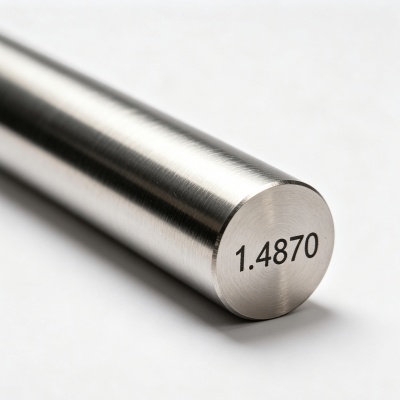
X53CrMnNiNbN21-9 (EN 1.4870 / NF EN 10090), commercially designated 21-43N, is a niobium-modified austenitic valve steel engineered specifically for internal combustion engine exhaust valves operating under the most severe combined conditions in metallurgy: simultaneous exposure to 700–850°C oxidizing/carburizing combustion gas, cyclic mechanical impact against the valve seat, and corrosion from leaded fuel, sulfur compounds, and vanadium-sodium salt deposits from heavy fuel oil. The alloy belongs to the 21-4N (EN 1.4871 / SAE EV8) family — the workhorse austenitic valve steel platform with 20–22% Cr, 8–10% Mn, 3.25–4.50% Ni, and 0.38–0.50% N — but 1.4870 adds the critical upgrade: niobium. Nb forms thermally stable Nb(C,N) carbonitrides that refine grain structure during solution treatment at 1,140–1,180°C and resist coarsening during prolonged service, delivering higher hot hardness, improved creep rupture life, and better resistance to combustion-gas corrosion attack compared to the base 21-4N grade. At FUSHUN METAL, X53CrMnNiNbN21-9 / 1.4870 is produced under ISO 9001 and AS9120B certified quality systems, with ESR refining available for critical exhaust valve applications. Every heat is verified by OES with full EN 10204 Type 3.1 traceability per NF EN 10090.
The 21-4N Valve Steel Family — Positioning of X53CrMnNiNbN21-9 / 1.4870
| EN Grade | EN No. | SAE | Type | Key Alloy Additions | Application Tier |
|---|---|---|---|---|---|
| X45CrSi9-3 | 1.4718 | HNV3 | Mart. | Medium Cr-Si, no Ni/N | Inlet valves, moderate temp |
| X85CrMoV18-2 | 1.4748 | — | Mart. | High-Cr + Mo + V | Heavy-duty exhaust, diesel |
| X53CrMnNiN21-9 | 1.4871 | EV8 | Aust. | 21%Cr-9%Mn-4%Ni + N | Standard exhaust valve (21-4N base) |
| X53CrMnNiNbN21-9 | 1.4870 | 21-43N | Aust. | 21-4N + Nb | Premium exhaust valve (Nb-upgraded) |
| X50CrMnNiNbN21-9 | 1.4882 | 21-43N | Aust. | 21-4N + Nb + W | Top-tier exhaust: W+Nb for max creep |
| X33CrNiMnN23-8 | 1.4866 | EV16 | Aust. | 23%Cr-8%Ni (higher Ni) | Marine diesel; heavy fuel oil |
FUSHUN METAL supplies the full 21-4N family including 1.4870 (Nb-modified) and 1.4871 (base). The Nb addition in 1.4870 provides measurable improvements in hot hardness retention and creep-rupture life over the base 21-4N grade — critical for modern turbocharged engines with elevated exhaust gas temperatures.
Equivalent Grades of X53CrMnNiNbN21-9 / 1.4870
| Standard Body | Designation |
|---|---|
| EN / DIN (Europe) | X53CrMnNiNbN21-9 / 1.4870 |
| AFNOR (France) | X53CrMnNiNbN21-9 / 1.4870 |
| ISO | X53CrMnNiNbN21-9 |
| SAE (USA) | 21-43N (EV8 + Nb family) |
| Standard Reference | NF EN 10090 / EN 10090 |
| Related Grade (base) | X53CrMnNiN21-9 / 1.4871 (EV8 / SUH35) |
| Related Grade (W+Nb) | X50CrMnNiNbN21-9 / 1.4882 (21-43NWNb) |
FUSHUN METAL supplies X53CrMnNiNbN21-9 / 1.4870 certified to NF EN 10090 (Valve steels and alloys for internal combustion engines). This is a specialist valve steel grade — no direct AISI/UNS/JIS equivalent exists, but it is the niobium-modified upgrade of the widely-used 21-4N (1.4871 / EV8 / SUH35) platform. EN 10204 3.1 certification per shipment.
FUSHUN METAL
Industrial Applications of X53CrMnNiNbN21-9 / 1.4870
Automotive Exhaust Valves
Gasoline & diesel engine exhaust valves — turbocharged engines with 800°C+ exhaust gas temperature. Nb carbonitrides resist softening and seat-face wear at peak combustion temperatures.
Heavy-Duty Diesel Valves
Commercial vehicle, locomotive, and stationary diesel exhaust valves — resists vanadium and sodium salt hot corrosion from heavy fuel oil combustion byproducts.
Marine Diesel Engines
Slow & medium-speed marine diesel exhaust valves — resists sulfur-vanadium-sodium salt deposits from bunker fuel. Nb-modified for extended service intervals between overhauls.
Racing & Performance Engines
High-RPM racing engine valve blanks — survives 9,000+ RPM cyclic impact, leaded-fuel corrosion, and thermal shock from rapid throttle cycling without fatigue cracking.
Waste-Gate & EGR Valves
Turbocharger waste-gate valve spindles, EGR valve stems — exposed to hot exhaust gas + carbon particulate abrasion with cyclic actuation loads.
Nuclear & Power Generation
Nuclear valve stems, steam isolation valve spindles — austenitic non-magnetic structure for MRI-safe and nuclear-spec applications requiring corrosion + creep resistance.
FUSHUN METAL delivers X53CrMnNiNbN21-9 / 1.4870 to engine valve manufacturers and engine OEMs worldwide — ISO 9001 & AS9120B certified, NF EN 10090 compliant, EN 10204 3.1 per shipment. ESR refined for premium valve blanks with guaranteed micro-cleanliness.
Supply Range — X53CrMnNiNbN21-9 / 1.4870 at FUSHUN METAL
Valve Steel Bar (Rolled)
Diameter: 10–800 mm
Length: 2,000–12,000 mm
Condition: Solution Treated
Standard: NF EN 10090
ESR Refined Valve Bar
Diameter: 20–300 mm
Purity: Low S (≤0.005%), high cleanliness
Application: Premium exhaust valves
UT per EN 10228-3 available
Forged Valve Blanks
Head dia: 15–200 mm
Stem dia: 5–50 mm
Forged + rough-machined
Grainflow per valve forging map
Bright-Drawn Wire / Coil
Diameter: 2–20 mm
Tolerance: h9/h11
Coil weight: up to 500 kg
For cold-heading valve production
FUSHUN METAL supplies X53CrMnNiNbN21-9 / 1.4870 in solution-treated condition (1,140–1,180°C, water quenched) — ready for valve forging, machining, and final aging (760–815°C). ESR refining is recommended for premium exhaust valve applications requiring Class A inclusion ratings. Full ISO 9001 & AS9120B quality assurance, EN 10204 3.1 certification per shipment.
Chemical Composition of X53CrMnNiNbN21-9 per NF EN 10090
| C | Si | Mn | Cr | Ni | N | C+N | P | S |
|---|---|---|---|---|---|---|---|---|
| 0.48–0.58 | ≤ 0.45 | 8.00–10.00 | 20.00–22.00 | 3.25–4.50 | 0.38–0.50 | ≤ 0.90 | ≤ 0.045 | ≤ 0.030 |
All values in weight %. The metallurgy of X53CrMnNiNbN21-9 operates on four synergistic strengthening mechanisms: (1) Carbon + Nitrogen (C+N ≤0.90%) — the core of 21-4N strength: C provides interstitial solid-solution hardening in the austenite lattice; N forms carbonitride precipitates that resist dislocation motion at high temperature. The C+N cap of 0.90% prevents embrittlement while maximizing hot strength; (2) Cr 20–22% — forms a dense Cr2O3 scale that resists oxidation and sulfidation from combustion gas at 800°C+; (3) Mn 8–10% + Ni 3.25–4.50% — Mn partially replaces Ni to stabilize the austenitic structure at lower alloy cost while Ni ensures toughness; (4) Niobium — the defining upgrade over base 21-4N: Nb forms finely dispersed Nb(C,N) particles that pin austenite grain boundaries during solution treatment (1,140–1,180°C), preventing grain coarsening. During service, these Nb carbonitrides resist dissolution and coarsening, maintaining hot hardness and creep rupture life significantly longer than the Nb-free 1.4871 grade. FUSHUN METAL verifies all elements by OES and LECO combustion, with Nb content individually confirmed on every heat. Each shipment carries EN 10204 Type 3.1 certification per NF EN 10090.
Mechanical Properties of X53CrMnNiNbN21-9 — Room & Elevated Temperature
| Property | Room Temp. (20°C) | 700°C | 800°C | Condition / Standard |
|---|---|---|---|---|
| Tensile Strength, Rm | 950 – 1,200 MPa | ≥ 450 MPa | ≥ 370 MPa | Solution treated + aged |
| Yield Strength, Rp0.2 | ≥ 580 MPa | ~330 MPa | ≥ 250 MPa | NF EN 10090 / 21-4N family |
| Elongation A5 | ≥ 8% | — | ≥ 25% | Increased ductility at temp. |
| Reduction of Area, Z | ≥ 10% | — | NF EN 10090 | |
| Hardness | 30 – 40 HRC (280–350 HBW) | Solution treated + aged | ||
| Density | ~7.80 g/cm³ | NF EN 10090 | ||
| Elastic Modulus | ~215 GPa at RT | 21-4N family reference | ||
| Thermal Expansion | 18.5 × 10⁻⁶/K (20–600°C) | Austenitic: higher than ferritic | ||
| Thermal Conductivity | ~14.2 W/(m·K) at RT | Typical for austenitic grades | ||
| Magnetic Permeability | Non-magnetic (μ < 1.005) | Austenitic; MRI-safe | ||
| Max Service Temp. | 850°C continuous / 900°C intermittent | Oxidation resistance limit | ||
Heat treatment protocol: Solution treatment at 1,140–1,180°C, hold 0.5–1 h, water quench — dissolves all carbides and carbonitrides into the austenite matrix, achieving uniform grain size ASTM 5–8. Aging at 760–815°C for 10–14 h, air cool — precipitates fine C+N carbonitrides + Nb(C,N) for maximum hot hardness and creep resistance. For valve manufacturing: forge or machine in solution-treated condition, then age after final forming. FUSHUN METAL supplies in solution-treated condition as standard; pre-aged material available on request. Per-heat testing includes tensile (ISO 6892-1), hardness (EN ISO 6508 Rockwell C), and optional ultrasonic inspection per EN 10228-3. For premium valve applications, ESR refined material with inclusion rating per ASTM E45 is recommended.
Frequently Asked Questions — X53CrMnNiNbN21-9 / 1.4870
What is the difference between 1.4870 (Nb) and 1.4871 (base 21-4N)?
Both are austenitic 21-4N valve steels with the same base chemistry (0.48–0.58% C, 20–22% Cr, 8–10% Mn, 3.25–4.50% Ni, 0.38–0.50% N). The difference is niobium: 1.4870 adds Nb which forms thermally stable Nb(C,N) carbonitrides. In service, these particles pin austenite grain boundaries and resist coarsening at exhaust valve operating temperatures (700–850°C), delivering: (1) higher hot hardness retention — the valve seat face stays harder longer, reducing wear; (2) improved creep rupture life — the valve head resists plastic deformation (tuliping) under combustion pressure; (3) better resistance to grain-boundary oxidation attack from leaded fuel and sulfur compounds. Choose 1.4871 for standard naturally-aspirated engines; choose 1.4870 for turbocharged, high-output, and heavy-duty diesel engines where exhaust gas temperatures push the material’s upper limit. FUSHUN METAL stocks both grades.
Why are 21-4N valve steels non-magnetic? Does it matter?
The high Mn (8–10%) + Ni (3.25–4.50%) content stabilizes a fully austenitic crystal structure at all temperatures — austenite is inherently non-magnetic (μ < 1.005). This matters for two practical reasons: (1) in engine service, the valve does not interact with electromagnetic sensors (knock sensors, cam position sensors) that could be affected by a magnetic valve stem; (2) for remanufacturing and grinding operations, magnetic chip collection systems cannot capture non-magnetic valve grinding dust, requiring different shop procedures. Additionally, the non-magnetic property makes 21-4N grades suitable for MRI-adjacent equipment and nuclear applications where magnetic permeability is tightly controlled. Unlike martensitic valve steels (e.g., X45CrSi9-3), which are strongly magnetic and can interfere with sensor signals in modern engine management systems.
How should 1.4870 be heat treated for valve manufacturing?
The standard valve manufacturing route: (1) Receive material in solution-treated condition (1,140–1,180°C, water quenched) — FUSHUN METAL supplies in this condition as standard; (2) Hot forge the valve head from bar stock at 1,100–950°C; (3) Re-solution treat after forging at 1,150–1,180°C, water quench — this re-dissolves any carbides that precipitated during cooling after forging; (4) Machine the valve to final dimensions (stem, seat face, keeper grooves); (5) Age at 760–815°C for 10–14 h, air cool — this is the critical step that precipitates C+N carbonitrides and Nb(C,N) for final hot hardness. Do not age before machining — aged material is at 30–40 HRC and will cause rapid tool wear. For valve seat hardfacing (Stellite or similar), perform the facing weld before final aging.
How does FUSHUN METAL ensure 1.4870 valve steel quality?
FUSHUN METAL’s valve steel quality protocol: (1) incoming chemistry by OES + LECO C/S/N — nitrogen verification is mandatory for 21-4N grades; (2) Nb content verification — the defining difference between 1.4870 and 1.4871; (3) ESR refining (optional, recommended for premium valves) — reduces S to ≤0.005%, improves inclusion cleanliness; (4) solution treatment at 1,140–1,180°C with furnace chart recording; (5) grain size per ASTM E112 (target ASTM 5–8); (6) mechanical testing: tensile (ISO 6892-1), Rockwell C hardness (EN ISO 6508); (7) ultrasonic testing per EN 10228-3 (for bar diameters ≥20 mm); (8) final visual/dimensional inspection and heat-number stamping. Full chain under ISO 9001 & AS9120B, EN 10204 3.1, traceable to melt. For ESR material, inclusion rating per ASTM E45 Method A is provided.
What are the common failure modes of 21-4N exhaust valves, and how does Nb help?
The three dominant exhaust valve failure modes: (1) Valve tuliping — the head plastically deforms into a tulip shape under combustion pressure at high temperature. Nb carbonitrides in 1.4870 increase creep strength and delay this deformation; (2) Seat-face wear / guttering — localized erosion and hot corrosion at the valve-seat interface. Nb maintains higher hot hardness, slowing the wear rate; (3) Corrosion fatigue from combustion deposits — lead, sulfur, vanadium, and sodium compounds attack grain boundaries. Nb refines grain size and forms stable precipitates at boundaries, reducing the attack surface. However, 1.4870 is not a solution for all valve applications — for extreme marine diesel conditions with high vanadium in heavy fuel oil, the 23-8N grade (1.4866 / EV16) with higher Ni (7–9%) offers superior hot-corrosion resistance. FUSHUN METAL can advise on grade selection based on engine type, fuel, and exhaust gas temperature.