
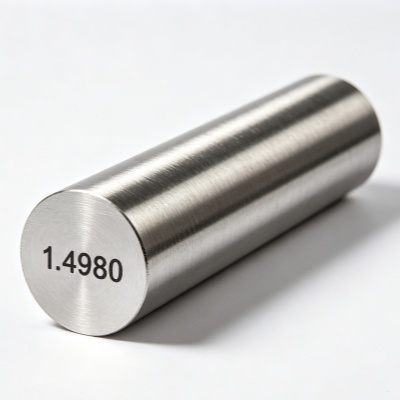
X6NiCrTiMoVB25-15-2 (EN 1.4980 / UNS S66286 / AISI 660), commercially known as Alloy A286 or Alloy 660, is a precipitation-hardening austenitic iron-based superalloy — not a conventional stainless steel, but a nickel-chromium-iron alloy engineered to develop high strength through the formation of gamma-prime (γ’) precipitates during aging heat treatment. The critical chemistry: 24–27% Ni + 13.5–16% Cr + 1.0–1.5% Mo + 1.9–2.3% Ti + ≤0.35% Al + 0.003–0.010% B. When solution-annealed at 900–980°C and aged at ~720°C for 16 hours, Ti and Al combine with Ni to form coherent γ’-Ni3(Ti,Al) precipitates — the identical strengthening mechanism used in nickel-based superalloys like Inconel 718. The result: room-temperature yield strength ≥600 MPa (vs ~260 MPa annealed), high-temperature strength retained to 700°C, oxidation resistance to 815°C continuous, corrosion resistance comparable to 316/316L, and fully non-magnetic in the solution-annealed condition — making it suitable for cryogenic equipment down to -196°C. Boron (0.003–0.010%) segregates to grain boundaries, dramatically improving creep ductility and stress-rupture life. At FUSHUN METAL, X6NiCrTiMoVB25-15-2 / 1.4980 / Alloy A286 is produced under ISO 9001 and AS9120B certified quality systems, with ESR/VAR refining for critical rotating-grade and aerospace applications. Every heat is verified by OES with full EN 10204 Type 3.1 traceability.
Equivalent Grades of X6NiCrTiMoVB25-15-2 / S66286 Across International Standards
| Standard Body | Designation |
|---|---|
| EN (Europe) | X6NiCrTiMoVB25-15-2 / 1.4980 |
| ASTM / UNS (USA) | AISI 660 / UNS S66286 |
| AMS (Aerospace) | AMS 5525 / 5732 / 5737 / 5804 |
| GE Specification | B50T1181 / B50T12 / B50T81 |
| VdTÜV (Germany) | Werkstoffblatt 435 |
| NACE (Oil & Gas) | MR0175 / ISO 15156-3 (sour service) |
| Commercial Names | Alloy A286 / Alloy 660 |
FUSHUN METAL supplies X6NiCrTiMoVB25-15-2 / 1.4980 certified to EN 10269, ASTM A453 Grade 660, AMS 5732/5737, and NACE MR0175 — EN 10204 3.1 per shipment. ESR/VAR refined for aerospace/rotating applications on request.
FUSHUN METAL
Precipitation Hardening Mechanism — The γ’ Advantage in X6NiCrTiMoVB25-15-2 / A286
Step 1: Solution Anneal
Heat to 900–980°C, hold 1–2 h, water quench. All alloying elements dissolve into a single-phase austenitic (γ) matrix. The material is now soft (~260 MPa yield), ductile (~40% elongation), and fully non-magnetic — ideal for cold forming, heading, and machining.
Step 2: Aging (720°C / 16 h)
Ti and Al diffuse out of the austenite matrix and combine with Ni to form coherent, ordered γ’-Ni3(Ti,Al) precipitates — nanometer-scale particles that impede dislocation motion. Yield strength jumps from ~260 to ≥600 MPa.
Boron: The Grain-Boundary Guardian
0.003–0.010% B segregates to grain boundaries, suppressing cavity nucleation during creep. This is the key to A286’s stress-rupture performance — without boron, creep ductility drops sharply and intergranular fracture dominates.
Mo + V: Thermal Stability
Mo (1.0–1.5%) retards γ’ coarsening at temperature; V (0.10–0.50%) forms stable MC carbides that pin grain boundaries against growth — together they preserve the aged microstructure during long-term service at 650–700°C.
This is the identical metallurgical mechanism that powers nickel-based superalloys — just executed in an iron-rich matrix for cost efficiency. FUSHUN METAL verifies Ti (1.90–2.30%), Al (≤0.35%), and B (0.003–0.010%) on every heat by OES + LECO — these three elements directly control γ’ volume fraction and grain-boundary integrity.
Industrial Applications of X6NiCrTiMoVB25-15-2 / A286
Jet Engines & Gas Turbines
Turbine discs, blades, wheels, afterburner components, nozzle assemblies — high strength to 700°C, oxidation to 815°C continuous. AMS 5732/5737 certified for rotating-grade aerospace.
High-Temp Fasteners & Springs
ASTM A453 Grade 660 bolting for flanges, pressure vessels, valve bonnets — Class D (≥725 MPa yield) up to 650°C. Excellent cold-heading formability in solution-treated condition.
Automotive Turbo & Exhaust
Turbocharger rotors, exhaust manifold studs, exhaust valves — resists oxidation and thermal fatigue at 700–800°C, outperforms conventional stainless fasteners.
Cryogenic Equipment
Non-magnetic solution-treated condition (μ ~1.01) + excellent toughness at -196°C — specified for LNG valve stems, superconducting magnet structural parts, cryogenic pump shafts.
Oil & Gas / Nuclear
NACE MR0175 approved for sour-service fasteners. Nuclear reactor internals, steam generator tubes — retains strength under irradiation, resists stress-corrosion cracking.
Thermal Process Engineering
Heat-treat furnace fixtures, retorts, radiant tubes — resists carburization and oxidation at 700–815°C, lower cost than nickel-based wrought alloys for furnace hardware.
FUSHUN METAL supplies X6NiCrTiMoVB25-15-2 / 1.4980 to aerospace, power generation, and oil & gas OEMs — ISO 9001 & AS9120B certified, AMS-compliant heat treatment, EN 10204 3.1 per shipment, ESR/VAR route for rotating-criticality orders.
Supply Range — X6NiCrTiMoVB25-15-2 / 1.4980 at FUSHUN METAL
Round Bar (Rolled / Forged)
Diameter: 10–1,200 mm
Length: 2,000–12,000 mm
Condition: Sol. Annealed / Aged
Standard: EN 10269, AMS 5732/5737
ESR / VAR Refined Bar
Diameter: 50–800 mm
Purity: S ≤ 0.002%, inclusion-rated
Application: Rotating turbine discs
UT/ASTM E45 inclusion rating available
Forged Disc / Ring / Shaft
OD: up to 2,000 mm
Max weight: ~10,000 kg
Grainflow per forging map
UT per EN 10228-3 / AMS-STD-2154
Sheet / Plate / Hex / Wire
Sheet: 0.5–6 mm (AMS 5525)
Plate: 6–100 mm
Hex: 10–100 mm (fastener blanks)
Wire: Ø0.5–20 mm (AMS 5858)
FUSHUN METAL holds strategic inventory of A286 / 1.4980 in solution-annealed condition for rapid dispatch. In-house aging heat treatment (720°C / 16 h) available to deliver pre-aged material to exact mechanical property requirements. Full ISO 9001 & AS9120B quality assurance, EN 10204 3.1 / 3.2 certification, NACE MR0175 compliance documentation on request.
Chemical Composition of X6NiCrTiMoVB25-15-2 per EN 10269
| C | Ni | Cr | Mo | Ti | Al | V | B | Mn | Si |
|---|---|---|---|---|---|---|---|---|---|
| 0.03–0.08 | 24.0–27.0 | 13.5–16.0 | 1.00–1.50 | 1.90–2.30 | ≤ 0.35 | 0.10–0.50 | 0.003–0.010 | 1.00–2.00 | ≤ 1.00 |
All values in weight %. The composition is balanced around four functional groups: (1) Austenite stabilizers — 24–27% Ni ensures a fully austenitic matrix; (2) γ’ formers — Ti (1.90–2.30%) + Al (≤0.35%) combine with Ni to precipitate γ’-Ni3(Ti,Al) during aging; (3) Solid-solution + carbide strengtheners — Mo (1.0–1.5%) retards γ’ coarsening, V (0.10–0.50%) forms MC carbides; (4) Grain-boundary enhancer — B (0.003–0.010%) is the critical trace element: too little and creep ductility collapses, too much and incipient melting occurs during solution annealing. At FUSHUN METAL, all 10 elements are verified by OES with LECO for C/S, and boron is confirmed by ICP–OES due to its ppm-level sensitivity requirement. Each delivery carries EN 10204 Type 3.1 certification signed by our ISO 9001 / AS9120B authorized inspector.
Mechanical Properties of X6NiCrTiMoVB25-15-2 — Annealed vs Aged
| Property | Solution Annealed (+AT) | Aged (+P, 720°C/16h) | Standard |
|---|---|---|---|
| Tensile Strength, Rm | ≥ 580 MPa | 900 – 1,150 MPa | EN 10269 |
| Yield Strength, Rp0.2 | ≥ 260 MPa | ≥ 600 MPa | ~2.3× increase from aging |
| Elongation A5 | ≥ 40% | ≥ 15% | EN 10269 |
| Reduction of Area, Z | — | ≥ 18% | EN 10269 / ASTM A453 |
| Hardness (Aged) | — | 248 – 341 HBW | EN 10269 / ASTM A453 |
| Charpy Impact (ISO-V) | — | ≥ 50 J (L) / ≥ 32 J (T) | EN 10269, at RT |
| Density | ~7.94 g/cm³ | Heavier than 304 (7.9) due to Ni+Mo | |
| Elastic Modulus | 201 GPa (RT) → 147 GPa (700°C) | EN 10269 reference | |
| Thermal Expansion | 16.5–18.0 × 10⁻⁶/K (20–700°C) | Higher than ferritic; similar to 304 | |
| Thermal Conductivity | ~13 W/(m·K) at RT | Lower than ferritic grades | |
| Magnetic Permeability | ~1.01 (μ); non-magnetic | Key for cryogenic/nuclear use | |
| Max Service Temp. | 700°C continuous / 815°C short-term | Oxidation limit: 815°C | |
| Cryogenic Service | -196°C (LNG); non-magnetic | Excellent toughness at cryo temps | |
| Stress-Rupture (650°C) | ≥ 358 MPa (100 h, ASTM A453 Cl. A) | Verified per heat on request | |
Heat treatment protocol: Solution anneal at 900 ± 14°C (ASTM A453 Class A) or 980 ± 14°C (Class B), hold ≥1–2 h, water quench. Precipitation hardening at 720 ± 14°C for ≥16 h, air cool. The aging temperature is critical — over-aging above ~750°C coarsens γ’ and drops yield strength; under-aging leaves residual stresses. For cold-heading and extensive machining, order material in solution-annealed condition and age after fabrication. FUSHUN METAL conducts per-heat mechanical testing per ISO 6892-1 (tensile), EN ISO 6506 (hardness), and ISO 148-1 (Charpy). Stress-rupture testing per ASTM E139 is available for critical bolting and turbine orders. ESR/VAR refined material achieves inclusion ratings per ASTM E45 Method A with S ≤ 0.002%.
Frequently Asked Questions — X6NiCrTiMoVB25-15-2 / 1.4980 / Alloy A286
Is A286 a stainless steel or a superalloy?
Technically both — but the classification matters for specification purposes. A286 / 1.4980 is catalogued under EN 10088 as a precipitation-hardening stainless steel, and it does offer corrosion resistance comparable to 316/316L. However, its metallurgy (γ’ precipitation hardening via Ti+Al) and its primary use case (high-temperature strength to 700°C) align it with iron-based superalloys. When ordering for aerospace applications, reference AMS specifications (5732, 5737); for industrial bolting, reference ASTM A453 Grade 660; for European applications, EN 10269 with the 1.4980 designation. All three paths lead to the same alloy — FUSHUN METAL can quote to any of these standards.
What is the difference between ASTM A453 Class A, B, C, and D?
These are four aging-strength classes for bolting material: Class A (solution anneal 900°C, yield ≥585 MPa) — standard bolting; Class B (solution anneal 980°C, yield ≥585 MPa) — higher solution temperature for larger sections; Class C (yield ≥585 MPa, with stress-rupture testing at 650°C) — for critical high-temperature bolting requiring creep verification; Class D (yield ≥725 MPa for d≤63.5 mm, ≥655 MPa for larger) — highest strength for premium bolting applications. The chemistry is identical across all four classes; the difference is solution-annealing temperature + mechanical property verification requirements. FUSHUN METAL can supply to any class — specify your required ASTM A453 class when inquiring.
Can A286 be machined? What condition should be ordered?
Yes — but always order in solution-annealed condition for machining. In the solution-treated state, A286 is soft (~260 MPa yield, ~40% elongation) and machinable with carbide tooling at low cutting speeds. After machining, the finished component is precipitation-hardened by aging at 720°C for 16 h. Do not attempt to machine aged A286 — at 248–341 HBW with high work-hardening rate, tool life will be very short and surface finish will be poor. FUSHUN METAL supplies solution-annealed bar specifically for machine shops that will perform in-house aging after fabrication. We also offer pre-aged material to finished mechanical properties for customers who only perform final finishing operations.
How does FUSHUN METAL ensure Alloy A286 / 1.4980 quality for aerospace?
FUSHUN METAL’s aerospace-grade A286 quality protocol: (1) ESR/VAR refining — reduces S to ≤0.002%, eliminates centerline segregation; (2) full chemistry by OES + ICP–OES for boron (ppm-level accuracy); (3) inclusion rating per ASTM E45 Method A — stringently controlled for rotating-grade cleanness; (4) solution anneal + age per AMS 5732/5737 parameters with furnace chart recording; (5) mechanical testing: tensile (ISO 6892-1), hardness (EN ISO 6506), Charpy (ISO 148-1); (6) stress-rupture at 650°C per ASTM E139 (on request); (7) ultrasonic testing per AMS-STD-2154 / EN 10228-3 Class AAA for rotating components; (8) final dimensional/visual, mark-stamping, and EN 10204 3.1/3.2 certification. Full chain under ISO 9001 & AS9120B, 100% traceable to melt origin.
How does A286 compare with Inconel 718 and 17-4PH?
A286 vs Inconel 718: 718 is a true nickel-based superalloy (Ni ~52%) with higher strength and 700°C+ capability, but costs 3–5× more. A286 (Ni 24–27%) is the iron-based alternative — captures ~70% of 718’s high-temperature performance at ~30% of the alloy cost. For turbine discs and structural components below 700°C, A286 is the cost-effective choice. A286 vs 17-4PH: 17-4PH (1.4542) is a martensitic precipitation-hardening stainless — lower cost, higher ambient strength (~1,000 MPa yield), but loses strength rapidly above 315°C and is magnetic. A286 is austenitic, non-magnetic, and retains strength to 700°C — choose 17-4PH for ambient/moderate-temp structural components, A286 for elevated-temperature service. FUSHUN METAL stocks all three grades and can advise on selection based on temperature, stress, and budget requirements.