
1.2085 X33CrS16 Corrosion-Resistant Mould Steel
Pre-hardened 16 % chromium mould steel with sulphur for PVC and other aggressive plastics. The chromium resists the hydrochloric acid released when PVC breaks down; the sulphur makes it cut like a free-machining grade. Delivered at 280–325 HB, no heat treatment needed.
At a glance
| Item | Detail |
|---|---|
| Grade | 1.2085 / X33CrS16 / 1.2099 / 420FM |
| Standard | DIN 1.2085; corrosion-resistant mould steel grade |
| Delivery condition | Quenched and tempered, 280–325 HB |
| Melt route | EAF plus vacuum degassing |
| Typical use | PVC and CPVC moulds, mould bases and die sets, food-industry machine parts |
| Certificate | EN 10204 3.1 with chemistry, hardness and mechanical properties |
What it is for, and what it is not
This is the sulphur-bearing version of 1.2316. Same 16 % chromium corrosion resistance, but with roughly 0.06 % sulphur so the chips break and the cutter lasts. In a mould base that has to be drilled, pocketed and tapped for weeks, that difference is real money.
It is specified where the plastic itself attacks the steel: PVC, CPVC and other halogenated compounds release hydrochloric acid at processing temperature, and a standard P20 base will pit within months. It is also used for moulds running in humid climates where condensation on a cold mould is unavoidable.
Where it does not belong: the sulphur sits in the steel as manganese sulphide stringers, and those stringers open up under polishing. If the cavity has to take a mirror finish, or the part is transparent, use 1.2316 or 1.2083 instead. We will tell you this before you order rather than after.
Supply range and delivery condition
| Form | Size range | Condition |
|---|---|---|
| Forged block | Thickness 100–600 mm × width 300–2000 mm | 280–325 HB |
| Forged round bar | Ø150–1200 mm | 280–325 HB |
| Rolled plate | Thickness 6–100 mm × width 60–1600 mm | Pre-hardened |
Sawn and squared to size. For mould bases we can supply a full set of plates cut from the same heat.
Chemical composition
| C | Si | Mn | P | S | Cr | Ni |
|---|---|---|---|---|---|---|
| 0.28–0.36 | 0.20–0.40 | 0.50–0.80 | 0.025 max | 0.05–0.10 | 15.0–17.0 | 0.20–0.50 |
DIN 1.2085 range. The heat analysis printed on the 3.1 certificate governs the actual lot.
Properties that decide the application
| Property | Value | What it means in the tool |
|---|---|---|
| Hardness as delivered | 280–325 HB | Machinable but already strong enough for a mould base |
| Tensile strength | 950–1100 N/mm² | Frame plates carry the clamp load without yielding |
| Thermal conductivity at 100 °C | 18 W/m·K | Heat leaves the cavity; cycle time stays predictable |
| Corrosion resistance | 16 % Cr | Resists HCl from PVC breakdown and humid storage |
| Polishability | Fair to good | Not a mirror-finish grade — see the note above |
Heat treatment
Normally none. The block arrives pre-hardened and stays that way; that is the point of the grade.
Stress relieving — 500–550 °C after heavy roughing, if you remove a large part of the section.
If you must harden it — soft anneal at 850–880 °C for 2–5 hours (max 240 HB), austenitise at 1000–1030 °C, oil quench, and temper twice. Achievable hardness is around 48 HRC. This is rarely the right route for a mould base.
How the pre-hardened plate is made
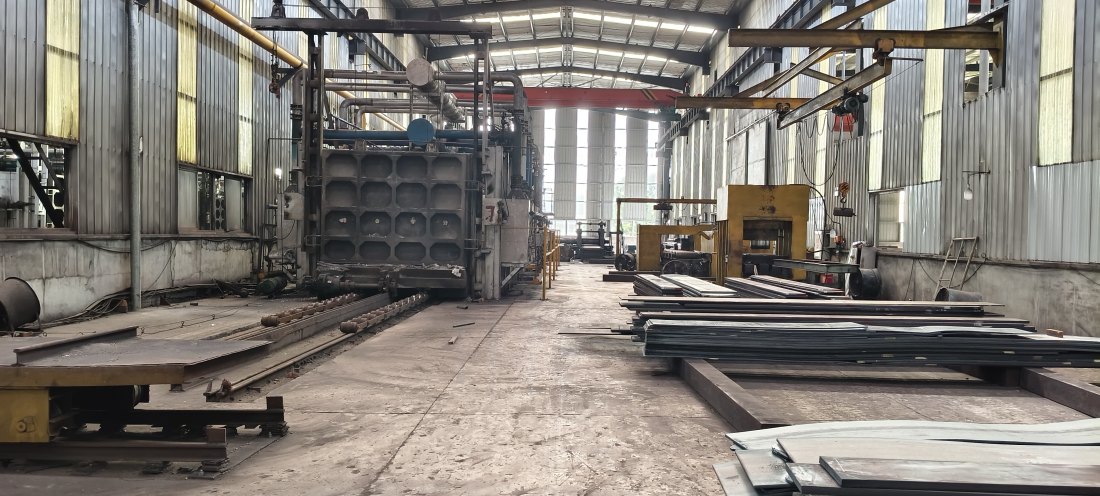
Plate and block are rolled or forged, then austenitised, quenched and tempered to 280–325 HB. The tempering temperature is what sets the final hardness, and it is held until the cross-section is uniform — not just at the surface where the portable hardness tester lands first.
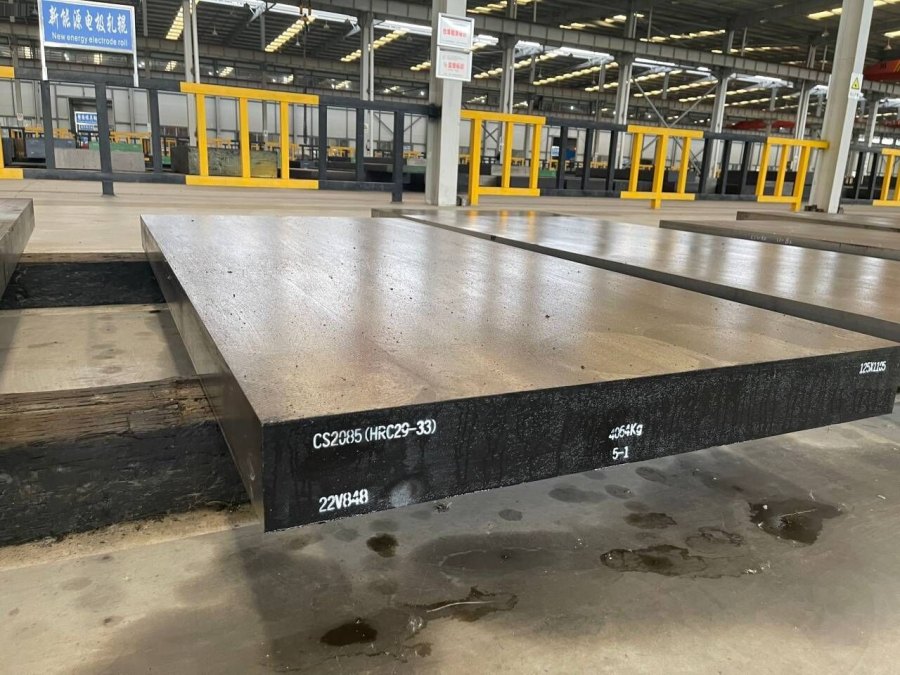
After tempering the faces are milled, the block is checked on both the milled face and the saw-cut end, and the grade, heat number, size and weight are stencilled on the end. A mould set — cavity plate, core plate and frame — is cut from one heat so the plates respond the same way to stress relieving and nitriding.
Surface treatments that work on this grade
- Nitriding — 500–530 °C, raises surface hardness without touching the core
- Hard chrome plating — good adhesion on 16 % Cr
- Polishing — to a satin finish; do not chase a mirror on the sulphur stringers
- EDM — leaves a recast layer that should be removed on a corrosion-critical surface
- Etching — acceptable, but test on an offcut first
Packing and delivery
Plates and blocks are oiled, wrapped and crated, with grade, heat number, size and net weight stencilled on the outside. PVC mould sets are packed as a matched set from one heat so the plates behave the same in service.
Typical lead time is 20–30 days on stock sizes. Loading from Shanghai, Qingdao or Shenzhen, FOB or CIF.
Request a quote
- Grade — 1.2085, or tell us the plastic and we will confirm whether 1.2316 is the better fit
- Form and size — plate or block, thickness × width × length
- Quantity in pieces
- Surface requirement — as sawn, milled, or ground; and whether a mirror finish is needed
- Certificate and inspection — 3.1 as standard, UT or hardness map on request
Email [email protected] or use the form below. Drawings in DXF, STEP or PDF are all fine.
Related mould steel grades
One heat-treatment route, one certification route — grades can be combined in a single shipment.