
1.2316 X38CrMo16 Cold Work Tool Steel For Plastic Mould
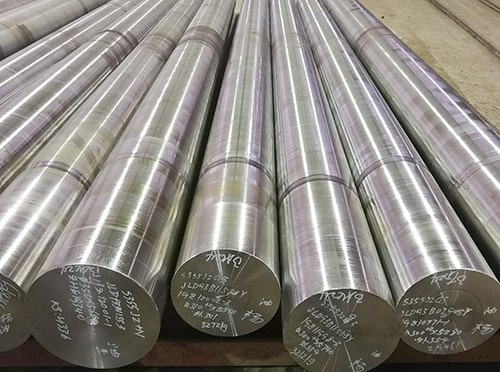
1.2316 X38CrMo16 Cold Work Tool Steel For Plastic Mould
This steel 1.2316 is mainly used for plastic injection molds, in connection with chemically aggressive and acidic plastics such as thermoplastics and for PVC-arminoplastics, extrusion tools, compressor parts and for special machine parts in the food industry.
We can provide more services:
1、Hardening and tempering
2、Vacuum heat treatment
3、Polished bright surface
4、Milling bright surface
5、CNC machine
6、Deep drilling
7、Cut into small pieces
8、Make it closer to the mold
Welcome to inquiry price from drawing
Cutting:
Precision cutting to standard dimensions
Custom cutting according to client specifications
Surface Grinding/Polishing:
Thickness tolerance: -0 to +0.1mm
Flatness: 0.01/100mm
Surface roughness: Ra ≤1.6 or Rz ≤6.3
Applications :
Molds for pressing of chemically-aggressive plastic substances etc. All kinds of silicon steel sheet and high-speed blanking die. Precise stamping die. Cold extruding forming die. Cavitations Molds, Standard Mould Base, Compression Mould for SMC, blowing mould, Pet preform mold, plastic piping & plumbing injection molds.
We can provide more services:
1、Hardening and tempering
2、Vacuum heat treatment
3、Polished bright surface
4、Milling bright surface
5、CNC machine
6、Deep drilling
7、Cut into small pieces
8、Make it closer to the mold
Welcome to inquiry price from drawing
Equivalent grades of steel X38CrMo16 (1.2316)
| EU EN |
Germany DIN,WNr |
ASTM AISI | JIS | |
| X38CrMo16 |
|
422 | SUS4201J2 |
Chemical composition % of steel X38CrMo16 (1.2316): EN 4957-2000
| C | Si | Mn | Ni | P | S | Cr | Mo |
| 0.33 – 0.45 | max 1 | max 1.5 | max 1 | max 0.03 | max 0.03 | 15.5 – 17.5 | 0.8 – 1.3 |
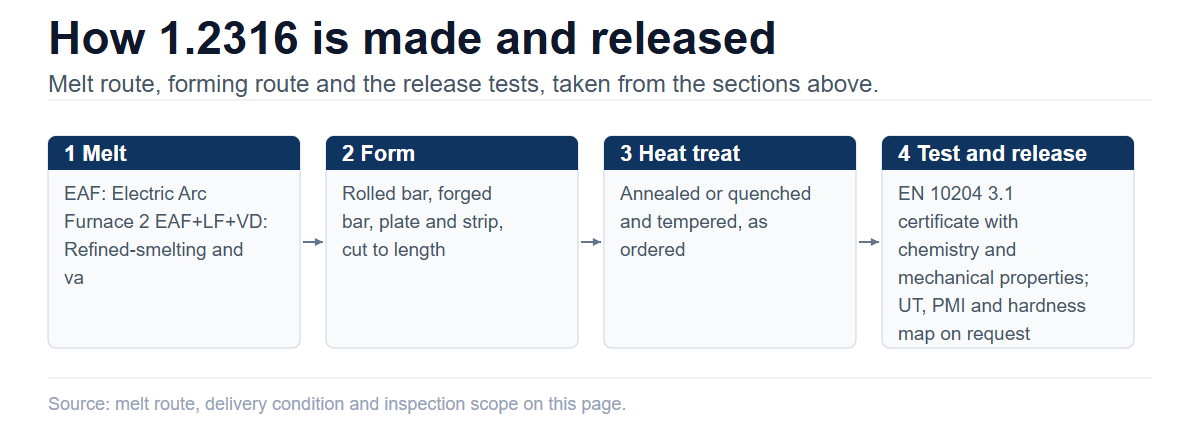
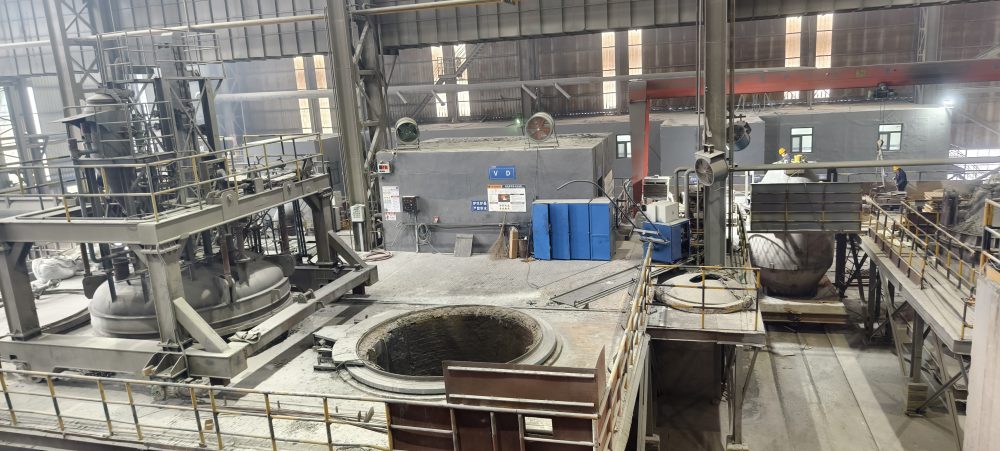
Smelting Option
1 EAF: Electric Arc Furnace
2 EAF+LF+VD: Refined-smelting and vacuum degassing
3 EAF+ESR: Electro Slag Remelting
4 EAF+PESR: protective atmosphere Electro Slag Remelting
5 VIM+PESR: Vacuum induction melting
Forming Option
1 Hot rolling process
2 Hot Forging: Electro-hydraulic; High-speed-hydraulic; Oil-hydraulic; Precision-forging
Heat-treatment Option
1 +A: Annealed (full/soft/spheroidizing)
2 +N: Normalized
3 +NT: Normalized and tempered
4 +QT: Quenched and tempered (water/oil)
Surface Option
1 Black Surface
2 Grounded: Bright but rough ; Not precision
3 Machining for plate: Bright and precision; Little turning scar
4 Peeled/Turned: Bright and precision; Little turning scar
5 Polished: Very Bright and precision size; Not turning scar
Other Services
1 Cutting: Small pieces
2 CNC Machine: Produce as your drawing
3 Package: Bare/Nylon/Canvas/Wooden
4 Payment:T/T, L/C, O/A(request credit)
5 Transport:FOB/CFR/CIF/DDU/DDP (train/ship/Air)
MECHANICAL PROPERTIES
| Yield Rp0.2 (MPa) |
Tensile Rm (MPa) |
Impact KV/Ku (J) |
Elongation A (%) |
Reduction in cross section on fracture Z (%) |
As-Heat-Treated Condition | Brinell hardness (HBW) |
| 116 (≥) | 695 (≥) | 23 | 33 | 11 | Solution and Aging, Annealing, Ausaging, Q+T,etc | 443 |
HEAT TREATMENT:
already pre-toughened; usually no heat treatment required
Soft annealing:
760 to 800 °C for about 4 to 5 hours; slow controlled cooling of 10 to 20 °C per hour to about 650 °C; further cooling in air, max. 230 HB
Hardening:
1030 to 1050 °C 15 to 30 minutes keeping curing temperature quenching in water/oil obtainable hardness: 49 HRC
Tempering:
Slow heating to tempering temperature immediately after hardening. Minimum time in furnace: 1 hour per 20 mm part thickness
You get chemical composition, mechanical properties and a price — with inspection certificates to EN 10204 3.1 issued against the heat number.
Trade terms and how an order runs
The terms below apply unless the enquiry states otherwise. They are the terms most of our European and North American buyers work to, and they can be adjusted in the quotation.
| Item | Standard terms |
|---|---|
| Incoterms 2020 | FOB Shanghai, Qingdao or Shenzhen; CIF and CFR quoted against the destination port. |
| Payment | T/T 30 % advance with the order, 70 % against the bill of lading copy; irrevocable L/C at sight accepted for orders above 20 t |
| Minimum quantity | One bundle or one plate for stock sizes; mill runs and special sections are quoted individually |
| Lead time | 20–30 days from order confirmation for stock sizes; 30–45 days where forging, heat treatment or machining is included |
| Inspection | EN 10204 3.1 with every lot; third-party inspection (SGS, BV, TUV) arranged on request before dispatch |
| Documents | 3.1 certificate, packing list, commercial invoice, bill of lading, certificate of origin; legalisation or chamber attestation on request |
| Packing | Seaworthy export packing — oiled, wrapped, crated or strapped on skids, marked with grade, heat number, size and net weight |
Frequently asked questions
Because the 16 % chromium resists the hydrochloric acid released when PVC breaks down at processing temperature. A standard P20 cavity pits within months; 1.2316 stays intact.
Pre-hardened at 30–34 HRC (about 300–340 HB), ready to machine. It can be hardened further to 48–52 HRC after machining if the cavity needs it, but most moulds never are.
Both are corrosion-resistant mould steels. 1.2083 (420 stainless) polishes to a mirror and is the choice for optical parts; 1.2316 is tougher and better for large, deep cavities where polish is less critical.
Yes, but not as deeply as a standard P20. The high chromium content makes deep acid texturing uneven; tell us the pattern and we will advise on the grade before you cut the block.
Forged blocks and plate, thickness 20–500 mm, cut to size; the size table on this page lists the standard ranges.
