
1.3343, HS6-5-2C, HIGH SPEED STEEL

HIGH-SPEED TUNGSTEN-MOLYBDENUM STEEL HS6-5-2C, S6-5-2, 1.3343, AISI M2 ACCORDING TO ISO 4957, DIN 17350.
| Standard | Steel Grade | ||||||||||
| Chemical Composition % | |||||||||||
| C: | Mn: | Si: | P: | S: | Cr: | Mo: | Ni: | V: | W: | Co: | |
| PN | SW7M | ||||||||||
| 0.82 – 0.92 | <0.4 | <0.5 | <0.03 | <0.03 | 3.5 – 4.5 | 4.5 – 5.5 | <0.4 | 1.7 – 2.1 | 6.0 – 7.0 | <0.5 | |
| ISO | HS6-5-2C | ||||||||||
| 0.86 – 0.94 | <0.4 | <0.45 | <0.03 | <0.03 | 3.8 – 4.5 | 4.7 – 5.2 | – | 1.7 – 2.1 | 5.9 – 6.7 | – | |
| ISO | HS6-5-2 – 1.3339 | ||||||||||
| 0.80 – 0.88 | <0.4 | <0.45 | <0.03 | <0.03 | 3.8 – 4.5 | 4.7 – 5.2 | – | 1.7 – 2.1 | 5.9 – 6.7 | – | |
| DIN | S6-5-2 – 1.3343 | ||||||||||
| 0.86 – 0.94 | <0.4 | <0.45 | <0.03 | <0.03 | 3.8 – 4.5 | 4.7 – 5.2 | – | 1.7 – 2.0 | 6.0 – 6.7 | – | |
| NF | Z85WDCV06-05-04-02 | ||||||||||
| 0.80 – 0.87 | <0.4 | <0.5 | <0.03 | <0.03 | 3.5 – 4.5 | 4.6 – 5.3 | – | 1.7 – 2.2 | 5.7 – 6.7 | – | |
| ASTM | UNS T11302 – AISI M2 | ||||||||||
| 0.78 – 0.88 | 0.15 – 0.40 | 0.20 – 0.45 | <0.03 | <0.03 | 3.75 – 4.50 | 4.5 – 5.5 | – | 1.75 – 2.20 | 5.50 – 6.75 | – | |
| GOST | R6M5 – Р6М5 | ||||||||||
| 0.82 – 0.90 | <0.5 | <0.5 | <0.03 | <0.25 | 3.80 – 4.40 | 4.8 – 5.3 | <0.4 | 1.7 – 2.1 | 5.5 – 6.5 | <0.5 | |
S6-5-2, HS6-5-2, 1.3343 – specification and application
High-speed steel with very good efficiency, ductility, resistance to abrasion and torsion, and impact strength used to work with products with a strength of more than 830 MPa. It is used in the production of drills, blades, knives, spiral drills, thread cutting tools, broaching tools, gear tools, milling cutters, mandrel reamers, end milling cutters, and circular saw segments. SW7M / 1.3343 is prone to decarburization and overheating during heat treatment. After hardening and tempering, it achieves hardness above 63 HRC.
Mechanical properties of SW7M, S6-5-2, HS6-5-2C, 1.3343
- Hardness in +A delivery condition: <269 HB
- Hardness in +A+C delivery condition: <319 HB
- Hardness in +A+CR delivery condition: <339 HB
- Hardness after hardening and tempering:
- at 300 ℃ = 61,5 HRC
- at 350 ℃ = 62 HRC
- at 400 ℃ = 62 HRC
- at 450 ℃ = 63 HRC
- at 500 ℃ = 65 HRC
- at 550 ℃ = 65 HRC
- at 600 ℃ = 60 HRC
- at 650 ℃ = 52 HRC
Heat and plastic treatment processes of SW7M, S6-5-2, HS6-5-2C, 1.3343 steel:
- Softening annealing at a temperature of 800 – 900 ℃
- Relief annealing at a temperature of 600 – 700℃
- Heating no. I in a temp. of about 550℃
- Heating no. II in a temp. of about 850℃
- Austenitizing at 1190 – 1230 ℃ (hardening in salt bath and oil)
- Tempering usually in the range of 550 – 570 ℃
- Forging and rolling at temperatures 1100 – 900 ℃
- Nitriding in the temperature range of 510 – 530 ℃
In the above mentioned grades the company provides:
- Drawn bars, hot-rolled bars, high-speed forged bars 1.3343, HS6-5-2, S6-5-2, HS6-5-2C
- High-speed steel sheets 1.3343, HS6-5-2, S6-5-2, HS6-5-2C
Other replacements and equivalents of the grade:
SW7M, 1.3343, HS6-5-2C, HS6-5-2, S6-5-2, 1.3339, X82WMOCRV6-5-4, X80WMOCRV6-5-4, X 82 WMOCRV 6-5-4, X 80 WMOCRV 6-5-4, R6M5, AISI M2, SKH51, SS 2722, R6, W6MO5CR4V2, CSN 19830, 1.3553, SC6-5-2, SC 6-5-2, 1.3341, BS BM2, X82WMO0605KU, X 80 WMO 06 05 KU, RP5, EM2, F-550.A, UNS T11302, AISI M-2, HS 6-5-2 C, S 6-5-2, Р6М5, R6M5.
One steel, five designations
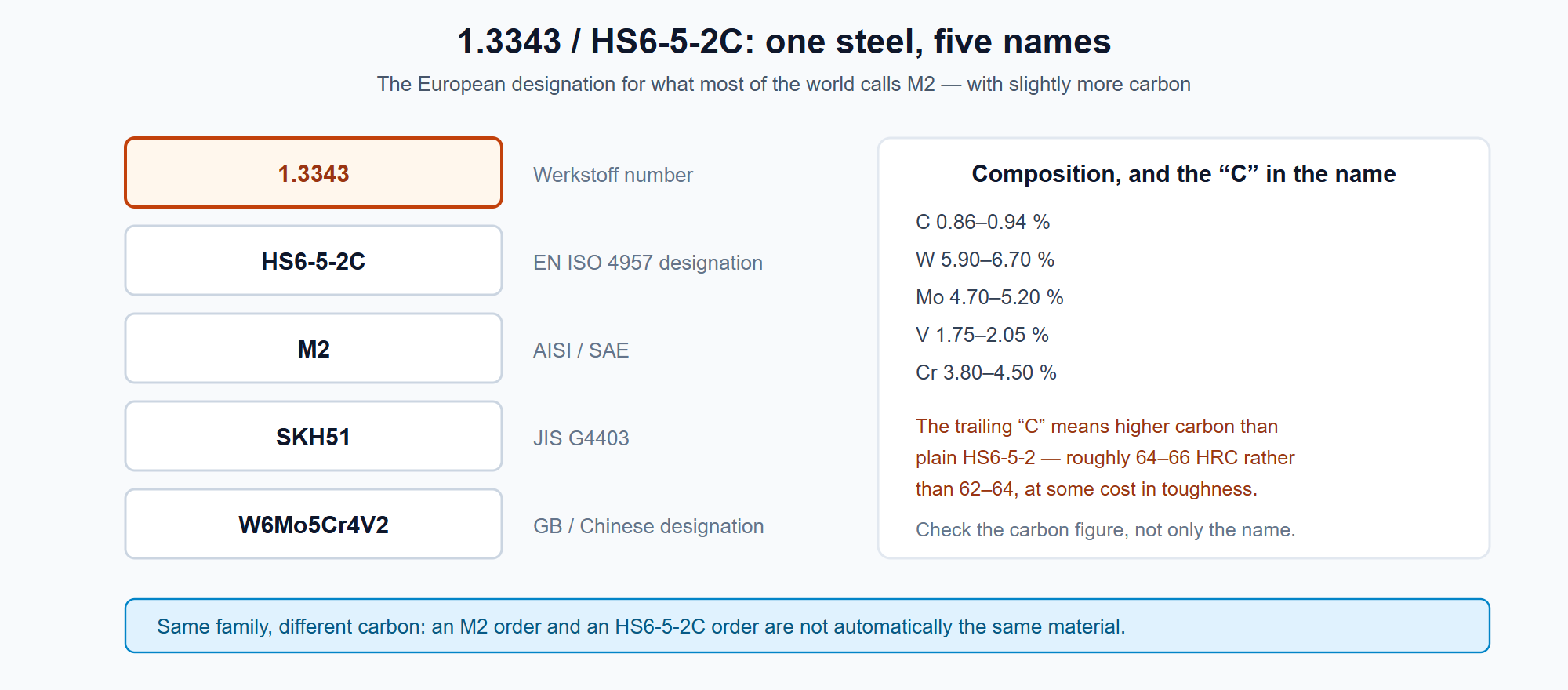
A drawing may cite 1.3343, HS6-5-2C, M2, SKH51 or W6Mo5Cr4V2. They refer to the same tungsten-molybdenum high speed steel family, and the mill certificate will usually list several of them side by side.
The one thing to watch is the trailing “C” in the European designation. HS6-5-2C is the higher-carbon variant — roughly 0.86–0.94 % carbon instead of about 0.85 — which takes hardness to 64–66 HRC at some cost in toughness. A plain M2 order and an HS6-5-2C order are close, but not identical.
What the designation encodes
HS6-5-2 is a composition code, not an arbitrary number: 6 % tungsten, 5 % molybdenum, 2 % vanadium. That is why the European names are worth learning — they tell you the analysis before you read the table.
| Name | System | Note |
|---|---|---|
| 1.3343 | Werkstoff | Numeric, used on European drawings |
| HS6-5-2C | EN ISO 4957 | Higher carbon variant |
| M2 | AISI | The most common name worldwide |
| SKH51 | JIS G4403 | Japanese designation |
| W6Mo5Cr4V2 | GB | Chinese designation |
What to put on the order
Name the standard as well as the grade, and state the carbon target if the application is hardness-critical. Two heats at opposite ends of the carbon range will not reach the same hardness after the same treatment.
Related reading
- What is M2 high speed steel? — the overview and how to choose between M2, M35 and M42.
- M2 chemical analysis — what each element does and what an out-of-range heat costs you.
- M2 heat treatment — the full cycle, why three tempers, and how M2 fails.
- M2 / 1.3343 bar and strip — sizes and forms we supply.