
1.4571 / 316Ti Stainless Steel: Composition, Properties and Supply
316Ti is 316 with titanium added to do one job: keep chromium in the matrix when the steel is held in the 400–850 °C band. It is the German standard answer to a problem that 316L only partly solves.
1.4571 is an austenitic stainless steel with 17 % chromium, 12 % nickel, 2 % molybdenum and a titanium addition. Chemically it sits on top of 316L; metallurgically it is a different answer to the same question, which is what happens to the chromium when the steel is welded or run hot.
It is still widely specified in Germany and in plants built to German practice, even though 316L has largely replaced it elsewhere. The reason is that 1.4571 solves a problem 316L does not: continuous service in the sensitisation range, or a weld that cannot be solution annealed afterwards.
Why titanium is in the analysis
Austenitic stainless steel protects itself with chromium oxide. Carbon competes for that chromium: above about 450 °C it diffuses to the grain boundaries and forms chromium carbide (Cr23C6), which pulls chromium out of the adjacent metal. The boundary is then too poor in chromium to passivate, and the steel corrodes along it — intergranular corrosion, which shows up as a weld that fails a bend test or a pipe that cracks beside a seam after a few years.
Titanium has a stronger affinity for carbon than chromium does. If enough titanium is present — in practice about five times the carbon content — the carbon precipitates as titanium carbide at high temperature, where it does no harm, and the chromium stays in solution. The steel is then “stabilised”, and the sensitisation range stops being a limit.
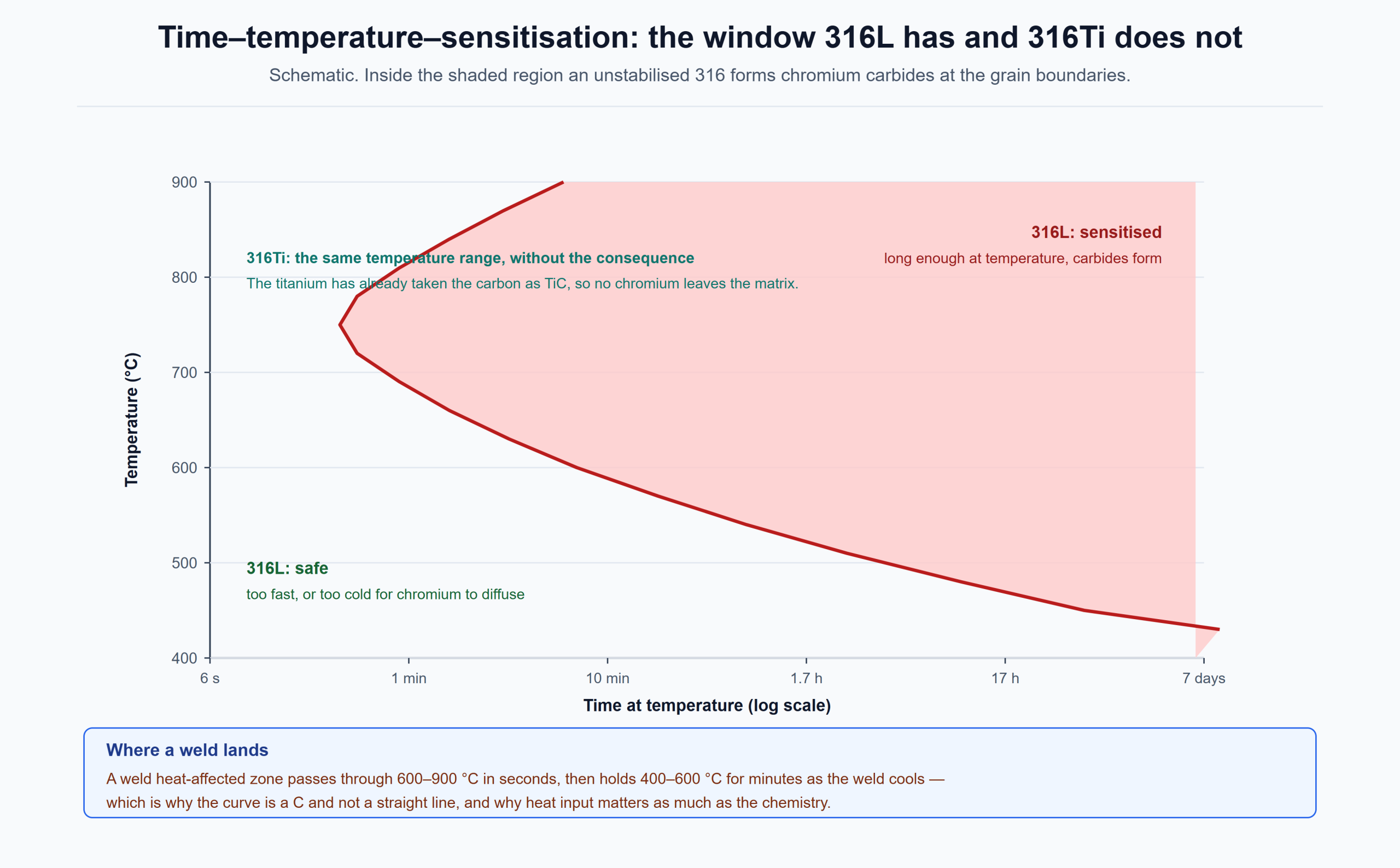
That is why 1.4571 can be used for continuous service up to about 800 °C, where 316L is normally limited to about 550 °C for structural duty and to lower stresses above that. It is also why 321 (stabilised with titanium, 18 % chromium) and 347 (stabilised with niobium) exist: the same mechanism, at different alloy levels.
Chemical composition
Table 1. Chemical composition to EN 10088-2, mass fraction in percent. Single values are maxima.
| C | Si | Mn | P | S | Cr | Ni | Mo | Ti |
|---|---|---|---|---|---|---|---|---|
| ≤0.08 | ≤1.00 | ≤2.00 | ≤0.045 | ≤0.015 | 16.5–18.5 | 10.5–13.5 | 2.00–2.50 | ≤0.70 |
The carbon limit is 0.08 % — higher than 316L, and deliberately so, because the titanium is there to handle it. A 1.4571 heat with unusually low titanium, or an unfavourable titanium-to-carbon ratio, loses the protection the grade was bought for. That is the one chemistry detail worth checking on the certificate: Ti should be at least five times C.
Equivalent designations
Table 2. Equivalent designations for 1.4571.
| System | Designation |
|---|---|
| EN / EU | X6CrNiMoTi17-12-2 — 1.4571 |
| AISI / UNS | 316Ti — S31635 |
| DIN (old) | X10CrNiMoTi18-10 |
| JIS | SUS 316Ti |
| AFNOR | Z6CNDT17-12 |
| BS | 320S31 |
| UNI | X6CrNiMoTi17-12 |
Mechanical properties
Table 3. Mechanical properties to EN 10088-2, by condition.
| Condition | Tensile strength | 0.2 % proof strength | Elongation |
|---|---|---|---|
| +A, annealed | 500–700 MPa | 200–240 MPa | 40 % min |
| +AT, solution annealed | 500–730 MPa | 190–210 MPa | 40 % min |
| +AT+C, cold worked | 810–850 MPa | — | — |
These are modest numbers for a stainless steel, and that is normal: the austenitic grades are bought for corrosion resistance and ductility, not for strength. Where more strength is needed the grade is cold worked (+AT+C) or replaced with a duplex or a precipitation-hardening stainless.
316Ti against 316L
Table 4. Where the two grades differ, and where they do not.
| Property | 1.4571 / 316Ti | 1.4404 / 316L |
|---|---|---|
| Carbon | ≤0.08 % | ≤0.030 % |
| Stabiliser | Titanium, min 5× C | None |
| Intergranular corrosion after welding | Resistant without post-weld anneal | Resistant in thin sections; needs low carbon and controlled heat input |
| Continuous service ceiling | about 800 °C | about 550 °C for structural duty |
| Weldability | Good, but titanium raises the risk of nitride and oxide inclusions in the weld pool | Better; the standard choice for thin-wall welded fabrication |
| Surface finish | Titanium inclusions can show as streaks after polishing | Cleaner polish |
| Availability and price | Fewer mills, higher price | Widely stocked, lower price |
The practical rule in Europe is that 316L is the default and 316Ti is specified only when one of two things is true: the part runs continuously above about 550 °C, or it is welded in a heavy section that cannot be solution annealed afterwards. Specifying 316Ti for a thin-wall decorative part buys nothing and costs more.
Corrosion resistance
The pitting resistance of 316Ti is the same as 316L, because the alloying elements that set it — chromium and molybdenum — are the same. The chart below uses the pitting resistance equivalent number (PREN = Cr + 3.3 Mo + 16 N) to place the grade against its neighbours.
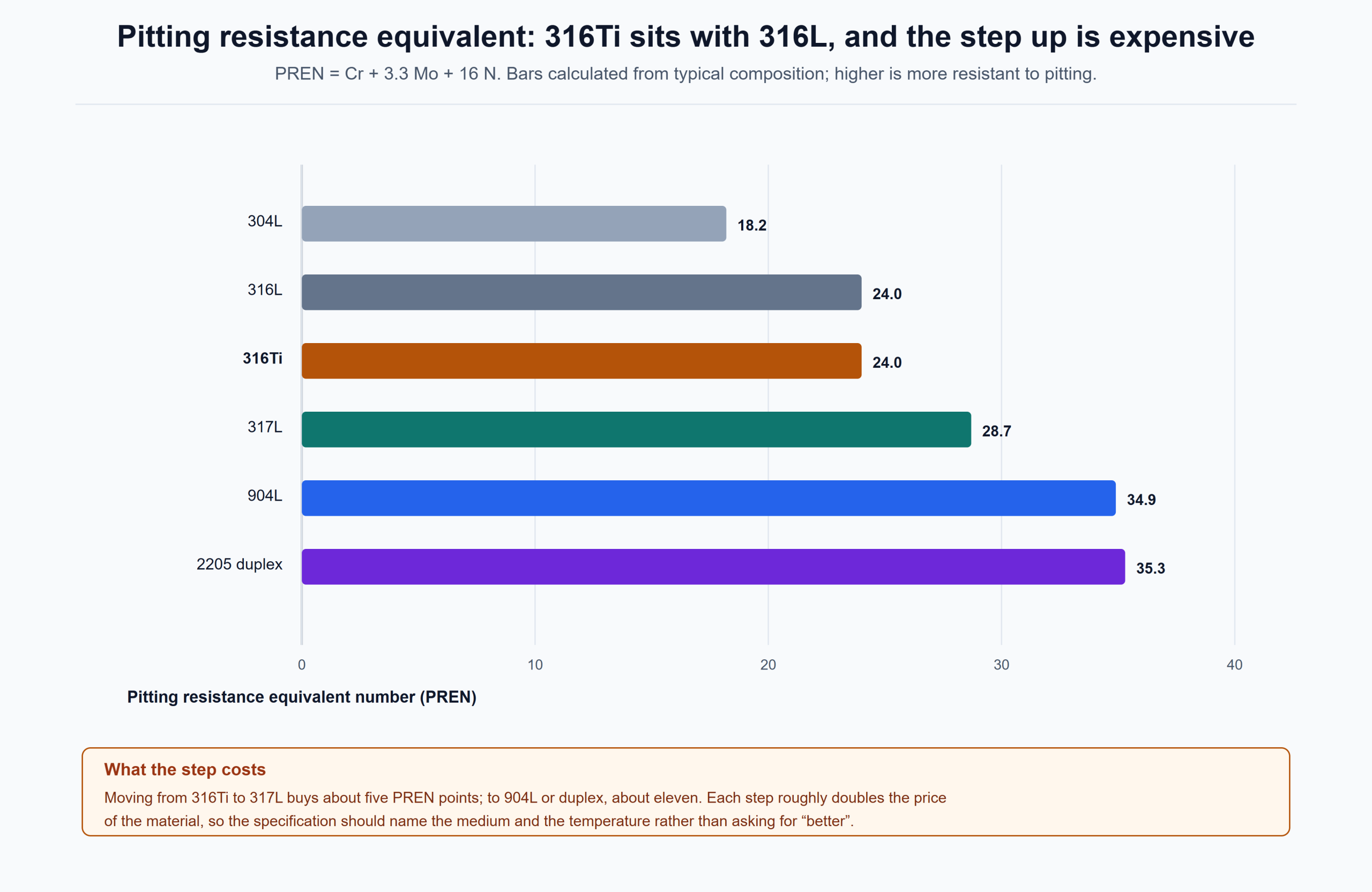
A PREN around 24 is enough for fresh water, food, pharmaceutical and most atmospheric service, and for mild chloride exposure. It is not enough for seawater, brine or high-chloride process streams, where the specification moves to a 6 % molybdenum grade, a super-austenitic or a duplex steel.
Where it is used
- Exhaust systems and expansion joints, where the part runs hot and is welded.
- Heat exchangers and boiler components in chemical and petrochemical plant.
- Pipework and vessels in the food, beverage and pharmaceutical industries that are sterilised with steam.
- Pulp and paper digesters, where the liquor is both hot and corrosive.
- Flanges, fittings and valve bodies that are welded into a line and cannot be heat treated afterwards.
Welding
1.4571 welds with the standard austenitic processes — TIG, MIG, MMA and SAW — using a matching 316Ti filler or a 318 (Nb-stabilised) filler where the joint will run hot. The titanium makes the melt slightly less forgiving than 316L: it forms nitrides and oxides that can end up as inclusions in the weld, so shielding gas quality and interpass cleanliness matter more than they do on 316L. Heat input should be moderate and the interpass temperature kept below 150 °C.
Post-weld solution annealing is not normally required, which is the point of the grade. If the weld is later held in the 600–800 °C range for long periods, the titanium carbide itself can coarsen and the toughness of the weld metal falls — a detail worth checking on thick-section, high-temperature work.
Supply range and condition
Bar is the volume product for this grade: 80–600 mm diameter in lengths of 1000–9000 mm, solution annealed and pickled unless a bright finish is specified. Tube, sheet and strip come from the same rolling programme.
Table 5. Typical supply range for 1.4571 / 316Ti.
| Form | Size range | Condition |
|---|---|---|
| Round bar | Ø80–600 mm, length 1000–9000 mm | Solution annealed, or cold worked |
| Billet and forged bar | To drawing | Solution annealed |
| Seamless tube and pipe | OD 6–610 mm | Solution annealed |
| Sheet and plate | Thickness 0.5–80 mm | Hot or cold rolled, annealed and pickled |
| Strip and wire | Thickness 0.1–6 mm | Annealed or cold rolled to temper |
Table 6. Delivery condition, surface and melting route.
| Item | Options |
|---|---|
| Delivery condition | +A annealed, +AT solution annealed, +AT+C cold worked, +NT normalised and tempered |
| Surface | Black, ground, machined, peeled or turned, polished; pickled and passivated for welded assemblies |
| Melting route | EAF; EAF + LF + VD; EAF + ESR; EAF + PESR; VIM + PESR |
| Forming route | Hot rolling, or hot forging by electro-hydraulic, high-speed hydraulic, oil-hydraulic or precision forging |
| Test certificate | EN 10204 3.1 with chemistry including titanium, mechanical properties and, on request, ASTM A262 Practice E |
Inspection, certification and services
Delivery is normally solution annealed and pickled, or bright annealed for thin strip. The certificate has to show the titanium content, not just the carbon: a heat whose titanium is below five times the carbon has lost the protection the grade was bought for, even though every other line is in range.
Table 7. Workshop and commercial services offered with 1.4571.
| Service | Detail |
|---|---|
| Cutting | Saw-cut blanks to length; waterjet or plasma cut plate to drawing |
| Machining | CNC turning, milling and drilling; weld preparation to drawing |
| Packing | Bare, nylon wrap, wooden case; export seaworthy packing |
| Payment and terms | T/T, L/C at sight, or O/A against approved credit; FOB, CFR, CIF, DDU or DDP |
The same mill programme covers the tool and mould grades that usually ship with a 316Ti order: 1.2510/H10, 1.2842, 1.2379/D2, 1.2080/X210Cr12/D3, 1.2436, 1.2365, 1.2885, 1.2343, 1.2344/H13/SKD61, 1.2581/H21, 1.2709, 1.2345, 1.2738/P20Ni, 1.2083/420J2, 1.2316, 1.2312/P20S, 1.2311 and 1.2764.
What to put on the enquiry
- Grade: 1.4571 to EN 10088-2, or 316Ti to ASTM A240 — both, if the part crosses standards.
- Condition: solution annealed, or cold worked to a strength level.
- Service temperature and whether it is continuous or cyclic. That is the answer that decides whether 316L would have done.
- Whether the part is welded, and whether a post-weld heat treatment is possible.
- Surface finish and any intergranular corrosion test requirement.
Related reading
- 317L stainless steel — the next molybdenum step up when chlorides are the problem
- 321 / 321H — the same titanium trick at 18 % chromium
- 1.4961 / 347H — niobium stabilisation for the hottest welded service
- 310S — when the service temperature goes beyond what a stabilised 316 will take
- Which stainless steels are magnetic — why the austenitic grades here are non-magnetic
You get chemical composition, mechanical properties and a price — with inspection certificates to EN 10204 3.1 issued against the heat number.
