
154CM Stainless Steel: Composition, Hardness and Uses
A 14 % chromium, 4 % molybdenum martensitic steel run at 58–61 HRC. The American premium blade grade: more wear resistance than 440C at the same corrosion level, and the reference point most custom knife makers still quote against.
At a glance
| Item | Detail |
|---|---|
| Designations | 154CM (Crucible trade name) / near equivalent to 1.4125 family |
| Standards | ASTM A276 chemistry; mill specification for the balance |
| Delivery condition | Annealed max 255 HB, or hardened and tempered strip |
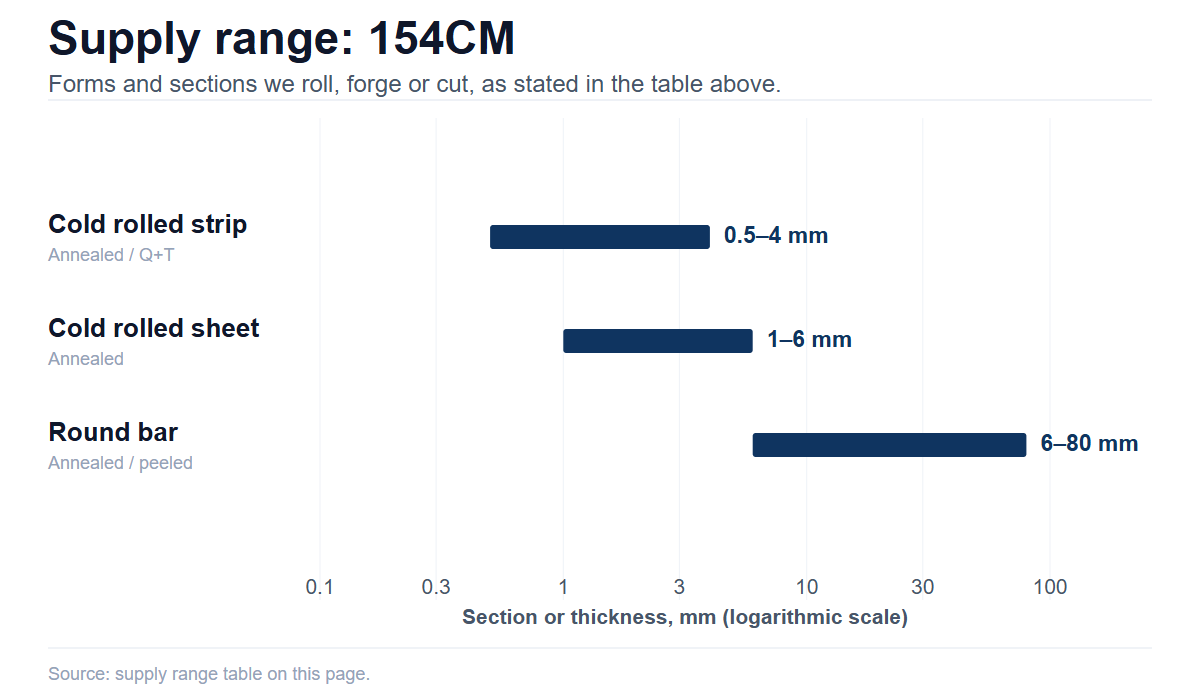
| Supply range | Strip 0.5–4.0 mm, sheet 1.0–6.0 mm, bar to Ø80 mm |
| Typical use | Custom and production knife blades, die wear parts, pump components, measuring tools |
| Certificate | EN 10204 3.1 with chemistry, hardness and mechanical properties |
Why 4 % molybdenum matters
154CM is a high-carbon martensitic stainless — about 1.05 % carbon and 14 % chromium — with 4 % molybdenum. The molybdenum forms its own hard carbides, which is why the steel holds 58–61 HRC with better wear resistance than 440C at the same chromium level.
It also holds hardness a little better if the blade gets hot — friction from a sawing action or a bad grinding pass. That is the practical difference a maker notices, more than any laboratory number.
The trade: 154CM is less tough than CPM154 or 3V at the same hardness. For a blade that gets impact — a camp knife, a chopper — the powder metallurgy version is worth the premium. For a slicing knife, 154CM at 59–60 HRC is the classic answer.
Supply range and delivery condition
| Form | Size range | Condition |
|---|---|---|
| Cold rolled strip | Thickness 0.5–4.0 mm × width up to 400 mm | Annealed / Q+T |
| Cold rolled sheet | Thickness 1.0–6.0 mm × width up to 600 mm | Annealed |
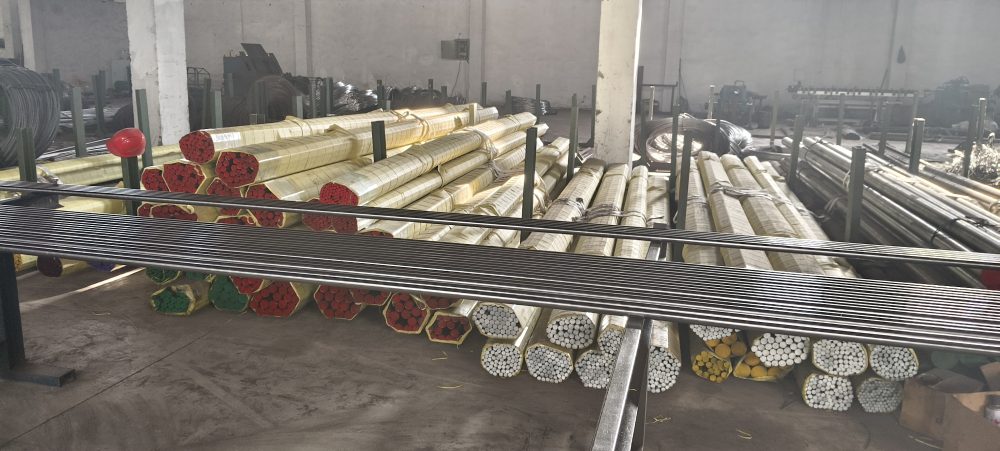
| Round bar | Ø6–80 mm | Annealed / peeled |
Blade stock is normally supplied in annealed strip so the maker can blank, harden and finish-grind.
Chemical composition
| C | Si | Mn | P | S | Cr | Mo |
|---|---|---|---|---|---|---|
| 1.05 | 0.30 | 0.50 | ≤0.030 | ≤0.030 | 14.0 | 4.00 |
Typical 154CM analysis (Crucible trade name). The heat analysis on the 3.1 certificate governs the lot.
Mechanical properties
| Condition | Hardness | Note |
|---|---|---|
| Annealed | ≤255 HB | Machinable, magnetic |
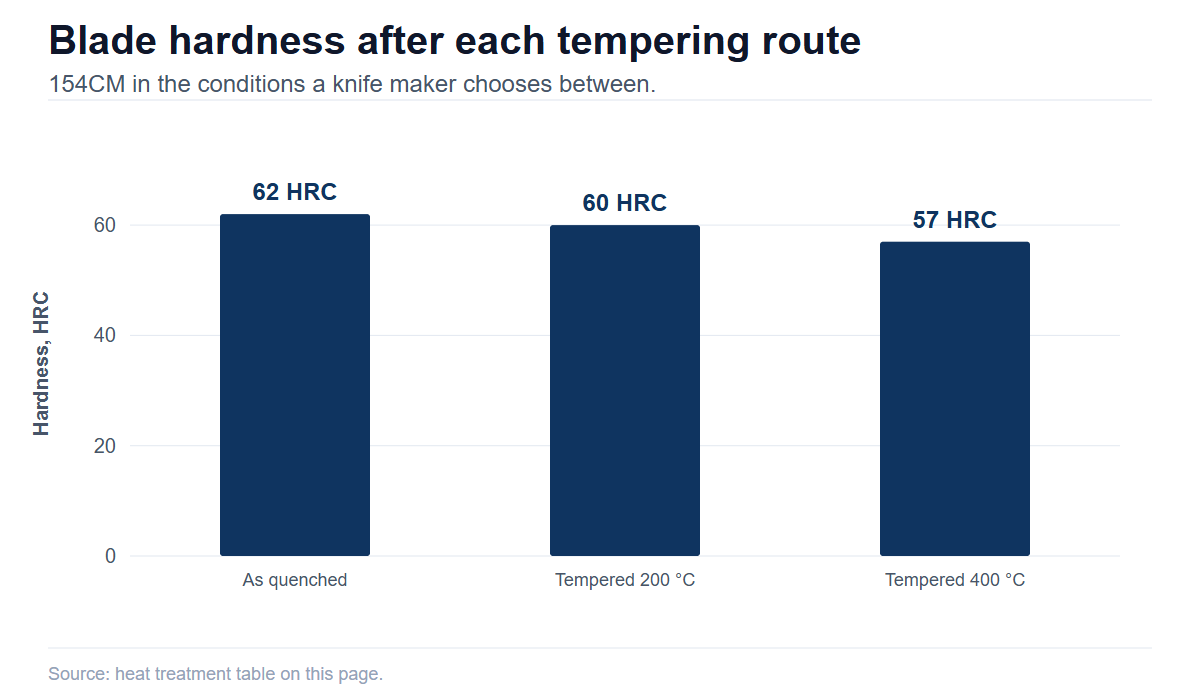
| Hardened 1080 °C, oil or air | 61–63 HRC | As quenched |
| Tempered 200 °C | 59–61 HRC | Blade condition |
| Tempered 400 °C | 56–58 HRC | Higher toughness |
Room temperature. Cryogenic treatment before tempering is common where the blade must hold dimension after grinding.
Heat treatment
| Step | Temperature | Medium | Result |
|---|---|---|---|
| Annealing | 870–900 °C, furnace cool | — | ≤255 HB |
| Hardening | 1060–1090 °C | Oil or air | 61–63 HRC |
| Tempering | 180–220 °C | Air, twice | 59–61 HRC |
| Cryogenic (optional) | −80 °C before tempering | — | Less retained austenite |
Two tempers on anything thinner than 3 mm; the second converts the austenite the first one stabilised.
Where orders go wrong
- Running it too hard. 62–63 HRC looks good on paper and chips on a cutting board. 59–61 is the production window for a reason.
- Skipping the cryogenic step on thin stock. Retained austenite converts over months and the blade moves after the final grind.
- Buying it as a stainless. 14 % chromium with 1 % carbon is stain resistant, not stainless. Salt water and dishwasher detergent will mark it.
What ships with every lot
- EN 10204 3.1 mill certificate with chemistry and hardness
- Hardness traverse across the strip on request
- Decarburisation depth check on annealed strip
- Thickness tolerance and crown measurement
- Microstructure report — carbide distribution and retained austenite on request
Cutting, machining and surface
| Operation | What we hold |
|---|---|
| Slitting | Width from 6 mm |
| Precision grinding | Thickness tolerance ±0.02 mm |
| Surface finishing | Ground or polished; annealed stock is ground before hardening |
| Blanking | Laser, waterjet or stamping from DXF |
Blank annealed, harden, then finish-grind with flood coolant — 154CM work-hardens if ground dry.
Trade terms and how an order runs
The terms below apply unless the enquiry states otherwise, and they can be adjusted in the quotation.
| Item | Standard terms |
|---|---|
| Incoterms 2020 | FOB Shanghai, Qingdao or Shenzhen; CIF and CFR quoted against the destination port |
| Payment | T/T 30 % advance, 70 % against the bill of lading copy; irrevocable L/C at sight above 20 t |
| Minimum quantity | One bundle or one plate for stock sizes; mill runs quoted individually |
| Lead time | A 14 % chromium, 4 % molybdenum martensitic steel run at 58–61 HRC. The American premium blade grade: more wear resistance than 440C at the same corrosion level, and the reference point most custom knife makers still quote against. |
| Documents | 3.1 certificate, packing list, invoice, bill of lading, certificate of origin |
| Inspection | Third-party inspection (SGS, BV, TUV) arranged before dispatch on request |
Packing and delivery
Strip is coiled, interleaved and boxed with grade, heat number, thickness and weight on the label.
Typical lead time is 25–35 days; the grade is mill-rolled rather than stocked in every thickness.
Request a quote
- Grade — 154CM unless the blade needs CPM154 or 440C
- Thickness × width, and coil weight or cut length
- Quantity in kilograms
- Condition — annealed, or hardened and tempered with the hardness window
- Certificate and inspection — 3.1 as standard, hardness traverse on request
Email [email protected] or use the form below. Drawings in DXF, STEP or PDF are all fine.
Related grades
One heat-treatment route, one certification route — grades can be combined in a single shipment.
- 5Cr15MoV — the mid-range blade grade
- 420HC — lower carbon, tougher, cheaper
- 440C — the reference this grade is measured against
Browse all stainless steel grades →
Governing standard: ASTM A276 (PDF)
Frequently asked questions
There is no exact EN equivalent. It is a Crucible trade name for a 1.05 % C, 14 % Cr, 4 % Mo martensitic stainless; ATS-34 is the Japanese equivalent made by Hitachi. The certificate carries the chemistry, which is what matters.
59–61 HRC for slicing knives. 62–63 holds an edge longer on abrasive material but chips on bone, ice or a careless cut.
154CM holds more wear resistance at the same hardness because of the 4 % molybdenum, and it is slightly tougher in production heat treatment. 440C is cheaper and easier to find in small quantities.
Stain resistant, not stainless. 14 % chromium protects against food acids and humidity; chlorides and dishwasher detergent will still mark it.
Strip from 0.5 to 4.0 mm, sheet to 6.0 mm and bar to Ø80 mm, annealed or hardened and tempered, with 3.1 certification.
