
41CrAlMo7 (1.8509) Nitriding Steel: EN41B
41CrAlMo7 is the aluminium-bearing nitriding steel that reaches 950–1,100 HV at the surface without a quench. The part is quenched and tempered to a tough core, machined to final size, then nitrided at 500–530 °C — below the tempering temperature — so the core does not soften and the part does not move. That is why it is used for gears, cylinder liners, extrusion screws and moulds that have to stay straight.
Where 41CrAlMo7 Fails — and Why
The grade is bought for one property that no other steel delivers as cleanly: a hard case on a finished part, with no quench after machining. Aluminium in the analysis forms a fine nitride dispersion at 500–530 °C; chromium and molybdenum add to it. The case is 0.3–0.6 mm deep, hard to 1,100 HV, and it grows the part by only a few microns.
The limits are equally clear. The case is thin and it is supported by the core, so a soft core means a case that collapses; that is why the quench and temper before nitriding is part of the specification, not a preliminary. And the case does not survive impact: a nitride layer chips where a carburised layer would deform.
41CrAlMo7 is a nitriding steel, not a through-hardening grade. It is quenched and tempered to a core strength first, then nitrided at 500–550 °C — below the tempering temperature — so the core does not soften while the surface forms a hard nitride case.
The alloying elements do the work. Chromium, molybdenum, aluminium and vanadium form stable nitrides at the surface; the aluminium is what gives this grade its very high case hardness, and the molybdenum keeps the core from temper embrittlement during the long nitriding cycle.
The advantage over carburising is distortion. There is no quench after nitriding, so the part keeps its dimensions and can be finish-machined before the treatment. The cost is time: a 0.5 mm case takes tens of hours, not minutes.
- Nitriding a part that has not been through-hardened first; the case sits on a soft core and collapses under load.
- Masking nothing: the case grows a few microns and the thread or the bore no longer fits after treatment.
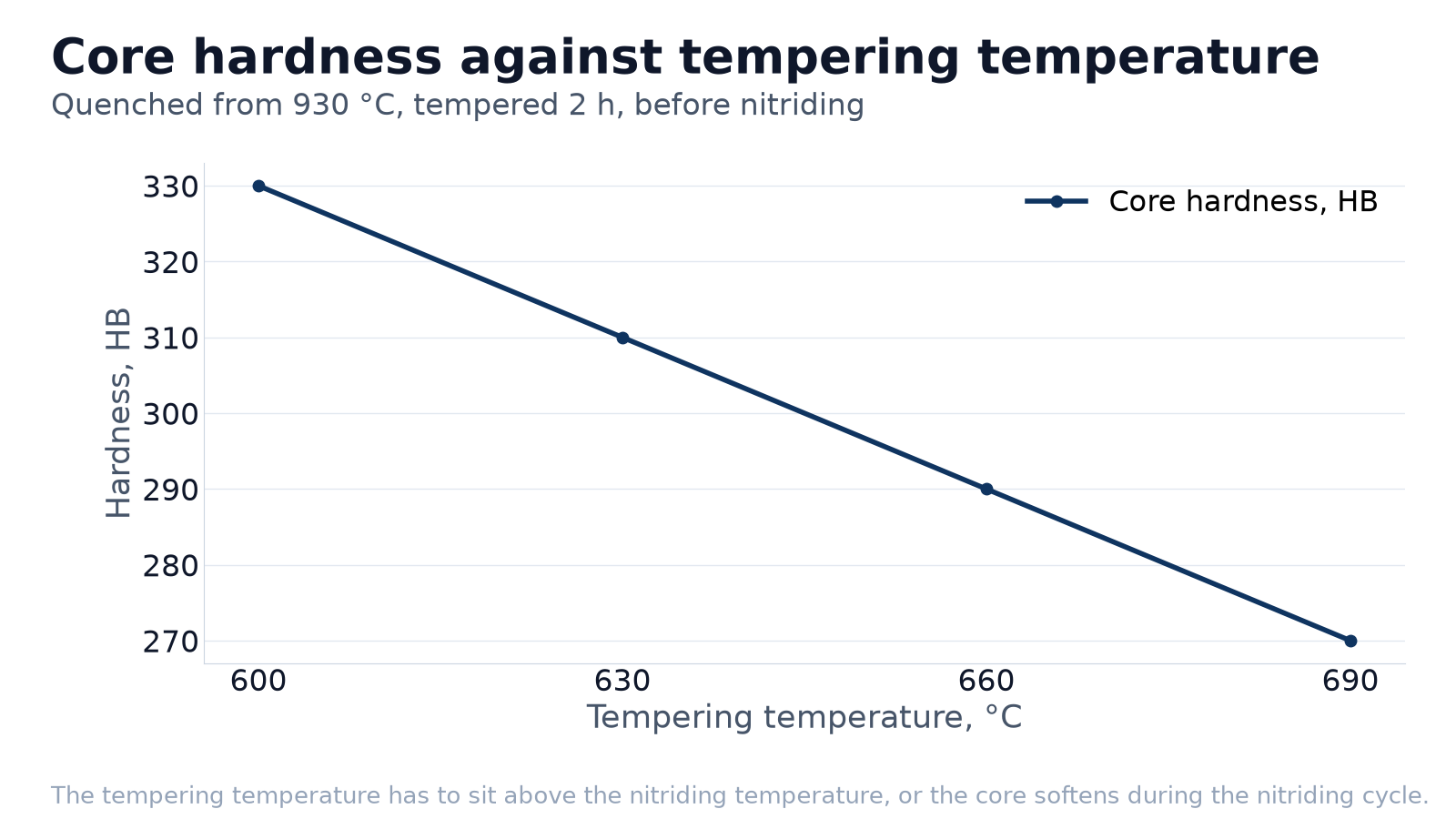
- Running the nitriding temperature above the tempering temperature of the core; the part softens from the inside out.
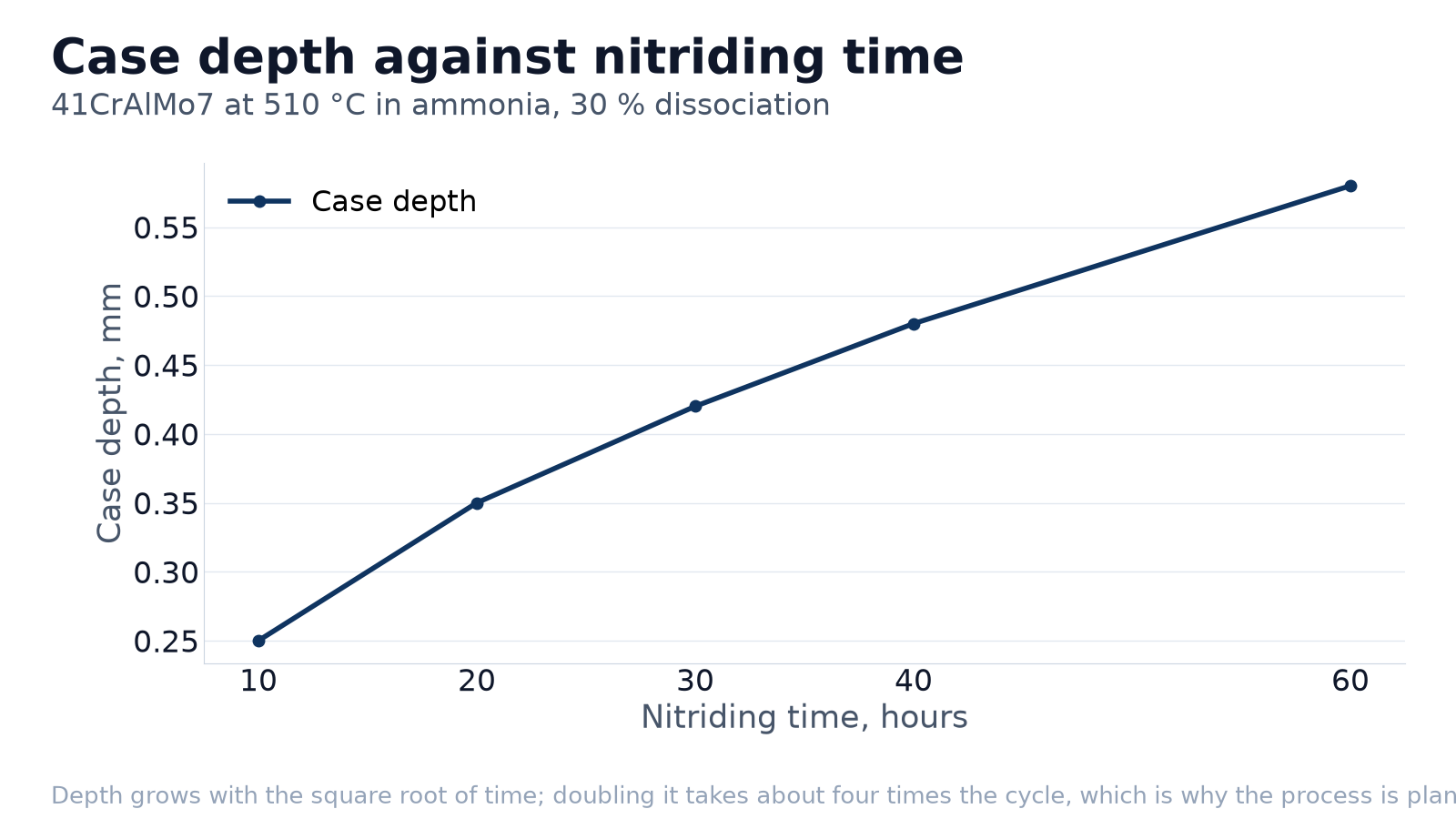
- Expecting a deep case in a short cycle; the growth rate falls off with depth and cannot be accelerated by raising the temperature without losing the core.
Supply Range and Delivery Condition
Supply is quoted in the quenched and tempered condition, ready for machining before nitriding.
Table 1 — Supply range by form, size and delivery condition
| Form | Size range | Delivery condition |
|---|---|---|
| Rolled round bar | Ø 20–300 mm | Quenched and tempered |
| Forged round bar | Ø 150–500 mm | Quenched and tempered |
| Forged flat bar | 100–400 × 300–1,200 mm | Quenched and tempered |
| Plate | 20–150 mm | Quenched and tempered |
The bar is supplied quenched and tempered to 280–320 HB, which is the condition the part is machined in before nitriding. A mill certificate with the tempering temperature is issued so that the nitriding cycle can be set below it.
Chemical Composition
Aluminium, chromium, molybdenum and vanadium are the nitride formers. The carbon range is kept moderate so the core can be quenched and tempered to a tough condition.
Table 2 — Chemical composition, wt. % (single values are maximums unless stated)
| Element | Min | Max | Typical |
|---|---|---|---|
| C | 0.38 | 0.45 | 0.42 |
| Si | 0.20 | 0.45 | 0.30 |
| Mn | 0.50 | 0.80 | 0.65 |
| P | — | 0.025 | 0.015 |
| S | — | 0.025 | 0.010 |
| Cr | 1.50 | 1.80 | 1.65 |
| Mo | 0.25 | 0.40 | 0.30 |
| Al | 0.80 | 1.20 | 1.00 |
Mechanical Properties
Core properties are given for the quenched and tempered condition. The case hardness is a result of the nitriding cycle and is reported separately.
Table 3 — Mechanical properties by condition
| Condition | Rp0.2 (MPa) | Rm (MPa) | A (%) | KV2 (J) | HB |
|---|---|---|---|---|---|
| Quenched and tempered | ≥750 | 950–1,150 | ≥12 | ≥30 | 280–320 |
| Nitrided case | — | — | — | — | 950–1,100 HV |
| Core after nitriding | ≥700 | ≥900 | ≥12 | ≥25 | 260–300 |
Heat Treatment
Harden and temper first, machine to final size, then nitride. The nitriding temperature must stay below the tempering temperature of the core.
Table 4 — Heat treatment schedule
| Step | Temperature | Time / atmosphere | Cooling |
|---|---|---|---|
| Austenitising | 900–950 °C | 30 min per 25 mm | Oil |
| Tempering | 600–680 °C | 2 h per 25 mm | Air |
| Nitriding | 500–530 °C | 24–60 h, ammonia | Furnace cool |
| Stress relief before nitriding | 550–600 °C | 2 h | Furnace cool |
Equivalent Grades and Standards
The European nitriding grades are close to the American Nitralloy family but the aluminium range differs, and that difference sets the achievable case hardness.
Table 5 — Equivalent grades and governing standards
| System | Designation |
|---|---|
| EN | 41CrAlMo7 / 1.8509 |
| DIN | 41CrAlMo7 |
| BS | 905M31 / EN41B |
| AFNOR | 40CAD6.12 |
| GB | 38CrMoAl |
What Ships With Every Lot
- EN 10204 3.1 mill certificate with chemistry and mechanical properties, heat number and melt route.
- Hardness survey and dimensional report on every piece on request.
- Ultrasonic inspection to ASTM A388 or SEP 1921 where the section or the application calls for it.
- Third-party inspection — SGS, BV, TUV — arranged before dispatch, at the customer’s instruction.
- Spectro check on the finished part where a weld or a heat treatment has been added after despatch.
Machining, Welding and Surface Finish
The part is machined after quenching and tempering and before nitriding. Because there is no quench after nitriding, the finished dimensions are the machined dimensions plus the case growth — typically 2–8 µm — which has to be allowed on threads and bores.
Areas that must stay soft are masked with a copper or tin coating. Welding after nitriding is not possible; welding before nitriding requires a stress relief and a check that the weld does not form a brittle nitride zone.
Packing, MOQ and Delivery Terms
Bars are supplied black or peeled, stamped with the heat number and the tempering temperature on the tag. Long parts are protected with VCI paper and supported to avoid bending in transit.
Table 6 — Trade terms, packing and documents
| Item | Standard terms |
|---|---|
| Trade terms | FOB Shanghai / CIF / CFR / EXW; FOB is the default. |
| Minimum order | One bundle, plate or coil for stock sizes; mill runs quoted individually. |
| Lead time | 20–30 days from order confirmation for stock sizes; 30–45 days where forging or heat treatment is included. |
| Payment | 30 % T/T deposit, 70 % against the bill of lading copy; L/C at sight above 20 t. |
| Packing | Seaworthy export packing — crated or strapped, marked with grade, heat number, size and net weight. |
| Documents | EN 10204 3.1 certificate, packing list, invoice, bill of lading, certificate of origin; legalisation on request. |
Frequently Asked Questions
What is the difference between 41CrAlMo7 and 31CrMoV9?
Both are nitriding steels. 41CrAlMo7 carries aluminium and reaches a harder case (950–1,100 HV); 31CrMoV9 has no aluminium, reaches about 750–900 HV and is tougher.
How deep is the nitrided case?
0.3–0.6 mm for a 24–60 h cycle at 510 °C. The table above gives the depth against time.
Does the part distort during nitriding?
Only by the case growth of a few microns, because there is no quench. That is the reason the grade is chosen for finished parts.
Can it be welded?
Before nitriding, with preheat and a post-weld stress relief. After nitriding, no — the case cracks.
What core hardness is supplied?
280–320 HB after quenching and tempering; the exact tempering temperature is on the certificate.
Related Grades
Browse the full range: alloy structural steel grades.
Request a Quote
- Grade and governing standard
- Form, size and quantity
- Delivery condition and hardness
- Certificate and testing requirements
- Destination port and required date
Email [email protected] or use the form below. Drawings in DXF, STEP or PDF are all fine. Stock sizes ship within 20 days of order confirmation.