
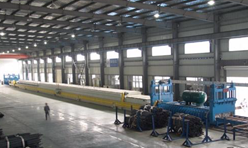
Spheroidizing Annealing
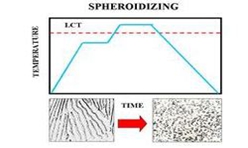
Spheroidizing Annealing
Spheroidize Annealing
Spheroidize annealing is applicable to steels which have more than 0.8% carbon. Parts are heated to between 1150°F and 1200°F and holding it at this temperature for a period of time to convert the microstructure. Essentially, cementite changes from a lamella formation to an alpha ferrite matrix with particles of spheroidal cementite (Fe3C). Spherodize annealing is generally done on parts which have been work hardened, to allow them to be further worked, either rolled in the case of coils, or drawn for wire. This resulting product has improved ductility and toughness with reduced hardness and strength. Spherodize annealing is normally carried out under a protective (endothermic) atmosphere to prevent oxidation and decarburization.
We can supply follows heat treatment services:
Normalizing, Annealing, Quenching, Tempering, Carburizing, Nitriding, High-frequency surface hardening and other processing services.
And we can strictly enforce the national standards.
And we have follows heating equipment:
Pit furnace: Dia1300mm max, Length9500mm max.
Salt bath furnace: Length1900mm max, Width1600mm max, Height900mm max.
Trolley furnace: Legth15000mm max, Width6000mm max, Height6000mm max.
Tunnel type continuous reheating furnace:dia30mm-dia250mm
Induction quenching line: dia15mm-dia120mm
Normalizing cooling fan can be used in combination of wind capacity air-cooled systems.
Why spheroidise at all
In the annealed condition, high-carbon steel carries its carbon as lamellar cementite — platelets stacked in layers. Lamellae are hard and abrasive, which is good for a cutting tool and bad for everything that happens before it. Machining a lamellar structure wears tools quickly, and cold drawing or rolling it produces cracks because the platelets act as internal notches.
Spheroidising converts those platelets into rounded particles of cementite in a ferrite matrix. The steel becomes softer, far more ductile, and — counter-intuitively — often machines better at a slightly higher hardness, because the chips break cleanly instead of smearing.
The three routes
| Route | Temperature | Typical cycle | Used for |
|---|---|---|---|
| Subcritical anneal | 620–700 °C, below A1 | Long hold, slow cool | Simple, low distortion, widely used |
| Isothermal | Austenitise, then hold at 680–720 °C | Faster than subcritical | Production volumes, tighter control |
| Cyclic | Repeated cycles across A1 | Several short cycles | Refractory and heavily banded structures |
The 1150–1200 °F figure earlier on this page is 620–650 °C — the subcritical route. It is the one that produces the least distortion, which matters for finished or near-finished parts.
What good spheroidisation looks like
The result is assessed metallographically, not by hardness alone. A well spheroidised 52100 shows rounded carbides uniformly distributed in the ferrite; a poor one still shows lamellae or a mixed network. Standard rating charts (SEP 1520, or the ASTM charts used by bearing makers) grade the structure, and bearing customers typically specify a minimum percentage of spheroidised carbide.
Hardness is the shop-floor proxy: 52100 spheroidised anneals to about 190–210 HB. If the hardness comes out right but the structure is lamellar, the machining will still be poor.
What goes wrong
Incomplete spheroidisation. Usually from too short a hold at temperature or a cooling rate that is too fast. The part measures soft enough but machines badly and cracks during cold forming.
Carbide banding. Inherited from the casting and rolling, not created by the anneal. Bands of carbide make the properties directional; a heavy band cannot be removed by annealing and has to be controlled at the mill, by reduction ratio and by homogenising.
Decarburisation. A long anneal in an uncontrolled atmosphere burns carbon out of the surface. For a bearing or a die, that soft skin has to be removed by grinding.
Which grades are spheroidised
Bearing steels (52100, GCr15), cold work tool steels (D2, Cr12MoV, 1.2083), high-carbon spring and wire grades, and any steel above about 0.8 % carbon that will be drawn, cold rolled or heavily machined. Below 0.6 % carbon the lamellar structure is not the main problem, and a normal anneal is usually enough.
You get chemical composition, mechanical properties and a price — with inspection certificates to EN 10204 3.1 issued against the heat number.