
Spring Steel Strip and Plate
Cold rolled strip from 0.1 to 6.0 mm thick and up to 1650 mm wide, in seven spring grades. Supplied annealed for forming, or hardened and tempered to final hardness so the part needs no heat treatment after it is stamped. The grade, the edge and the delivery condition decide whether the spring survives — not the tensile figure on the certificate.
At a glance
Table 1 — spring steel at a glance
| Item | Detail |
|---|---|
| Grades | 55 / 65 / 70 / 75 / 85, 65Mn, 60Si2Mn, 50CrVA — see the cross-reference below |
| Standards | DIN 17222; EN 10132; GB/T 1222 |
| Delivery condition | Cold rolled, annealed (G), annealed and re-rolled (G+K), or hardened and tempered (H+A) |
| Supply range | Thickness 0.1–6.0 mm × width up to 1650 mm |
| Surface | Grey blue (GR), bright (BK), polished (P), polished and colour tempered (P+AF) |
| Certificate | EN 10204 3.1 with chemistry, mechanical properties and hardness |
Why annealed or tempered is the first decision
This is the specification decision that causes the most rework. Annealed strip is soft, formable, and must be hardened after the spring is wound or stamped — which means distortion and an extra heat treatment step. Hardened and tempered strip arrives at final hardness (typically 42–48 HRC for clock-type springs), can be formed and used without further treatment, but will crack if bent sharply.
If the design has tight radii, buy annealed and harden after forming. If the design is a simple profile and the volume is high, buy tempered strip and accept the forming limits.
A spring strip slit from wide coil has a sheared edge with micro-cracks running into the section. Under fatigue those edges are where the crack starts. Dressed or rounded edges cost more per kilogram and routinely double the fatigue life of a stamped spring. Buyers who change grade to fix a fatigue problem, without changing the edge, usually see no improvement.
Where spring steel orders go wrong
- Buying tempered strip and then forming a tight radius — the strip cracks at the bend.
- Specifying 45 HRC without the tempering temperature; 45 HRC from 400 °C and from 500 °C are different springs.
- Ignoring edge condition — a sheared edge carries micro-cracks into the fatigue section.
- Assuming annealed strip has no decarburisation; it must be measured, not assumed.
When spring steel is the wrong grade
Spring steel strip is not a corrosion material. For food, marine or chloride service use 301 or 302 stainless and accept the lower strength. Above 250 °C the tempered grades sag; use 50CrVA or a stainless spring grade.
Supply range and delivery condition
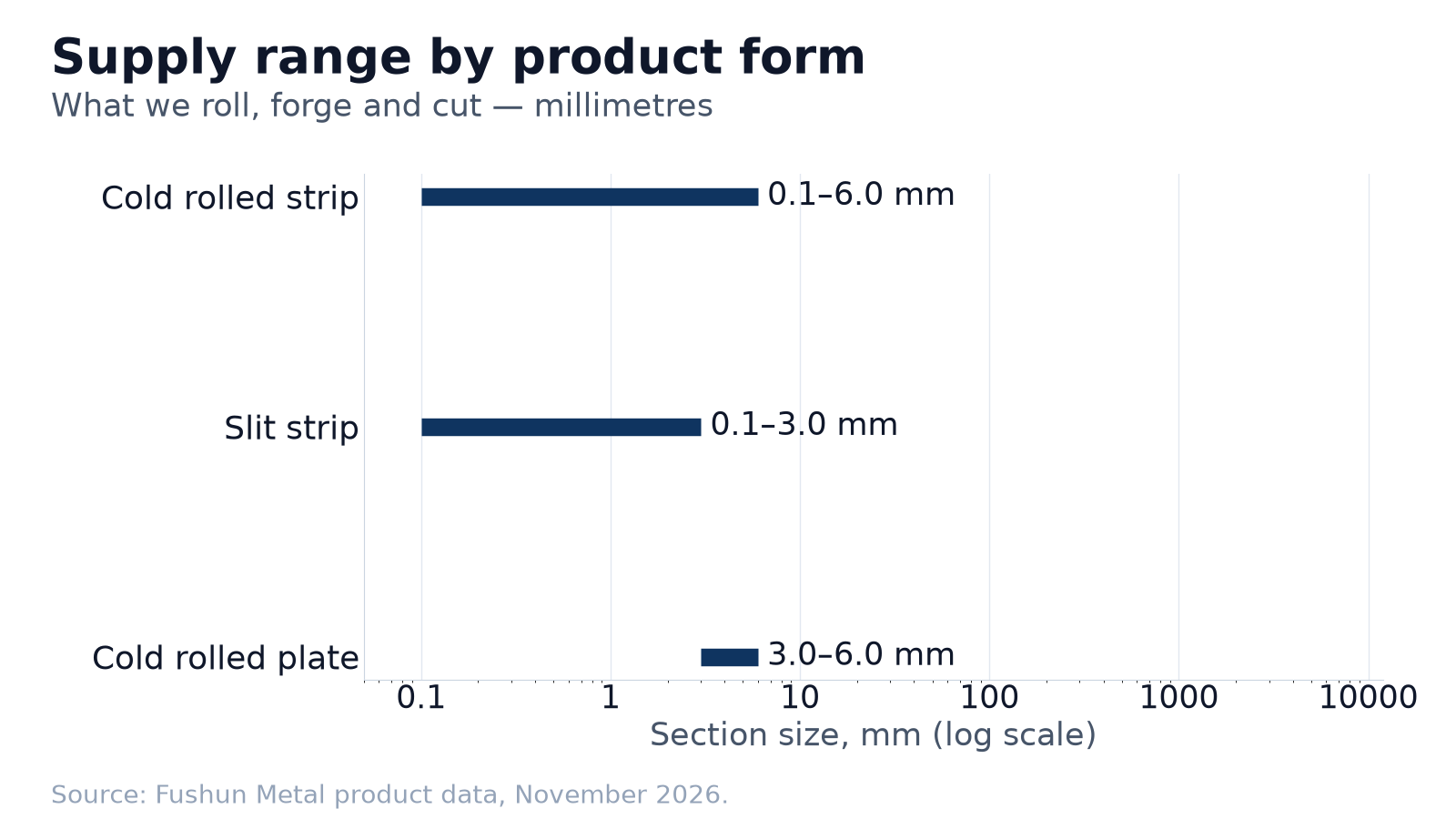
Table 2 — Supply range by form and delivery condition
| Form | Size range | Condition |
|---|---|---|
| Cold rolled strip | Thickness 0.1–6.0 mm × width up to 1650 mm | Annealed / tempered |
| Slit strip | Thickness 0.1–3.0 mm × width from 8 mm | As slit, deburred on request |
| Cold rolled plate | Thickness 3.0–6.0 mm × width up to 1250 mm | Annealed |
Widths above 1250 mm are rolled to order. Slit edges are sheared unless a dressed or rounded edge is specified — see the note on edge condition below.
Chemical composition
Table 3 — Chemical composition (wt. %), balance Fe
| Grade | C | Mn | Si | P | S | Cr | V |
|---|---|---|---|---|---|---|---|
| 55 | 0.52–0.60 | 0.50–0.80 | 0.17–0.37 | ≤0.035 | ≤0.035 | ≤0.25 | / |
| 65 | 0.62–0.70 | 0.50–0.80 | 0.17–0.37 | ≤0.035 | ≤0.035 | ≤0.25 | / |
| 70 | 0.62–0.75 | 0.50–0.80 | 0.17–0.37 | ≤0.035 | ≤0.035 | ≤0.25 | / |
| 75 | 0.72–0.80 | 0.50–0.80 | 0.17–0.37 | ≤0.035 | ≤0.035 | ≤0.25 | / |
| 85 | 0.95–1.04 | ≤0.40 | ≤0.35 | ≤0.025 | ≤0.025 | / | / |
| 65Mn | 0.62–0.70 | 0.90–1.20 | 0.17–0.37 | ≤0.035 | ≤0.035 | ≤0.25 | / |
| 60Si2Mn | 0.56–0.64 | 0.70–1.00 | 1.50–2.00 | ≤0.035 | ≤0.035 | ≤0.35 | / |
| 50CrVA | 0.46–0.54 | 0.50–0.80 | 0.17–0.37 | ≤0.025 | ≤0.025 | 0.80–1.10 | 0.10–0.20 |
Heat analysis per the grade table on this page; product analysis tolerances apply.
Why the certificate carries five designations
Table 4 — Grade cross-reference
| GB | ASTM | JIS | EN | DIN |
|---|---|---|---|---|
| 55 | 1055 | / | CK55 | 1.1204 |
| 60 | 1060 | / | CK60 | 1.1211 |
| 70 | 1070 | / | CK67 | 1.1231 |
| 75 | 1075 | / | CK75 | 1.1248 |
| 85 | 1086 | SUP3 | CK85 | 1.1269 |
| 65Mn | 1066 | / | / | / |
| 60Si2Mn | 9260 | SUP6 / SUP7 | 61SiCr7 | 60SiCr7 |
| 50CrVA | 6150 | SUP10A | 51CrV4 | 1.8159 |
The same strip is bought and sold under all five systems. Put the designation you need on the purchase order; the 3.1 certificate carries it.
Mechanical properties
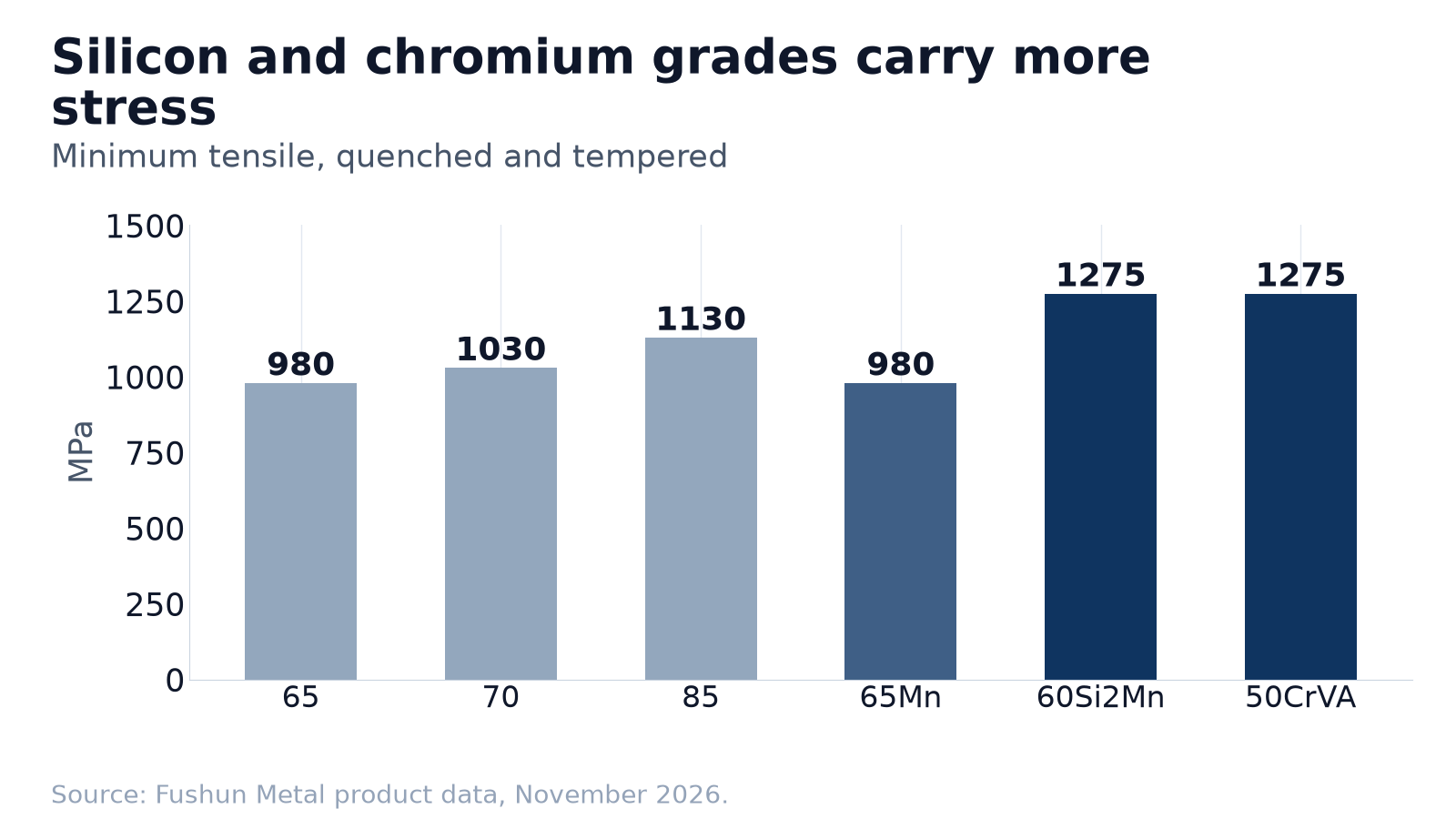
Table 5 — Mechanical properties
| Grade | Tensile Rm | 0.2 % proof | Elongation A5 | Reduction of area |
|---|---|---|---|---|
| 65 | ≥980 MPa | ≥785 MPa | ≥9 % | ≥35 % |
| 70 | ≥1030 MPa | ≥835 MPa | ≥8 % | ≥30 % |
| 85 | ≥1130 MPa | ≥980 MPa | ≥6 % | ≥30 % |
| 65Mn | ≥980 MPa | ≥785 MPa | ≥8 % | ≥30 % |
| 60Si2Mn | ≥1275 MPa | ≥1180 MPa | ≥5 % | ≥25 % |
| 50CrVA | ≥1275 MPa | ≥1130 MPa | ≥10 % | ≥40 % |
Quenched and tempered condition, tested at 20 °C. These are minimums for the grade, not a promise for every thickness.
Heat treatment
Table 6 — Heat treatment schedule
| Grade | Quenching °C | Medium | Tempering °C |
|---|---|---|---|
| 65 | 840 | Oil | 500 |
| 70 | 830 | Oil | 480 |
| 85 | 820 | Oil | 480 |
| 65Mn | 830 | Oil | 540 |
| 60Si2Mn | 870 | Oil | 480 |
| 50CrVA | 850 | Oil | 500 |
Tempering temperature is set by the hardness the part needs, not by the grade alone; every 40 °C roughly halves the retained strength. Oil quench throughout — these grades crack in water at strip thickness.
Why 65Mn is not 60Si2Mn
The grade table tells you what is available. It does not tell you which one the spring needs. Three questions decide it: the stress level, the environment, and whether the part is formed before or after hardening.
Table 7 — Grade selection by duty
| Duty | Grade | Why |
|---|---|---|
| General purpose, low cost | 65Mn / 1065 | Cheap and adequate for static or lightly loaded springs |
| Higher stress, good fatigue | 60Si2Mn / 9260 | Silicon raises the elastic limit and the fatigue resistance |
| Valve springs, elevated temperature | 50CrVA / 6150 | Chromium and vanadium resist softening where plain silicon grades sag |
| Severe fatigue, shock loading | 50CrVA / 6150 | Vanadium refines the grain and widens the tempering window |
| Corrosion or food contact | 301 / 302 stainless | Sacrifices strength for corrosion resistance |
What ships with every lot
- EN 10204 3.1 mill certificate — chemistry, tensile, proof stress, elongation and hardness, against the heat number
- Thickness and width report; crown and flatness measured across the coil
- Hardness traverse across the width on tempered strip, on request
- Decarburisation depth check on hardened and tempered strip
- Edge condition declaration — sheared, dressed or rounded
Packing and delivery
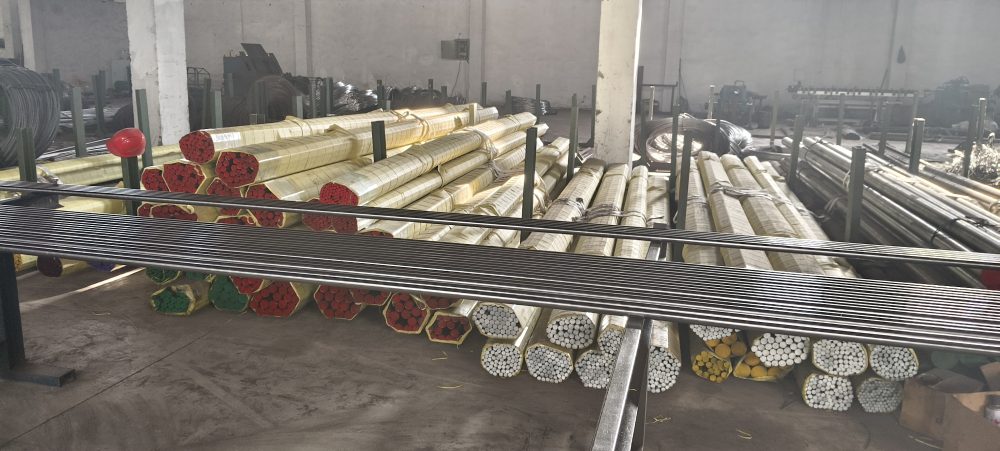
Strip travels on wooden pallets or in crates, coil eye vertical, wrapped in VCI paper and strapped. Each coil is labelled with grade, heat number, thickness, width, weight and delivery condition, matching the 3.1 certificate inside the crate.
Typical lead time is 20–30 days for stock thicknesses, 30–45 days for tempered strip or non-standard widths. Loading from Shanghai, Qingdao or Shenzhen.
Table 8 — Trade terms, packing and documents
| Item | Standard terms |
|---|---|
| Trade terms | FOB Shanghai, Qingdao or Shenzhen; CIF and CFR quoted against the destination port |
| Minimum order | One coil for stock sizes; mill runs from 3 t per width |
| Lead time | 20–30 days for stock; 30–45 days where tempering, slitting or edge dressing is included |
| Payment | T/T 30 % advance, 70 % against the bill of lading copy; irrevocable L/C at sight above 20 t |
| Packing | Seaworthy export packing — crated or strapped, marked with grade, heat number, size and net weight. |
| Documents | 3.1 certificate, packing list, invoice, bill of lading, certificate of origin |
Frequently asked questions
What is the difference between annealed and tempered spring strip?
Annealed strip is soft and formable but has to be hardened after the spring is made. Tempered strip arrives at 42–48 HRC, needs no further treatment, and will crack if it is bent sharply. Tight radii point to annealed; simple profiles and high volume point to tempered.
Which grade should I use for a valve spring?
50CrVA / 51CrV4 / 6150. Chromium and vanadium hold hardness where the plain silicon grades sag, and the wider tempering window gives the springmaker room to tune the load without losing fatigue life.
What is the maximum strip width?
1650 mm at 0.1–6.0 mm thickness. Above 1250 mm the strip is rolled to order rather than cut from stock coil.
Does edge condition really change fatigue life?
Yes. A sheared edge carries micro-cracks into the section and that is where fatigue cracks start. Dressed or rounded edges cost more per kilogram and commonly double the life of a stamped spring — cheaper than moving to a higher grade.
What condition and certificate ship with the order?
Cold rolled and annealed as standard, or hardened and tempered to your hardness window. Every lot ships with an EN 10204 3.1 certificate; hardness traverses and decarburisation checks are added on request.
Request a quote
Send these five lines and we quote within one working day
- Grade — 65Mn, 60Si2Mn or 50CrVA, or the performance you need and we will pick
- Thickness × width, and coil weight or cut length
- Delivery condition — annealed, annealed and re-rolled, or hardened and tempered with the hardness window
- Edge — sheared, dressed or rounded
- Certificate and inspection — 3.1 as standard, hardness traverse on request
Email [email protected] or use the form below. Drawings in DXF, STEP or PDF are all fine.