The difference between carbon steel wire and piano wire
- Carbon spring steel wire
Carbon spring steel wire is the selection of high-quality carbon steel coils, isothermal quenching by the lead bath and then cold-dialed to strengthen and become. There are three groups by purpose
Group B: for general springs and other uses
Group C: for low-stress springs
Group D: For high stress springs
- Piano wire
Piano wire is selected with piano wire disc, quenched in a lead bath at room temperature made of pulls, according to its use can be divided into three groups
Group C1: Springs for various critical applications
Group C2: For various types of high stress springs
Group F: for valve springs
High carbon steel spring wire (SWC) gin wire (SWP-B) chemical composition table
Chemical composition of high carbon steel (SWC) (%)
Carbon (C) Silicon (Si) Manganese (Mn) Phosphorus (P) Sulfur (S)
0.69-0.70 0.15-0.35 0.60-0.90 0.03 0.03
Chemical composition of piano wire (SWP-B) (%)
Carbon (C) Silicon (Si) Manganese (Mn) Phosphorus (P) Sulfur (S) Copper (Cu)
0.80-0.85 0.12-0.32 0.30-0.60 0.025 0.025 0.20
Piano wire is also known as piano wire, belongs to high carbon steel.
Chinese standard: GB4358
American Standard: ASTM A228
Japanese Standard: JIS G 3522
Material composition:C:0.80-0.85 Si:0.12-0.32 Mn:0.3-0.6 P:below 0.025 S:below 0.025 Cu:below 0.2
The hardness range is 41-60 and the allowable temperature is 120°.
Piano wire is quenched by the lead bath cold-drawn from a very high strength limit and elastic limit, is widely used small spring material. Wire quality, performance requirements are strict, in addition to the tensile test, but also for torsion, corrosion, sharp carbon and other tests. According to the use can be divided into the manufacture of a variety of important spring, a variety of high stress and mechanical spring and latching door spring piano wire used.
SWPA and SWPB are piano wire
Specification number: JIS G 3522
Material composition:C:0.80-0.85 Si:0.12-0.32 Mn:0.3-0.6 P:below 0.025 S:below 0.025 Cu:below 0.2
The hardness range is 41-60.
Allowable temperature is 120°.
Different toughness and tensile strength
SWPB is higher.
What the carbon buys
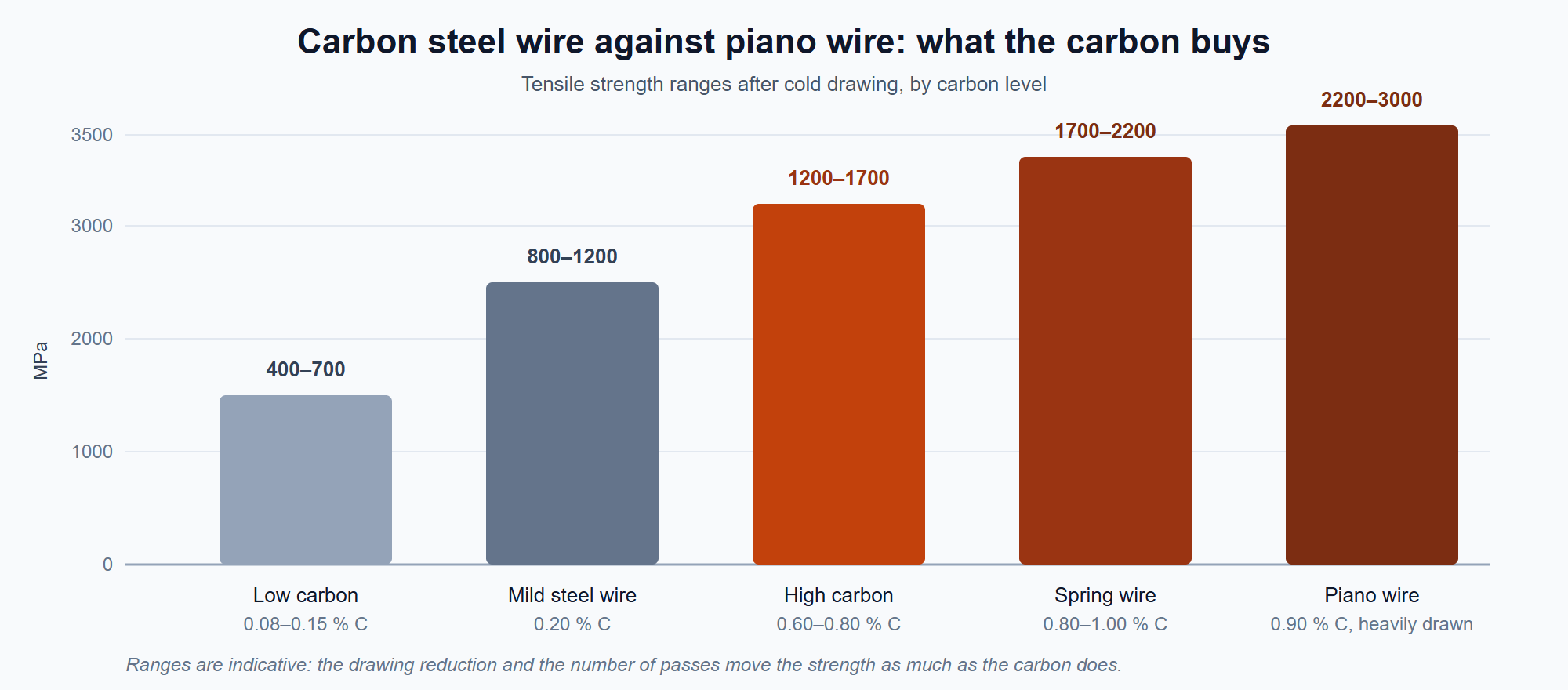
The difference between a fencing wire and a piano wire is mostly carbon, and then drawing. At 0.08–0.15 % carbon the wire is soft and bends easily; at 0.9 % the same wire, drawn down, will hold 2,500–3,000 MPa and return to shape after being coiled around itself.
That strength is not in the steel as delivered — it is put there by cold drawing. Each pass through a die reduces the diameter, increases the length, and work-hardens the metal. A piano wire is the result of a long sequence of passes, not a different heat.
Drawing matters as much as chemistry
Two mills can start from the same 0.9 % carbon rod and produce wires 300 MPa apart, because the strength depends on total reduction, the number of passes, the die angle and whether the wire was patent annealed between passes. Patenting — heating to austenite and cooling through a lead or air bath to fine pearlite — is what makes heavy reduction possible without the wire breaking.
That is why a wire specification has to state the process as well as the analysis: “0.9 % C, 2,500 MPa” without a drawing route is not a specification.
Where each grade is used
| Wire | Carbon | Typical use |
|---|---|---|
| Low carbon | 0.08–0.15 % | Binding wire, mesh, nails, welding wire |
| Mild steel | 0.20 % | General fabrication, galvanised mesh |
| High carbon | 0.60–0.80 % | Springs, brush bristles, rope |
| Piano wire | 0.90 % | Music wire, surgical needles, control cables |
You get chemical composition, mechanical properties and a price — with inspection certificates to EN 10204 3.1 issued against the heat number.