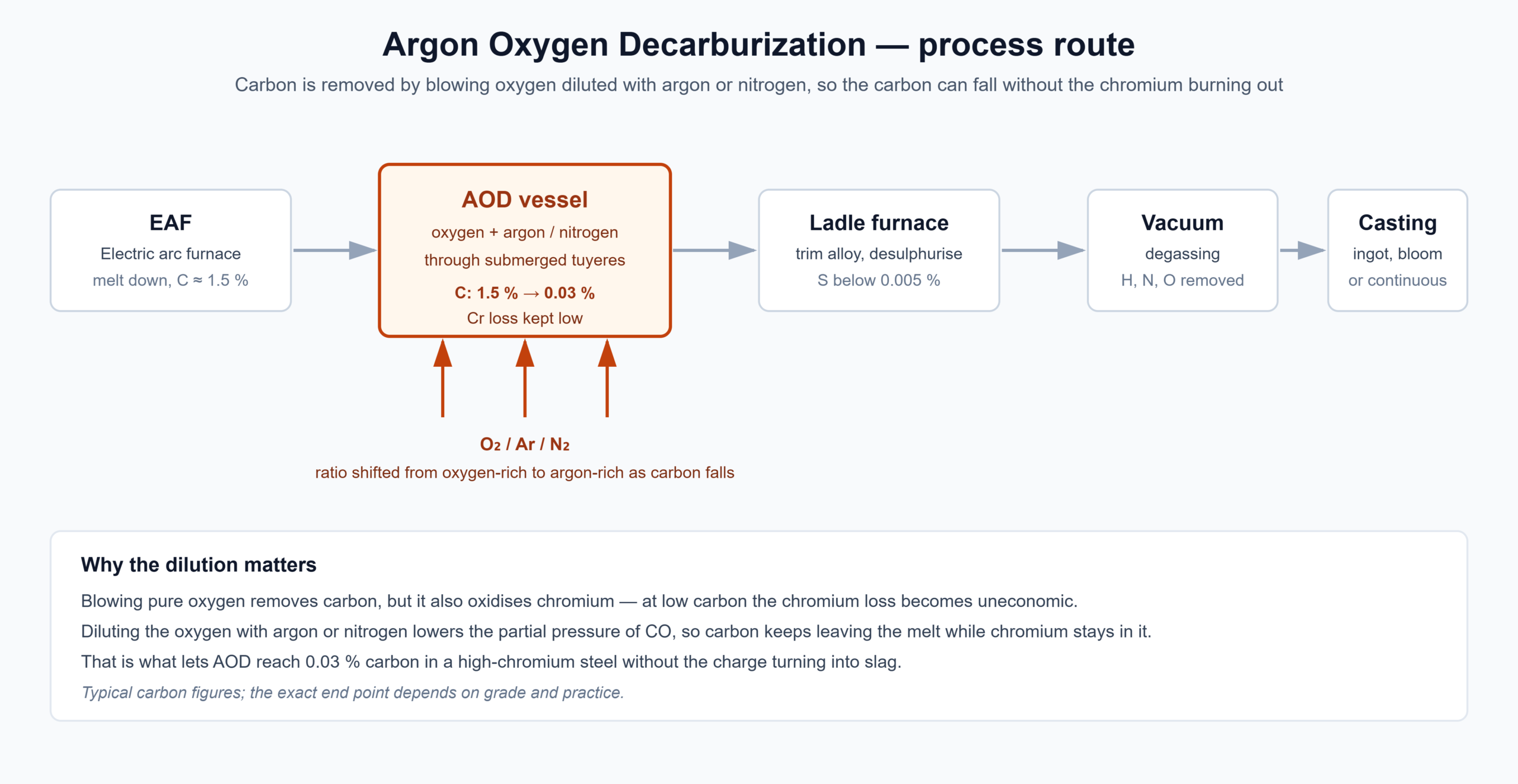
Argon oxygen decarburization — AOD — is the refining step that makes a high-chromium melt behave. Melting scrap and alloys in an electric furnace gets you the chemistry, but not the carbon level. AOD is where the carbon comes out without taking the chromium with it, and where the nitrogen and sulphur levels that modern duplex and super austenitic grades depend on are actually set.
Why a high-chromium melt needs AOD at all
Carbon and chromium compete for the same oxygen. Blow oxygen into a chromium-bearing melt and both oxidise: the carbon leaves as CO, but chromium leaves as slag. At high carbon the carbon wins easily; below about 0.5 % carbon the chromium loss becomes the dominant reaction, and the heat turns into slag.
That is the wall AOD breaks through. By diluting the oxygen with argon or nitrogen, the partial pressure of CO above the melt drops, the carbon reaction stays favourable, and the carbon can be driven down to 0.03 % or lower while chromium recovery stays close to 100 %.
What happens inside the vessel
The vessel itself is a refractory-lined shell with tuyeres below the bath level, typically in the side wall near the bottom. Blowing through the melt rather than onto it does three things: it creates strong stirring, it gives intimate slag–metal contact for desulphurisation, and it lets the gas composition be changed during the heat.
A typical sequence starts oxygen-rich to burn off carbon quickly, then shifts progressively to argon-rich as the carbon falls — the ratio follows the carbon, not the other way round. Silicon and aluminium are added at the end to reduce the oxidised chromium, iron and manganese back out of the slag, which is where the near-total metallic recovery comes from.
What it buys the buyer
- Low carbon without giving up chromium — the 316L and 316LN grades exist because AOD can hold carbon under 0.03 % in a steel that is 17 % chromium.
- Nitrogen control — nitrogen can be alloyed deliberately rather than left to chance, which is the basis of 2205, 2507 and the super austenitic grades. Without it the specified nitrogen range is not achievable on a commercial basis.
- Low sulphur — the stirring and slag contact take sulphur below 0.005 %, which matters for impact toughness and for welding.
- Cleanliness — dissolved gases and oxide inclusions drop, so the mechanical properties improve beyond what the chemistry alone would predict: better reduction of area, better impact, more consistent ultimate strength.
- Weldability — lower silicon and lower sulphur mean fewer weld defects and, in some fabrications, less filler metal consumed.
Where it shows up in the grades we supply
The grades that cannot be made properly without AOD are the ones with a narrow window between carbon, nitrogen and chromium: duplex and super duplex (2205, 2507, 1.4501), super austenitic (254SMO, 654SMO, AL-6XN, Alloy 31), the low-carbon austenitics (316L, 316LN, 1.4404) and the precipitation hardening grades where carbon has to be kept low for the ageing response to work.
A mill certificate that states “AOD refined” is telling you something specific: the carbon, nitrogen and sulphur figures on that certificate were achieved by refining, not by diluting the charge with expensive low-carbon scrap.
What to ask before you buy
- Was the heat AOD refined, and is the melting route stated on the certificate?
- What are the actual carbon, nitrogen and sulphur figures — not just “conforms”?
- For duplex grades, is the nitrogen in the specified range, and was it measured or calculated?
- Is there a gas analysis (oxygen, hydrogen, nitrogen) for critical forgings?
The answer separates a mill that refines from one that simply melts and blends.