
Only three metals are magnetic at room temperature: iron, cobalt and nickel. Everything else — aluminium, copper, brass, titanium, zinc, lead, gold, silver, magnesium — is not. That is the short answer. The useful part is why, and it explains a set of traps that catch buyers and inspectors every week.
The three ferromagnetic metals, and why they are the only ones
Magnetism at the atomic scale depends on unpaired electrons. Iron, cobalt and nickel each have an electron shell that leaves unpaired spins, and in the right crystal structure those spins line up with their neighbours instead of cancelling. The result is a domain that behaves like a tiny magnet, and a material made of such domains responds to a magnet.
Gadolinium is the fourth, but only below about 20 °C, which is why it never appears in commercial metalwork. The strong permanent magnets in motors and speakers are not any of these metals in pure form — they are alloys and compounds of rare earths with iron or cobalt, engineered for a much higher coercivity than the metals themselves have.
What is not magnetic
| Metal | Magnetic? | Note |
|---|---|---|
| Aluminium | No | Commonly mistaken for magnetic because it is light and “metal-like” |
| Copper, brass, bronze | No | Copper alloys are entirely non-magnetic |
| Titanium | No | Non-magnetic, which matters for medical and aerospace fixtures |
| Zinc, lead, tin | No | — |
| Gold, silver, platinum | No | Precious metals are not ferromagnetic |
| Magnesium | No | — |
A magnet is a quick way to separate steel from aluminium on a scrap pile. It is not a way to identify which steel you have — that is a different question, and the answer is not on the magnet.
The trap: steel is not always magnetic
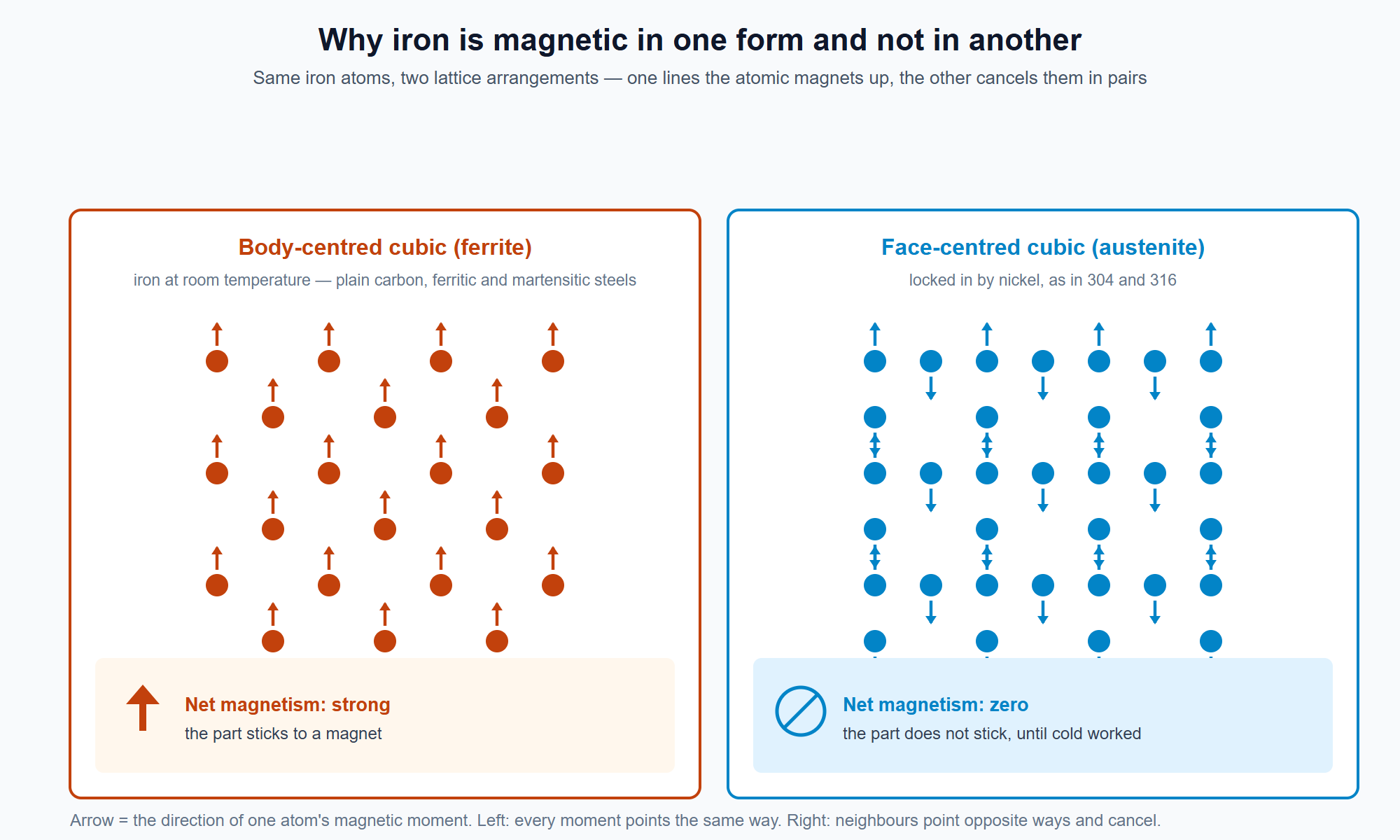
Iron is magnetic as ferrite, the body-centred structure it has at room temperature. Heat it above about 912 °C and it becomes austenite, a face-centred structure in which the atomic magnets pair up and cancel — non-magnetic. Cool it back and it reverts.
Add enough nickel and the austenite survives at room temperature. That is exactly what 304 and 316 stainless are: iron that has been locked into the non-magnetic structure. It is why a stainless fastener will not hold on a magnetic jig, and why “stainless” and “non-magnetic” get treated as the same thing when they are not.
For the full picture of which stainless grades are magnetic and which are not — including why cold-worked 304 becomes slightly magnetic — see which types of stainless steel are magnetic.
Where this matters commercially
- Scrap sorting — a magnet separates ferrous from non-ferrous quickly, with the stainless caveat above.
- Welding and fixturing — magnetic clamps hold carbon steel and ferritic stainless but drop austenitic stainless.
- Instruments and sensors — non-magnetic is a written requirement in MRI equipment and sensitive electronics, and it is a grade requirement, not something to test for at goods-in.
- Disputes — “the magnet sticks, so it is not stainless” is the most common wrong argument in a delivery inspection. The steel can be perfectly correct and still stick, if it has been cold worked.
Related reading
- Which types of stainless steel are magnetic — the family-by-family answer, and the cold-working effect.
- P550 non-magnetic steel — the grade used for drill collars where magnetism must be absent.
- Non-magnetic forged retaining rings — generator applications.