
- Chemical Composition: The chemical composition of S7 tool steel is as follows:
- Carbon (C) – 0.45-0.55%
- Silicon (Si) – 0.20-0.50%
- Manganese (Mn) – 0.20-0.80%
- Chromium (Cr) – 3.00-3.50%
- Molybdenum (Mo) – 1.30-1.80%
- Vanadium (V) – 0.15-0.35%
- Phosphorus (P) – 0.030% max
- Sulfur (S) – 0.030% max
- Hardness: The hardness of S7 tool steel ranges from 54-60 HRC (Rockwell hardness).
- Toughness: S7 tool steel exhibits excellent toughness, making it ideal for high-stress applications that require resistance to shock and impact.
- Wear Resistance: S7 tool steel exhibits excellent wear resistance due to its high carbon and chromium content, making it ideal for applications that require resistance to abrasion and wear.
- Dimensional Stability: S7 tool steel exhibits good dimensional stability, meaning it maintains its shape and size even under high stress or pressure.
- Forging Dies: S7 tool steel is widely used in the manufacturing of forging dies, which are used to shape and form metal under high pressure and temperature. Its high toughness and wear resistance make it ideal for this application.
- Stamping Dies: S7 tool steel is also used in the manufacturing of stamping dies, which are used to cut and shape metal into specific shapes and sizes. Its high hardness and wear resistance make it ideal for this application.
- Extrusion Dies: S7 tool steel is used in the manufacturing of extrusion dies, which are used to shape and form plastics and metals under high pressure and temperature. Its high wear resistance and toughness make it ideal for this application.
- High Shock Resistance: S7 tool steel exhibits high shock resistance, making it ideal for applications that involve high stress and impact.
- Good Wear Resistance: S7 tool steel exhibits good wear resistance, making it ideal for applications that involve high levels of abrasion and wear.
- Excellent Toughness: S7 tool steel exhibits excellent toughness, making it ideal for applications that require resistance to shock and impact.
- Good Dimensional Stability: S7 tool steel exhibits good dimensional stability, meaning it maintains its shape and size even under high stress or pressure. This makes it an ideal material for applications that require high precision and accuracy.
What S7 is for
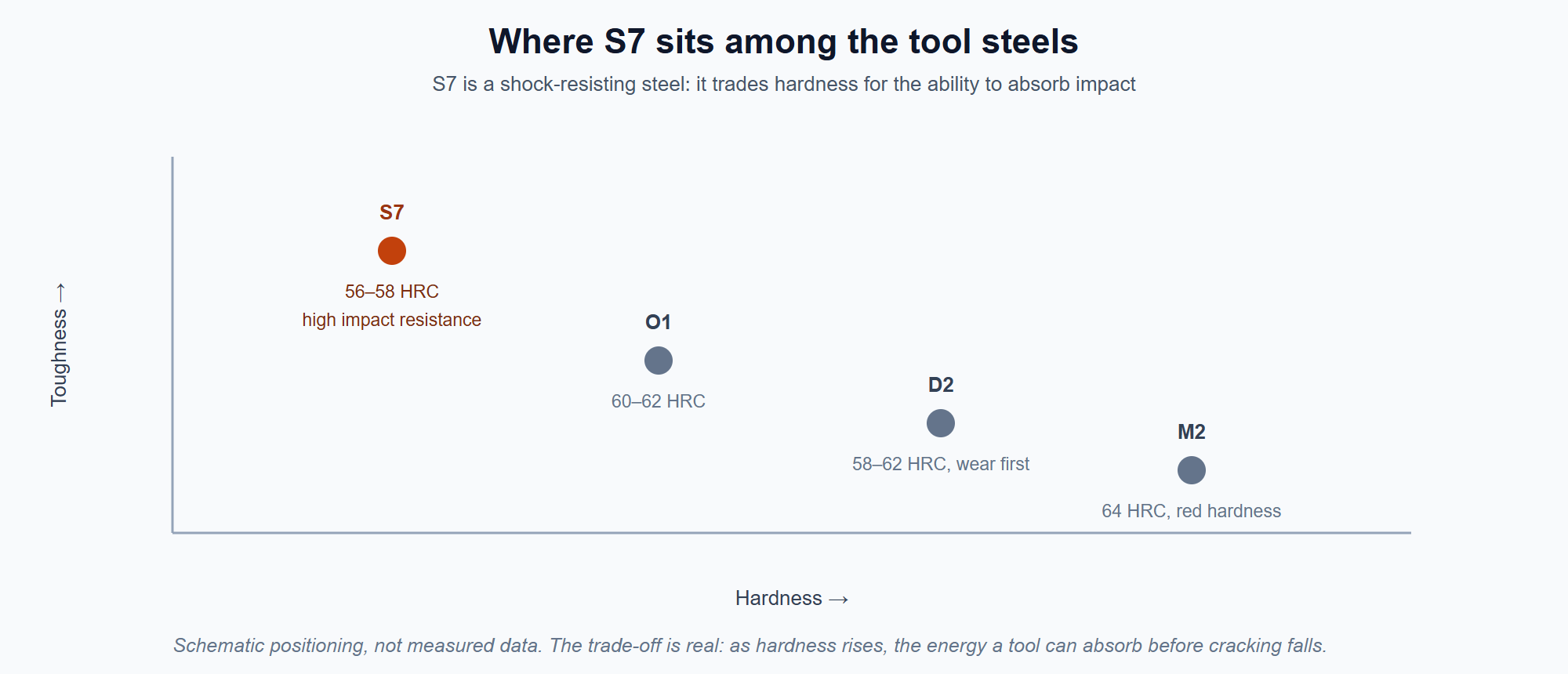
S7 is a shock-resisting tool steel: about 0.5 % carbon with chromium and molybdenum, hardened to 56–58 HRC. It is not the hardest tool steel available, and it is not meant to be. It is the grade you specify when the tool has to absorb impact without chipping or cracking.
That makes it the choice for pneumatic chisels, shear blades, punches under shock load, and dies that see hammer blows rather than steady pressure.
The trade it makes
| Grade | Hardness | Character |
|---|---|---|
| S7 | 56–58 HRC | Highest impact resistance in the group |
| O1 | 60–62 HRC | Oil hardening, balanced |
| D2 | 58–62 HRC | Wear resistance first, brittle under impact |
| M2 | 64 HRC | Red hardness, for cutting at speed |
As hardness rises, the energy a tool can absorb before cracking falls. S7 sits deliberately lower on that curve.
Heat treatment and the one caution
S7 hardens from about 940 °C and tempers at 200–540 °C depending on the toughness required. It is deep hardening and reasonably forgiving, but it is not stainless: without a coating or oil film it will rust, and a rusted impact tool is a cracked impact tool waiting to happen.