
Forging Basics: What the Hammer Does to the Grain
A forging is not a casting that has been hit. It is a part whose internal structure was built by deformation — and the properties that follow are the reason a crankshaft is forged and a gearbox housing is not.
The process is 6,000 years old and the principle has not changed: heat the steel until it is soft, squeeze it until it fills the shape you want, and let the deformation rearrange the microstructure while it does so. What has changed is the control — of temperature, of reduction, of atmosphere and of the inspection that proves the result.
This page covers the three processes a buyer will meet, the temperature window that governs all of them, and the four defects that separate a forging from a forging that passes ultrasonic inspection.
Grain flow is the product
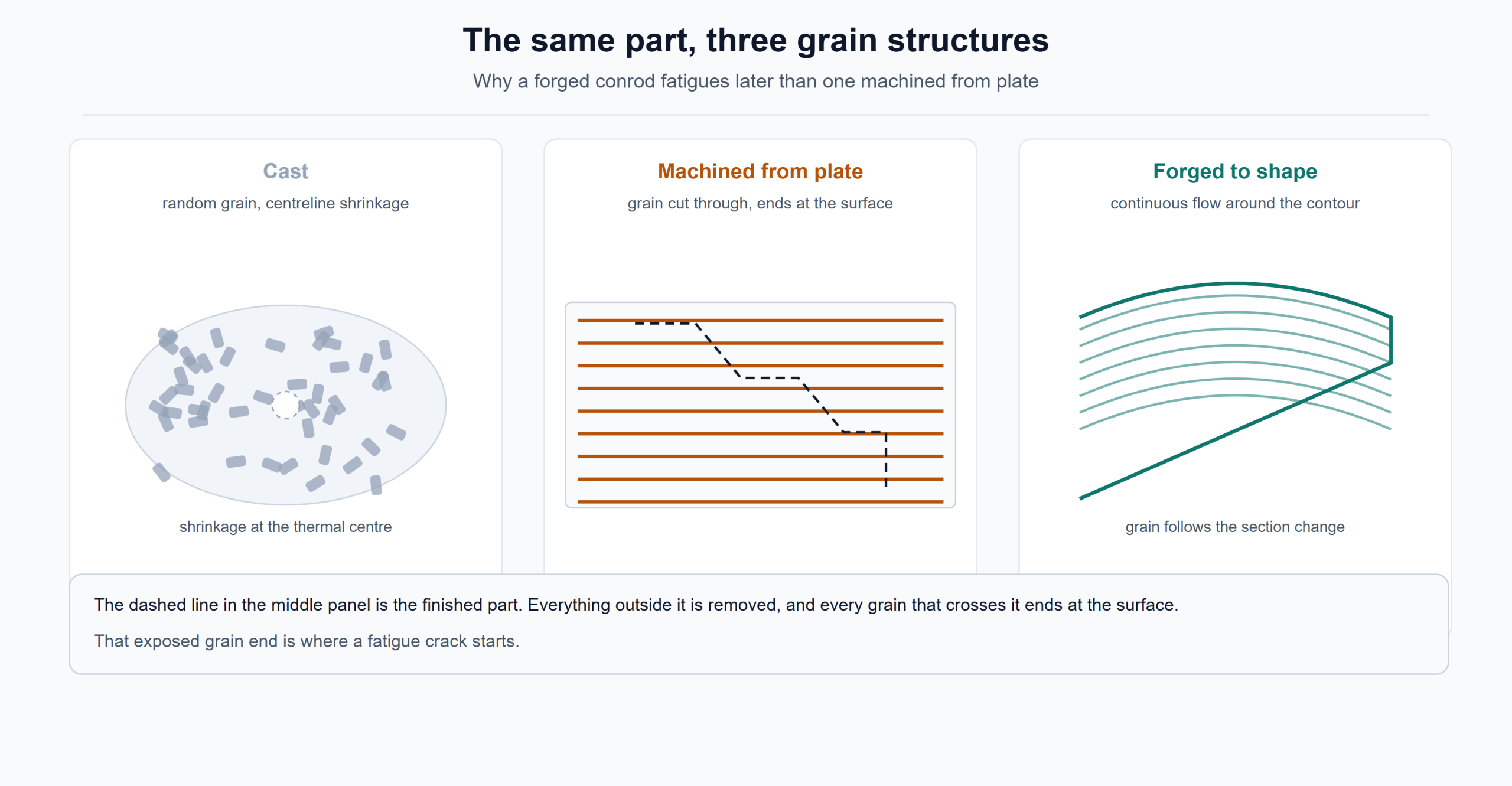
Casting pours liquid metal into a mould. The grains grow from the cold mould wall inward, in whatever direction the heat leaves, and the last liquid to freeze collects the segregation in the centre. Machining a part from a cast or rolled block cuts through that structure and leaves the grain ends exposed at the surface, like cutting a bundle of fibres across.
Forging does the opposite. The deformation elongates the grains and aligns the inclusions and second phases with the metal flow, so the finished part has a continuous grain structure that follows its own contour. A conrod forged to shape has grain running around the big-end eye; the same part machined from plate has grain running straight through it and terminating at the surface.
Three processes, three applications
The choice between them is decided by quantity, by size, and by how much machining the customer is prepared to do afterwards.
Table 1. Open die, closed die and ring rolling compared.
| Process | How it works | Typical size | Tooling cost | Best for |
|---|---|---|---|---|
| Open die | Flat or shaped dies, part rotated and repositioned between strokes | 0.5–200 t | Low, standard dies | Large shafts, discs, blocks, one-off heavy parts |
| Closed die (impression) | Two shaped die halves, metal confined and flashed | 0.1–150 kg | High, die per part | Volume parts: conrods, flanges, gear blanks, hand tools |
| Ring rolling | A pierced blank squeezed between a driven roll and a mandrel | 0.5–10 m diameter | Medium, roll set | Bearing rings, flanges, tyre rims, pressure vessel necks |
| Upset forging | A bar is gripped and the end is headed in a die | 10–150 mm bar | Medium | Bolts, valve stems, axle shafts |
Open die forging is what most steel buyers actually order: a rolled bloom or ingot is upset, drawn and shaped between flat dies to a rough block, then machined. It is the route for large flanges, die blocks and heavy shafts, where the tooling for a closed die would exceed the value of the order.
The temperature window
Every forging process runs inside a window bounded by two failures. Below the lower bound the steel work-hardens faster than it deforms and cracks. Above the upper bound the grain grows, the grain-boundary phase melts, and the part is scrap that no heat treatment can recover.
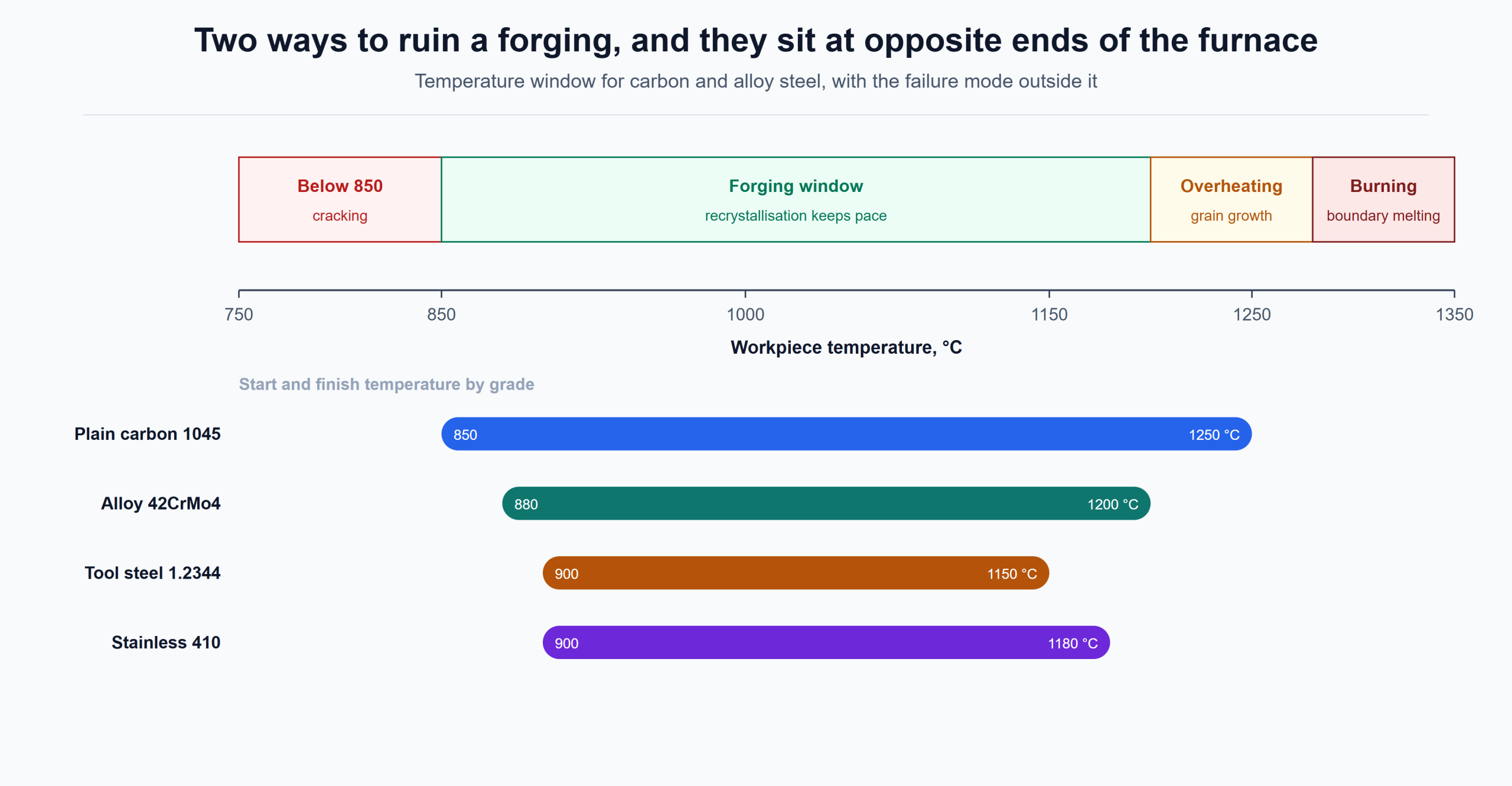
For plain carbon steel the window is wide: start at 1,200–1,250 °C, finish above 850 °C. For alloy and tool steel it narrows from both ends — a 1.2344 die block is forged from 1,050–1,150 °C and must not finish below 900 °C, because the higher alloy content lowers the solidus and widens the brittle range.
Two rules follow. First, furnace time counts as much as furnace temperature: a 500 mm section needs roughly one hour per 25 mm to soak through, and holding it at temperature for twice that time grows the austenite grain beyond what the subsequent normalising can refine. Second, the finishing temperature has to be measured on the part, not inferred from the furnace — a thin section can drop 150 °C between the last stroke and the die opening.
Forging ratio: the number that is usually missing
Forging ratio is the ratio of the starting cross-section to the finished cross-section, and it is the only simple measure of how much deformation the centre of the part actually received. A ratio of 1 means the part was heated and shaped at the surface; a ratio of 4 means the centre was worked.
Table 2. Forging ratio and what it delivers.
| Forging ratio | Effect on structure | Where it is specified |
|---|---|---|
| 1–2 | Casting structure largely retained in the centre | Non-critical blocks, counterweights |
| 2–3 | Ingot porosity largely closed, grain refined | General engineering forgings |
| 3–5 | Centre-line sound, inclusions aligned, properties isotropic in the short direction | Shafts, gears, pressure parts |
| 5–8 | Full refinement, banding broken up | Critical rotating parts, aerospace |
| > 8 | Diminishing return, risk of banding and directionality | Rarely specified; adds cost without benefit |
The ratio has to be achieved in the direction that matters. A block drawn from 500 mm to 250 mm square has a ratio of 4 in the drawing direction and no working at all in the transverse direction, which is why heavy discs are upset first and then drawn.
The four defects worth inspecting for
Folds and laps. A fold is a surface already oxidised when it is pushed back into the body of the part. It appears as a linear indication on ultrasonic inspection and as a crack after heat treatment. It comes from a die design with a sharp change of section, or from an operator turning the part without cleaning the scale.
White spots. Hydrogen flakes. Hydrogen above about 2 ppm in a section over 150 mm, cooling slowly through 400 °C, precipitates as molecular hydrogen at internal surfaces and opens flat, silvery cracks. Prevention is vacuum degassing and controlled cooling after forging — not inspection afterwards.
Overheating and burning. Overheated steel has coarse grains that can be refined by normalising; burnt steel has melted grain boundaries and cannot be recovered. The margin between the two is 20–30 °C and one hour of extra soak.
Cut grain flow. Not a forging defect but a machining one: a part machined from a block with the grain running across the section loses the fatigue benefit the forging was bought for. This is why the drawing should specify the grain direction relative to the load.
What to put on the purchase order
- Process and forging ratio — for example open die forged, minimum ratio 4:1 in the longitudinal direction.
- Starting stock and melting route — rolled bar, continuously cast bloom or ingot, and whether VD or ESR was used.
- Heat treatment condition — as-forged, normalised, or quenched and tempered, with the hardness range and the test location.
- Ultrasonic inspection — the standard (ASTM A388 or EN 10228-3), the acceptance level, and whether inspection is on the rough machined or black surface.
- Machining allowance and tolerance — for open die parts, DIN 7527 covers the allowance for a given size and shape.
- Certificate — EN 10204 3.1 with chemical, mechanical and non-destructive results against the heat number.
Frequently asked questions
Is a forged part stronger than a machined part?
In fatigue, usually yes, because the grain flow follows the contour and the surface is not interrupted by cut grain ends. In static tension, the difference is small if both parts are made from the same grade and heat treated the same way. The advantage is directional and it disappears if the grain flow is cut by machining.
What is the difference between open die and closed die forging?
Open die forging shapes the part between flat or simple dies over many strokes; it suits large, low-quantity parts and leaves a generous machining allowance. Closed die forging confines the metal in a shaped die and produces the final shape in a few strokes; it needs a dedicated die and suits higher quantities.
Can forgings be welded?
Yes, with the same preheat and filler rules as the base grade. The forging ratio does not change weldability, but the heat treatment condition does: a quenched and tempered forging welded without preheat will form untempered martensite in the heat-affected zone.
Why is forging more expensive than casting?
More operations, more scrap allowance, more inspection and, for closed die work, a die that only fits one part. The premium buys fatigue life and inspection confidence, which is why it is spent on rotating and pressure-containing parts and not on housings.
Related reading
- Cast vs Forged Steel — the structural comparison behind the price difference
- Quenching and Tempering Large Forgings — why section size decides the cooling rate
- DIN 7527 Machining Allowances — the standard behind the black-part dimensions
- Forged Die Blocks — open die blocks for tooling, with the ratio specified
- Large Forged Flanges — the heavy open die product form
You get chemical composition, mechanical properties and a price — with inspection certificates to EN 10204 3.1 issued against the heat number.