
What Is Temper Embrittlement in Steel?
Temper embrittlement refers to a phenomenon where quenched steel becomes brittle after tempering within certain temperature ranges or after slowly cooling through these ranges. It can significantly affect the toughness and reliability of steel components.
Classification of Temper Embrittlement
Temper embrittlement is typically divided into two categories:
- First-Class (Irreversible) Temper Embrittlement
Occurs at 250–400°C and cannot recur after re-tempering at this range post-treatment. Once eliminated by higher temperature treatment, it does not return. - Second-Class (Reversible) Temper Embrittlement
Happens in the 400–650°C range and reappears if steel is reheated and cooled slowly through this range. Fast cooling prevents its reoccurrence.
First-Class Temper Embrittlement (Low-Temperature, Irreversible)
Temperature Range
200°C to 350°C
Causes
- Impurities such as sulfur (S), phosphorus (P), arsenic (As), tin (Sn), antimony (Sb), copper (Cu), hydrogen (H), and oxygen (O) contribute to embrittlement.
- Alloy elements like manganese (Mn), silicon (Si), chromium (Cr), nickel (Ni), and vanadium (V) exacerbate the effect.
- Larger austenite grain sizes and high retained austenite levels worsen embrittlement.
- Grain boundary segregation and carbide films weaken grain cohesion.
Countermeasures
- Avoid tempering within the embrittlement temperature range.
- Use isothermal quenching to bypass the risky range.
- Lower the content of impurity elements in steel.
- Refine austenitic grains during processing.
Common Materials Affected
Alloy structural steels, especially Cr-Mn steels, are prone to first-class embrittlement. This type cannot be remedied by reheating within the same temperature range.
Second-Class Temper Embrittlement (High-Temperature, Reversible)
Temperature Range
450°C to 650°C
Causes
- Harmful impurities (P, Sb, Sn, As, B, S) segregate at grain boundaries.
- Alloy elements like Ni, Cr, Mn, Si, and C promote embrittlement.
- Elements like Mo, W, V, and rare earth metals counteract embrittlement.
- Slow cooling after tempering exacerbates the effect.
- Coarse austenitic grains amplify susceptibility.
Prevention Strategies
- Minimize impurities in steel during smelting.
- Add niobium (Nb), vanadium (V), and titanium (Ti) to refine grain structure.
- Introduce molybdenum (Mo) or tungsten (W) to suppress impurity diffusion.
- Avoid slow cooling post-tempering—use rapid cooling techniques.
- Apply subcritical or residual heat quenching to suppress embrittlement.
Understanding the Tempering Curve and Brittleness Behavior
What Happens During Tempering?
As the tempering temperature increases:
- Hardness and strength of quenched steel gradually decrease.
- Ductility and toughness improve.
- However, in certain temperature zones, toughness drops instead of increasing—this is temper embrittlement.
First-Class Embrittlement Impact
Shown in Figure 1 below, the Charpy impact energy of quenched steel drops significantly within the 200–400°C range. This embrittlement:
- Leads to intergranular or cleavage fractures.
- Increases the likelihood of brittle failure in components under stress.
- Cannot be reversed by fast cooling or re-heating within the same range.
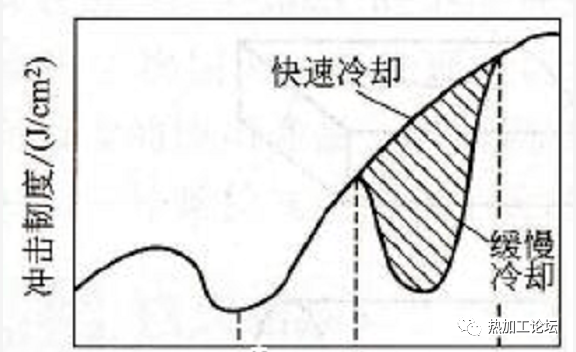
Schematic curve showing Charpy impact energy of structural steel versus tempering temperature, highlighting the embrittlement zone.
Steel Type Sensitivity and Treatment Adjustments
Effect of Alloy Elements
- In nickel-chromium steels, antimony causes the most embrittlement, followed by tin.
- In chromium-manganese steels, phosphorus has the highest effect, followed by Sb and Sn.
- For low-carbon steels, phosphorus is more impactful; for medium-carbon steels, tin dominates.
Special Heat Treatment Solutions
- Use high-temperature deformation heat treatment to significantly improve toughness and eliminate embrittlement.
- After high-temperature tempering, apply rapid cooling to suppress the second-class embrittlement.
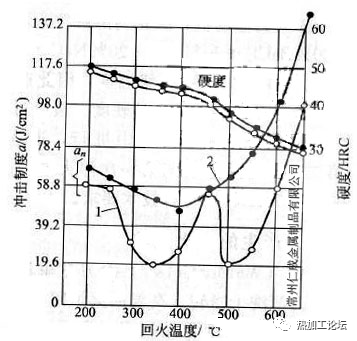
Graph showing the impact toughness of 40CrNi4 steel at various tempering temperatures, comparing standard quenching with high-temperature deformation treatment.
Case Study – Nitriding and Surface Brittleness
Nitriding Considerations
Parts undergoing gas nitriding (typically at 500–550°C for 40–70 hours) develop a hardened case of 0.3–0.6mm. This enhances wear resistance and fatigue strength but risks embrittlement.
Critical Step – De-nitriding
To reduce surface brittleness:
- Conduct de-nitriding at 540–560°C for 2–3 hours.
- Ensure ammonia decomposition >80% during this step.
Neglecting this crucial stage can lead to premature failure of precision parts.
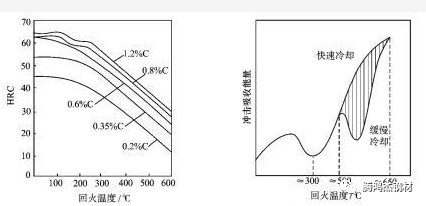
Variation of hardness and impact toughness with tempering temperature for steels with different carbon content and cooling rate
Summary
Temper embrittlement is a critical metallurgical concern in steel heat treatment. By understanding the causes, temperature ranges, and alloy sensitivities, manufacturers can:
- Optimize heat treatment processes.
- Avoid embrittlement-prone temperature zones.
- Apply alloying and quenching strategies effectively.
Both types of temper embrittlement—irreversible (first-class) and reversible (second-class)—require precise metallurgical control for consistent performance and safety in steel components.