EAF, AOD, LF and VD: What Each Furnace Is For
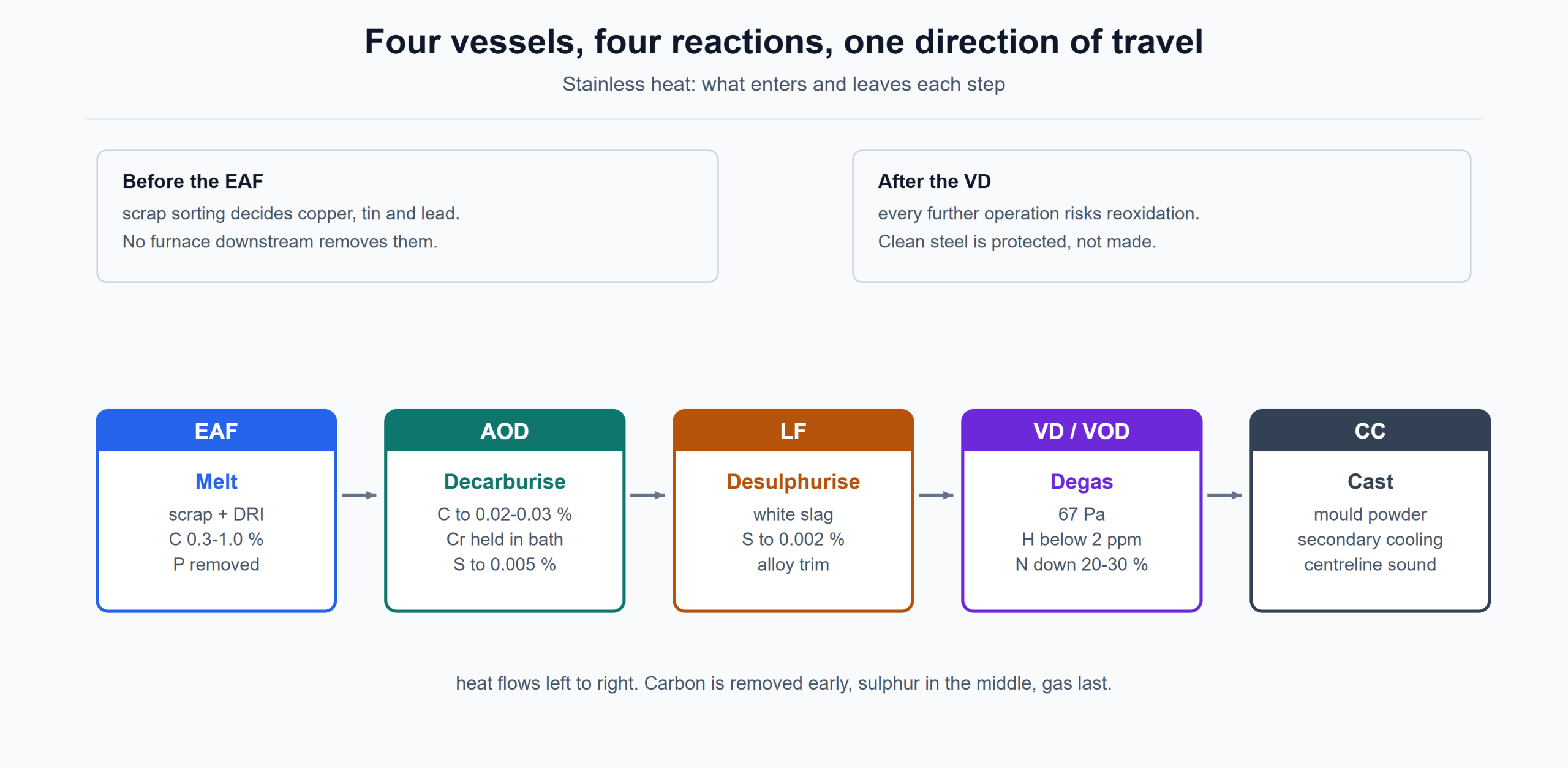
Four vessels, four different jobs. One melts, one decarburises, one desulphurises and one degasses — and no single vessel can do all four at once, which is why a stainless heat passes through the whole line.
A furnace list on a mill brochure reads like a row of identical boxes. In the plant they are not interchangeable: each one is built around a specific chemical reaction, and the reaction only runs in the temperature, pressure and slag conditions that vessel can hold.
This page sets out what each of the four does, what it cannot do, and how the sequence is chosen for a given grade. It is the difference between quoting “EAF + AOD + LF + VD” and knowing which of those steps the customer is actually paying for.
Why one furnace is never enough
Steelmaking is a sequence of removals, and the removals fight each other. Decarburisation produces oxygen that must later be removed. Desulphurisation needs a reducing slag, while decarburisation needs an oxidising one. Degassing needs vacuum, and vacuum costs heat. Every step therefore has an order, and the order is set by thermodynamics rather than by layout.
The classic stainless route runs EAF → AOD → LF → VD (or VOD) → continuous casting. Carbon steel takes a shorter path, EAF → LF → VD, because it does not need the argon-oxygen decarburisation stage.
Electric arc furnace: melt, and remove what is easy
The EAF is a melting vessel first and a refining vessel second. Three graphite electrodes strike an arc into a scrap or DRI charge; the arc column reaches 3,500–4,000 °C while the bulk bath sits at 1,550–1,650 °C. Melting a 100 t charge takes 35–50 minutes at 40–60 MVA, depending on the scrap mix and the amount of chemical energy injected.
What the EAF does well: melt, dephosphorise (with an oxidising slag and a high tapping temperature), and drop carbon to roughly 0.05–0.08 %. What it does badly: desulphurise, hold a low nitrogen level, and protect alloying elements — the arc atmosphere is oxidising, so chromium burns unless the slag is saturated with lime and the oxygen potential is controlled.
That is why an EAF tapping for stainless is usually tapped with 12–18 % Cr already in the bath and a carbon level of 0.3–1.0 %, deliberately high. The carbon is there to protect the chromium during meltdown; the AOD will remove it later under conditions where chromium survives.
Argon oxygen decarburisation: remove carbon without losing chromium
The argon oxygen decarburisation vessel is the reason stainless steel is affordable. Decarburising a 18 % Cr melt with oxygen alone oxidises the chromium along with the carbon — the affinity of chromium for oxygen is higher than that of iron and, at low carbon, higher than that of carbon itself. The AOD solves this by lowering the partial pressure of carbon monoxide.
Argon is mixed into the oxygen blown through side tuyeres. The CO produced by decarburisation is swept out by the argon, so the equilibrium moves and carbon continues to oxidise while chromium does not. The blow is run in stages, with the argon-to-oxygen ratio rising from about 1:3 at high carbon to 1:1 and finally pure argon for the final rinse.
A modern AOD takes 0.5–1.0 % C down to 0.02–0.03 % in 20–35 minutes, with chromium recovery above 98 %. The same vessel then runs a reducing stage — silicon or aluminium added with lime and fluorspar — which recovers the chromium from the slag and drops sulphur to 0.005 % or below.
The number to remember
Every 0.01 % of carbon left in the bath at AOD tap is roughly 20 s of extra argon. That is why a 316L with 0.025 % C and a 316L with 0.015 % C are not the same price, even when both pass the certificate.
Ladle furnace: the composition and temperature workshop
The LF is a holding vessel with three graphite electrodes, a porous plug in the bottom for argon stirring, and a slag door. It does four things:
- Desulphurisation — a white, highly basic slag (CaO/SiO2 above 3) under reducing conditions takes sulphur to 0.002–0.005 % in 15–25 minutes.
- Temperature correction — 3–5 °C per minute of heating, which is what pays for the heat lost in tapping and transfer.
- Alloy trimming — the ferroalloys that have to hit a narrow window (Mo, Ni, Ti, Nb) are added here, not in the EAF.
- Inclusion modification — a calcium treatment converts solid alumina clusters into liquid calcium aluminates that do not clog the caster nozzle.
Inclusion control at this stage is what decides fatigue life later; the calcium treatment and the stirring time are covered under inclusion control in vacuum-melted grades. The LF cannot decarburise. It is an open vessel with a slag layer and graphite electrodes; any oxygen that would burn carbon also burns the electrodes and the slag. Carbon control is finished by the time the heat reaches the LF, and the argon stirring is there to homogenise what is left, not to remove it.
Vacuum degassing: the last millionth
VD and VOD work on the same principle: lower the pressure, and the reactions that produce gas become favourable. At 67 Pa (0.5 Torr), hydrogen in the melt drops from 4–6 ppm to below 2 ppm in 15–20 minutes, and nitrogen can be reduced by 20–30 % if the sulphur level is low enough for the reaction to proceed.
The difference between VD and VOD is the oxygen lance. VD only degasses; VOD blows oxygen under vacuum, which allows carbon to be removed to 0.005–0.01 % without any risk of chromium loss — the route for 316L with a 0.02 % carbon ceiling, and for ultra-low-carbon ferritic grades.
Table 1. What each vessel can and cannot do.
| Function | EAF | AOD | LF | VD / VOD |
|---|---|---|---|---|
| Melt scrap / DRI | Yes | No | No | No |
| Decarburise below 0.05 % C | No | Yes | No | Yes (VOD) |
| Desulphurise below 0.005 % S | No | Partly | Yes | Partly |
| Remove hydrogen below 2 ppm | No | No | No | Yes |
| Remove nitrogen | No | Partly | No | Yes |
| Heat / superheat | Yes | No | Yes | No |
| Alloy trimming to narrow window | Coarse | Coarse | Yes | No |
| Inclusion modification | No | Partly | Yes | Partly |
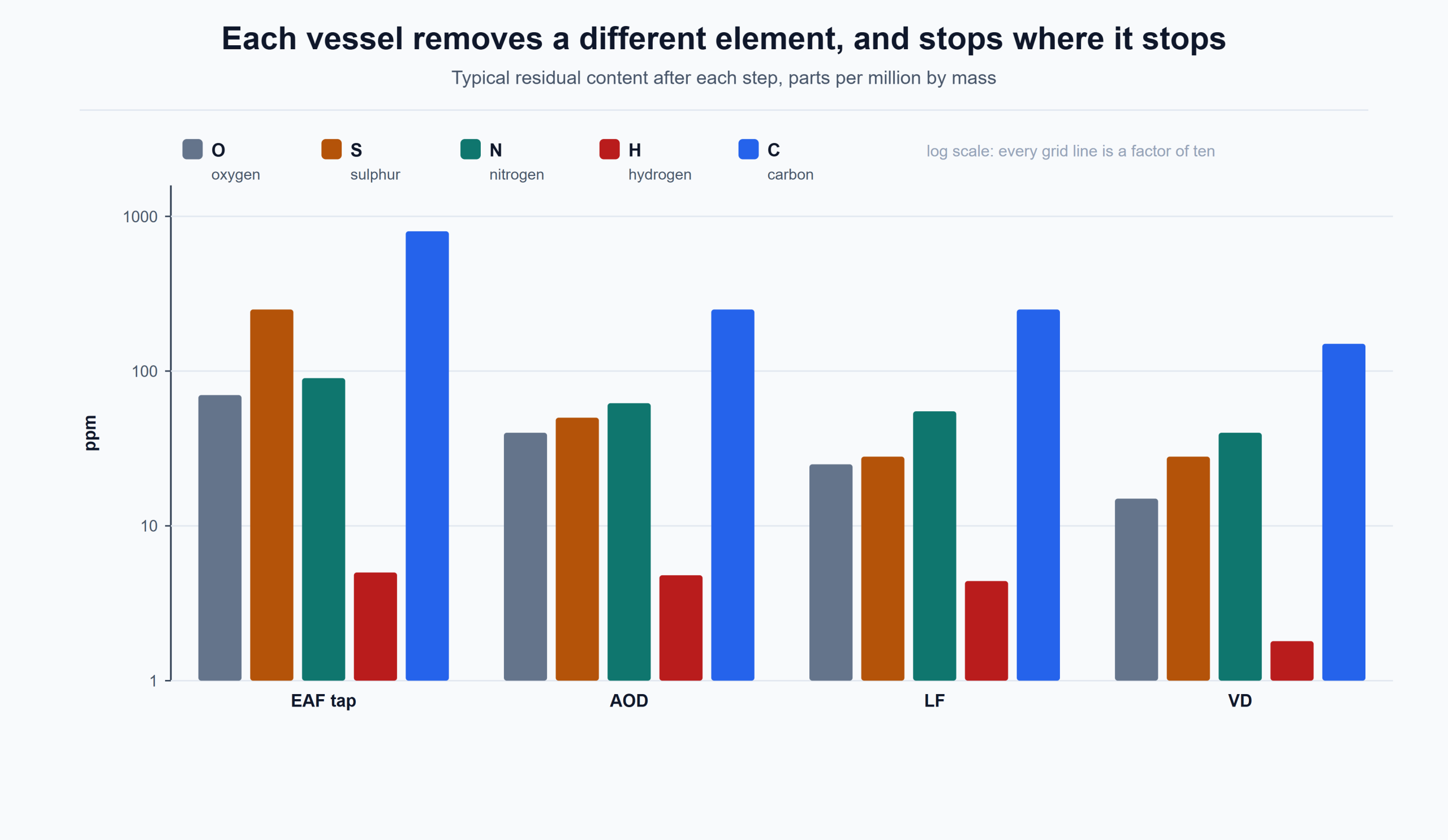
The same matrix as a picture: each bar is the typical residual after that step. Watch hydrogen — it does not move until the vacuum vessel, and that is why a hydrogen limit is a route requirement rather than a grade requirement.
What the route looks like for a real grade
The four vessels are combined differently depending on what the certificate has to say.
The endpoint of the liquid steel is only half the story. What happens in the mould decides whether the centreline is sound, as the casting route for D2 continuous cast bloom shows.
Table 2. Typical route and endpoint by grade family.
| Grade family | Route | C at tap | S | H | Why this route |
|---|---|---|---|---|---|
| 304 / 316 coarse | EAF–AOD–LF–CC | 0.03 % | 0.005 % | 3–4 ppm | AOD handles carbon and chromium; VD not needed |
| 316L / 316L low C | EAF–AOD–LF–VD–CC | 0.02 % | 0.003 % | ≤ 2 ppm | Vacuum guarantees the carbon and hydrogen ceiling |
| Duplex 2205 | EAF–AOD–LF–VD–CC | 0.02 % | 0.002 % | ≤ 2 ppm | Nitrogen is alloyed, not removed; VD controls hydrogen |
| Ultra-low C ferritic | EAF–AOD–VOD–CC | 0.008 % | 0.003 % | ≤ 2 ppm | VOD is the only route to 0.01 % C at 18 % Cr |
| Carbon steel Q&T | EAF–LF–VD–CC | 0.35 % | 0.005 % | ≤ 2 ppm | No decarburisation step needed |
Three things buyers get wrong
“AOD is a degasser.” It is not. The AOD removes carbon and sulphur; hydrogen is barely touched because the vessel is open to atmosphere. A 316L that only saw EAF and AOD will typically carry 4–6 ppm hydrogen, which is enough to fail a heavy-section forging acceptance test.
“LF means clean steel.” An LF can also make steel dirtier if the slag is not killed or the argon flow is too high and exposes the bath. The inclusion count depends on the calcium treatment and the stirring time, not on the vessel name.
“More vacuum is better.” Deep vacuum below 10 Pa adds cycle time and refractory wear for a hydrogen reduction that has already flattened out. Most shops stop at 60–70 Pa and use the saved time for stirring.
Frequently asked questions
What does EAF stand for?
Electric arc furnace. It melts scrap or direct reduced iron with an electric arc struck between graphite electrodes and the charge.
What is the difference between AOD and VOD?
Both remove carbon under a reduced partial pressure of CO. AOD does it by diluting the gas with argon at atmospheric pressure; VOD does it by pulling a vacuum and blowing oxygen through a lance. VOD reaches lower carbon, AOD is cheaper per tonne.
Why is VD needed after LF?
For hydrogen. The LF heats and desulphurises but cannot remove hydrogen, and hydrogen above 2 ppm causes flaking in large forgings and porosity in heavy cast sections.
Can an EAF make stainless steel?
It can melt a stainless charge, and most stainless shops do start there, but the EAF cannot refine stainless — it loses chromium to the slag. The refining has to happen in the AOD.
Beyond VD the route leaves conventional steelmaking. Electroslag remelting and vacuum arc remelting are used when the inclusion and segregation limits cannot be met by a ladle furnace at all.
Related reading
- What Is AOD? — the argon-oxygen process in detail
- Electroslag Remelting (ESR) — the remelting step for tool steel and superalloy cleanliness
- VIM Inclusion Control in Alloy 718 — what vacuum induction melting adds to the chain
- Continuous Casting of D2 — why casting parameters decide carbide segregation
- Superalloy Revert Purification — recycling returns without carrying the tramp elements forward
You get chemical composition, mechanical properties and a price — with inspection certificates to EN 10204 3.1 issued against the heat number.