
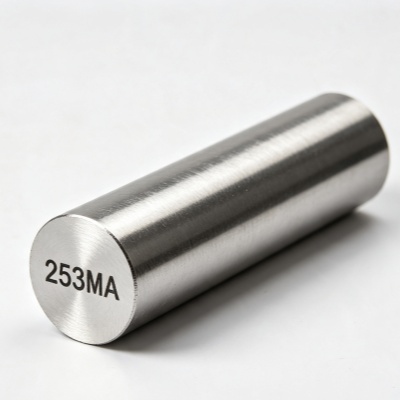
Equivalent Grades of 253MA Across International Standards
253MA is codified under multiple national and international specification systems. The table below maps its designations and governing standards across major markets. Fushun Metal certifies to all listed specifications and can dual-certify heats where required.
| Country / System | Designation | Key Standards |
|---|---|---|
| USA (ASTM/ASME) | S30815 / 253MA / F45 | ASTM A240 (Plate/Sheet), A276 (Bar), A213/A312 (Tube), A403 (Fittings), A182 (Forgings); ASME SA-240, SA-213, SA-312, SA-182 |
| Europe (EN) | 1.4835 / X9CrNiCe21-11-2 | EN 10095, EN 10216-5, EN 10297-2, EN 10272 |
| Sweden (Trademark) | 253MA (Outokumpu) / Sirius S15 | Proprietary; conforms to UNS S30815 / EN 1.4835 |
| China (GB) | 16Cr21Ni11Si2CeN | GB/T 20878 |
Applications of 253MA
253MA fills the economic and performance gap between standard 18/8 and 25/20 stainless steels and nickel-based alloys such as Alloy 800H. It is specified wherever cyclic oxidation resistance at 900–1150°C and moderate creep strength must be delivered at a material cost competitive with fabricated stainless steel rather than nickel alloy budgets. Its low nickel content (10–12%) also provides a distinct advantage over 310 and higher-nickel grades in sulfur-containing atmospheres where nickel sulfide formation accelerates attack.
Industrial Furnace Components
Radiant tubes, furnace rollers and walking beams, burner nozzles and flame shrouds, retorts, muffles, conveyor belts, heat-treating baskets, grates, refractory anchors, hoods, flues, and thermocouple protection sheaths for continuous operation to 1150°C.
Waste Heat Recovery
Recuperator and regenerator tube bundles, waste-heat boiler tubes, economizer and air-preheater tubing, flue-gas bypass dampers, and expansion bellows in metallurgical, glass, cement, and incineration plant heat recovery systems.
Petrochemical Furnace Tubes
Ethylene cracking convection-section tubes, styrene monomer reactor effluent tubes, EDC cracking furnace tubes, carbon-black process gas cooler and air-heater tubes, and sulphuric acid plant gas-converter air preheater tubes.
Power & Incineration
Fluidized-bed combustion plant tubing, waste-to-energy and mud-incineration furnace tubes, biomass boiler superheater pendants, pulverized-coal injection lances for blast furnaces, and flue-gas recirculation ducting.
Refinery & Chemical Heaters
Crude and vacuum heater tube supports and hangers, catalytic reformer furnace components, sulfur recovery unit (SRU) reaction furnace burner tips, and high-temperature process heater tube sheets and tube supports.
Cement, Glass & Mineral Processing
Preheater cyclone dip tubes, kiln burner nozzles, clinker cooler grates, glass furnace recuperator tubes, continuous wire annealing furnace muffles, and high-temperature material-handling hardware.
253MA — Supply Range by Fushun Metal
Fushun Metal stocks and processes 253MA across all major mill forms from a single integrated facility. Our in-house multi-stand 850/550/350/250 rolling mills and 1800-ton precision radial forger (GFM) enable a broad dimensional envelope without outsourcing—ensuring uninterrupted lot traceability from melt to delivery under ISO 9001 and AS9120B. All material is supplied in the solution-annealed condition per ASTM A240 / A213 / A276 (typically 1020–1150°C, rapid air or water cool). Cold-worked material should be re-annealed after 10–20% deformation to restore maximum creep strength in service. Welding is performed with matching 22.12HT filler (UNS S30815) or Type 309 as an alternative where lower creep strength is acceptable. Post-weld annealing is generally not required for high-temperature service. Mill test certificates to EN 10204 3.1 or 3.2 accompany every shipment.
Seamless Tube & Pipe
Tube OD 10 mm – 200 mm, wall 1 mm – 15 mm per ASTM A213 / A312 / EN 10216-5. Solution-annealed and pickled. Hydrostatic and eddy-current tested. Radiant-tube and furnace-roller grades available with elevated-temp tensile certification.
Plate & Sheet
Thickness 2 mm – 50 mm. Width up to 2,000 mm, length up to 8,000 mm. Solution-annealed and descaled per ASTM A240 / ASME SA-240. Surface: No.1, 2B, or 2D. Plasma/laser cut-to-size. Custom-fabricated furnace components available.
Rolled & Forged Bar
Rolled bar OD 6 mm – 300 mm per ASTM A276. Forged bar OD 80 mm – 600 mm. Solution-annealed, pickled, and peeled or centerless ground. Cut-to-order lengths. Flanges and forged fittings per ASTM A182 / A403.
Welded Tube & Fabricated Assemblies
Welded tube OD 15 mm – 300 mm per ASTM A358/A409/A813/A814. Butt-weld fittings per ASTM A403. Custom-fabricated radiant tube assemblies, retorts, and furnace hardware from in-house plate and tube stock.
Chemical Composition of 253MA — ASTM A240 / EN 10095
All heats produced by Fushun Metal are verified against the composition limits below by optical emission spectrometry and LECO combustion analysis. Full chemical certificates are issued with every shipment under ISO 9001 and AS9120B quality management. The four defining compositional features are: 21% chromium for chromia-scale oxidation protection to 1150°C; 1.4–2.0% silicon for silica sub-scale formation that acts as a diffusion barrier; 0.03–0.08% cerium as a reactive-element dopant that pegs the oxide scale to the metal surface, eliminating spallation during thermal cycling; and 0.14–0.20% nitrogen for solid-solution strengthening that provides the creep strength necessary for structural service at temperatures where conventional 18/8 and 25/20 stainless steels soften and collapse under load.
| Element | Cr | Ni | Fe | Si | C | N | Ce |
|---|---|---|---|---|---|---|---|
| Wt.% | 20.0–22.0 | 10.0–12.0 | Bal. | 1.4–2.0 | 0.05–0.10 | 0.14–0.20 | 0.03–0.08 |
| Element | Mn | P | S | ||||
| Wt.% | ≤0.80 | ≤0.040 | ≤0.030 |
Mechanical Properties of 253MA — Room & Elevated Temperature
253MA is a solid-solution-strengthened austenitic stainless steel; all properties are developed through solution annealing at 1020–1150°C followed by rapid cooling. It is not hardenable by heat treatment. Room-temperature values below represent minimum guaranteed properties per ASTM A240 (plate/sheet) and A276 (bar). Elevated-temperature tensile and creep data are provided as typical values. The alloy’s nitrogen content (~0.17%) is responsible for its elevated creep strength relative to standard 310 (which contains no deliberate nitrogen addition), enabling 253MA to replace more expensive nickel alloys in many structural furnace and petrochemical heater applications operating between 700°C and 1000°C.
Fushun Metal performs all solution annealing in-house under calibrated furnace controls. Hot-working: 900–1150°C. The alloy has excellent weldability by all standard fusion methods (GTAW, GMAW, SMAW). Matching 22.12HT filler metal (UNS S30815 composition) is recommended for creep-strength-critical joints. Type 309 filler provides acceptable corrosion resistance where creep strength of the weld is not the design-limiting factor. Pure argon shielding gas is recommended. The alloy will become sensitized if held in the 425–860°C range, which does not affect high-temperature oxidation performance but will reduce aqueous corrosion resistance after service—a consideration for components that see intermittent wet/dry cycling.
Physical constants: Density 8.0 g/cm³; Melting range 1371–1432°C; Hardness ≤217 HB / ≤95 HRB (annealed); Modulus of elasticity ~200 GPa at 20°C; Thermal conductivity 12.5 W/m·K at 20°C; Coefficient of thermal expansion 16.3 μm/m·°C (20–1000°C). Maximum continuous service in air: 1150°C (oxidation limit). Recommended structural temperature range: 850–1100°C. The alloy is non-magnetic in the annealed condition.
| Product Form | Test Temp. (°C) | Tensile Strength (MPa) | Yield Strength (MPa) | Elongation (%) | Creep / Notes |
|---|---|---|---|---|---|
| Plate & Sheet (A240) | 20 | ≥600 (typ. 650–850) | ≥310 (typ. 350–500) | ≥40 (typ. 45–68) | Hardness ≤217 HB |
| Bar (A276) | 20 | ≥600 (typ. 660–750) | ≥310 (typ. 420–500) | ≥40 | Hardness ≤95 HRB |
| Elevated Temp. (Typ.) | 800 | ~390–450 | ~140–165 | — | — |
| Elevated Temp. (Typ.) | 900 | ~170–200 | ~80–100 | — | Oxidation rated to 1150°C |
| Creep (0.0001%/h Typ.) | 704 | — | — | — | 124 MPa for 0.0001%/h |