
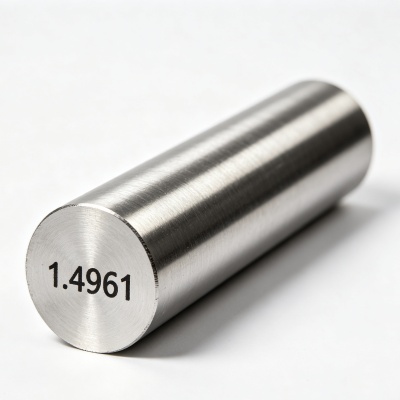
X8CrNiNb16-13, designated as EN 1.4961 (ISO digital code 4961-347-77-E), is a premium niobium-stabilized austenitic heat-resistant stainless steel engineered specifically for long-term creep service in the 600–750°C temperature band. FUSHUN METAL supplies this high-performance grade under ISO 9001:2015 and AS9120B certified quality systems with full material traceability from melt to shipment. While functionally analogous to ASTM 347H (UNS S34709 / EN 1.4912), X8CrNiNb16-13 is a distinct European specification with three critical metallurgical upgrades: its nickel content is elevated to 12.0–14.0% (versus 9.0–13.0% for standard 347H), providing superior austenite-phase stability and significantly reduced sigma-phase formation risk during prolonged exposure above 800°C; its silicon band is tightly controlled to 0.30–0.60% for optimized oxidation resistance without promoting Laves-phase embrittlement; and its phosphorus and sulfur ceilings are halved to 0.035% P / 0.015% S (versus 0.045% / 0.030% for ASTM 347H), yielding measurably cleaner grain boundaries and superior creep-rupture ductility. Niobium is added at a minimum of 10×C (up to 1.20%) to permanently scavenge free carbon as stable NbC precipitates, conferring intrinsic immunity to intergranular corrosion in the as-welded condition and after decades of service within the 450–850°C sensitization window. This grade is the material of record for ultra-supercritical (USC) boiler superheater tubing in European-designed power plants, molten-salt thermal storage systems in concentrated solar power (CSP) installations, nuclear steam generator U-tubes, and ethylene cracking furnace radiant coils where failure is not an option.
X8CrNiNb16-13 (1.4961) Overview
X8CrNiNb16-13 is classified under EN 10095 (heat-resisting steels) and EN 10302 (creep-resisting steels and nickel/cobalt alloys) as a niobium-stabilized austenitic grade rated for continuous operation up to approximately 750°C. Its defining compositional signature—approximately 16% Cr / 13% Ni / Nb-stabilized—places it in the sweet spot between standard 347-type chemistry and the higher-alloyed 20Cr-25Ni-Nb grades used in advanced gas-cooled reactors. The 12.0–14.0% nickel level is precisely calibrated: it is high enough to suppress the martensite-start (Ms) temperature well below ambient, ensuring full austenitic structure even after heavy cold work, yet not so high as to promote excessive nickel-aluminide formation at the oxide-metal interface during cyclic oxidation. At FUSHUN METAL, every heat of X8CrNiNb16-13 is verified by optical emission spectroscopy with independent niobium quantification, then solution-annealed at 1050–1150°C with controlled rapid cooling to produce a fully recrystallized, equiaxed austenitic grain structure with uniformly distributed NbC precipitates. Grain size is verified per ASTM E112 and typically targets ASTM 5.0 or finer for optimal creep performance. This grade is widely specified under EN 10028-7 for pressure vessel flat products and EN 10216-5 for seamless tubes in pressure applications throughout European-designed power generation, petrochemical, and nuclear plants. Beyond its primary high-temperature mission, X8CrNiNb16-13 also demonstrates excellent toughness at cryogenic temperatures down to −165°C, enabling its use in LNG storage tank structural supports and marine cryogenic piping where both low-temperature ductility and fabrication flexibility are required.
Typical Applications by Industry
Power Generation (USC)
- 600°C superheater tube bundles
- High-temperature reheater assemblies
- Steam-water separator shells
- Boiler header stubs & nipples
- High-pressure steam piping
Solar Thermal (CSP)
- Molten-salt storage tank liners
- Hot-salt piping & headers
- Thermal receiver tube panels
- Heat exchanger tube bundles
Nuclear Engineering
- Steam generator U-tubes
- Control rod drive housings
- Pressurizer heater sheaths
- Reactor internal fasteners
Petrochemical
- Ethylene cracking furnace coils
- Catalytic reformer tube sheets
- Urea synthesis reactor liners
- Quench heat exchanger internals
Aerospace
- Turbine exhaust nozzle supports
- Afterburner heat shields
- Hot-section structural brackets
- Engine test rig instrumentation
Oil Refining & Gas
- Catalytic cracking unit internals
- Refinery heater radiant tubes
- Hydrogen reformer outlet headers
- Flare tip assemblies
Thermal Processing
- High-temp furnace radiant tubes
- Annealing box fixtures & hangers
- Heat treatment baskets & trays
- Kiln burner tubes & muffles
Cryogenic & Marine
- LNG storage tank supports (−165°C)
- Cryogenic transfer piping
- Subsea manifold structural parts
- Deep-water riser connectors
X8CrNiNb16-13 Supply Range — FUSHUN METAL
FUSHUN METAL stocks and processes X8CrNiNb16-13 (1.4961) in an extensive dimensional range, manufactured under ISO 9001:2015 quality management and AS9120B aerospace distribution protocols. Every shipment includes MTC 3.1 documentation with heat number, full optical emission spectroscopy (with independent niobium verification), mechanical test results (tensile, yield, elongation, hardness), grain size per ASTM E112, and dimensional conformance. Third-party inspection, PMI with Nb confirmation, and intergranular corrosion testing per ISO 3651-2 Method C (or ASTM A262 Practice E) are available on request.
| Product Form | Process | Diameter / Thickness Range | Width / Length Range |
|---|---|---|---|
| Round Bar | Hot-Rolled | Φ10mm – Φ500mm | L: 3000 – 12000mm |
| Round Bar | Forged | Φ50mm – Φ800mm | L: 2000 – 12000mm |
| Flat Bar | Hot-Rolled | T: 5 – 100mm | W: 10 – 610mm |
| Flat Bar | Forged | T: 20 – 300mm | W: 50 – 800mm |
| Plate / Sheet | Hot-Rolled / Cold-Rolled | T: 0.5 – 100mm | W: 1000 – 2500mm; L: up to 12000mm |
| Seamless Tube | Cold-Drawn / Hot-Finished | OD: 6 – 610mm | WT: 0.5 – 60mm; L: up to 24000mm |
| Forging / Flange | Open-Die / Closed-Die | Custom: shafts, discs, rings, flanges, tube sheets, valve bodies — to customer drawing per EN 10028-7 / EN 10222-5 | |
Chemical Composition — X8CrNiNb16-13 per EN 10302 / EN 10095
At FUSHUN METAL, each incoming heat is verified by optical emission spectroscopy, with niobium content independently confirmed by XRF. The composition below conforms to EN 10302 and EN 10095 for 1.4961. Compared to standard ASTM 347H (S34709): note the tighter Si control (0.30–0.60%), the higher Ni floor (12% min), and the halved S/P limits—all of which directly benefit long-term creep ductility and grain-boundary cleanliness.
| Element | C | Si | Mn | P | S | Cr | Ni | Nb+Ta |
|---|---|---|---|---|---|---|---|---|
| Min (%) | 0.04 | 0.30 | — | — | — | 15.0 | 12.0 | 10×C |
| Max (%) | 0.10 | 0.60 | 1.50 | 0.035 | 0.015 | 17.0 | 14.0 | 1.20 |
Iron (Fe) balance. EN 10302 specifies that no unlisted elements may be deliberately added without purchaser agreement. The Nb:C ratio of 10×C (versus 8×C for 347H) provides an additional stabilization safety margin—FUSHUN METAL’s metallurgical lab verifies this ratio on every heat certificate.
Mechanical Properties — X8CrNiNb16-13 in Solution-Annealed Condition
Values below represent room-temperature properties after solution annealing (+AT) at 1050–1150°C with rapid cooling, per EN 10302 and EN 10028-7. Properties vary by product form and thickness; the table below separates flat and long product data where the standards differ. FUSHUN METAL’s heat treatment furnaces are instrumented with embedded thermocouples and logged continuously, with every cycle record archived for full traceability under ISO 9001 and AS9120B.
| Property | Metric Value | Imperial Value | Product Form & Remarks |
|---|---|---|---|
| Tensile Strength (Rm) | 510–690 MPa | 74–100 ksi | Long products & plate t≥3mm; flat 0.5≤t<3: 500–750 MPa |
| Yield Strength (Rp0.2) | ≥200–205 MPa | ≥29–30 ksi | Flat thin: ≥200 MPa; flat thick & long: ≥205 MPa |
| Elongation (A) | ≥30–35% | ≥30–35% | Flat thin (transverse): ≥30%; flat thick (transverse): ≥35%; long: ≥30% |
| Brinell Hardness | ≤200 HB | ≤~93 HRB | As-annealed; per EN standards |
| Density | ~7.93 g/cm³ | ~0.286 lb/in³ | Ambient temperature |
| Melting Range | ~1370–1400°C | ~2500–2550°F | Solidus–Liquidus; slightly lower than standard 347 due to higher Ni |
| Thermal Expansion | ~17 × 10⁻⁶/K | ~9.4 × 10⁻⁶/°F | 20°C to 600°C |
| Thermal Conductivity | ~16 W/m·K | ~111 BTU·in/h·ft²·°F | At 100°C |
| Max. Service Temp | 750°C (EN 10095) | 1380°F | Rated continuous; oxidation red-line at ~850°C |
Frequently Asked Questions on X8CrNiNb16-13 / 1.4961
How does 1.4961 differ from standard 347H (1.4912 / S34709)?
Three deliberate compositional differences distinguish 1.4961 as a premium European specification. First, nickel is raised to 12.0–14.0% (versus 9.0–13.0% for 347H)—this higher nickel content suppresses sigma-phase nucleation kinetics and provides measurably greater austenite stability during decades of service in the 600–750°C range. Second, silicon is tightly bracketed at 0.30–0.60%, a range that optimizes oxidation resistance without promoting Laves-phase (Fe₂Nb) embrittlement at grain boundaries. Third, phosphorus and sulfur are each halved to 0.035% P max and 0.015% S max, yielding cleaner grain boundaries and superior creep ductility. The Nb:C ratio is also increased to 10×C minimum (versus 8×C for 347H), providing a wider stabilization safety margin. In practice, for standard applications below 600°C, 347H (1.4912) is fully capable and more economical; for European-designed USC boilers, CSP molten-salt systems, and nuclear steam generators operating above 600°C, 1.4961 is the specified grade.
Why is 1.4961 specified for ultra-supercritical (USC) boiler tubing?
USC boilers operate with steam temperatures of 600–620°C and pressures exceeding 25 MPa. At these conditions, the material must simultaneously resist fireside oxidation from the flue gas, steamside oxidation from superheated steam, creep deformation under hoop stress, and thermal fatigue from load cycling. The 12–14% Ni of 1.4961 provides a stable austenitic matrix that resists microstructural degradation far longer than the leaner 9–13% Ni of standard 347H. The tight Si control (0.30–0.60%) ensures a dense, adherent Cr₂O₃ scale without the silica-rich subscale that can spall under thermal cycling. European boiler OEMs specifically reference EN 10302 grade 1.4961 for superheater and reheater tubing in their USC designs, and FUSHUN METAL supplies this grade with full EN 10204 3.1 certification traceable to the originating steel mill.
What welding filler is recommended for X8CrNiNb16-13?
AWS ER347 or ER347H (niobium-stabilized) is the standard matching filler, formulated with niobium to maintain stabilization in the deposited weld metal. Because niobium transfers across the arc with negligible oxidation loss—unlike titanium in ER321 fillers—the as-welded deposit retains full intergranular corrosion immunity without requiring post-weld solution annealing. For the most demanding applications above 650°C, ERNiCrMo-3 (Inconel 625) filler is often specified to provide maximum creep-rupture strength and oxidation resistance across the weld joint. Welding practice should maintain interpass temperature at or below 150°C and avoid excessive heat input to minimize grain growth in the heat-affected zone. FUSHUN METAL can supply matching ER347/ER347H filler wire and covered electrodes (E347) with base metal shipments.
Can 1.4961 be used in cryogenic service?
Yes—this is a valuable secondary capability that sets 1.4961 apart from many heat-resistant grades. The fully austenitic microstructure, stabilized by 12–14% nickel, remains ductile down to at least −165°C (LNG temperature) with no ductile-to-brittle transition. This dual-temperature capability makes it an efficient material choice for LNG storage tank internal support structures and cryogenic piping that must also withstand ambient-temperature fabrication, welding, and hydrostatic testing. Note that for purely cryogenic applications without an elevated-temperature requirement, more cost-effective grades (304L, 316L) are typically sufficient; 1.4961’s value proposition is in components that must perform across both cryogenic and elevated-temperature regimes.
What certifications accompany FUSHUN METAL shipments of 1.4961?
Every shipment of X8CrNiNb16-13 from FUSHUN METAL is supplied with an EN 10204 Type 3.1 Mill Test Certificate bearing heat number, full chemical analysis by optical emission spectroscopy (with independent niobium verification by XRF), mechanical property results (tensile, yield, elongation, and hardness per the applicable product standard), grain size determination per ASTM E112, and dimensional conformance report. The material is produced and verified under our ISO 9001:2015 registered quality management system, with AS9120B protocols governing traceability, storage, handling, and documentation retention. For critical applications, FUSHUN METAL offers supplementary testing including intergranular corrosion resistance per ISO 3651-2 Method C (equivalent to ASTM A262 Practice E), creep-rupture testing at the customer’s design temperature and stress, third-party witnessed testing, PMI with niobium confirmation, and custom test protocols defined at the time of order placement. All test equipment is calibrated to national standards and all records are archived for the full product lifecycle.