
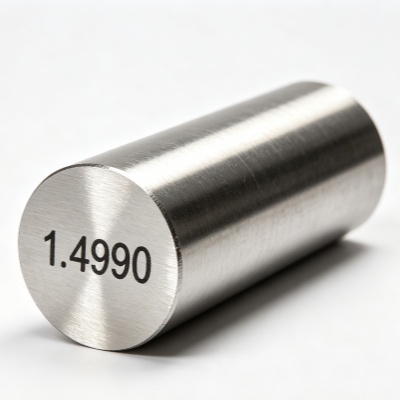
X7NiCrWCoNbNB25-23-3-3-2, designated as EN 1.4990, UNS S31035, and commercially known as Sanicro® 25 (Alleima), is the world’s most advanced commercially available austenitic heat-resistant steel for ultra-supercritical boiler tubing. FUSHUN METAL supplies this mission-critical grade under ISO 9001:2015 and AS9120B certified quality systems with full material traceability from melt to shipment. Unlike all preceding 300-series heat-resistant grades, 1.4990 is not an evolutionary modification of a standard stainless steel—it is a purpose-built, multi-element microalloyed super-austenitic alloy engineered through four simultaneous strengthening mechanisms that operate in parallel from room temperature to 700°C: tungsten (3.0–4.0%) for potent solid-solution strengthening of the austenitic matrix; copper (2.5–3.5%) for coherent nano-scale Cu-rich precipitate strengthening that resists coarsening up to ~700°C; niobium (0.4–0.6%) combined with nitrogen (0.20–0.30%) to form thermally stable MX-phase carbonitride dispersoids that pin grain boundaries; and boron (0.002–0.008%) segregating to grain boundaries to suppress cavity nucleation and dramatically improve creep ductility. Cobalt (1.0–2.0%) further stabilizes the austenitic matrix and retards the formation of embrittling sigma and Laves phases during decades of service. The result is a 700°C / 100,000-hour creep-rupture strength of approximately 100–110 MPa—a figure that places 1.4990 in a performance class previously achievable only with nickel-based superalloys such as Alloy 617 and Haynes 230, but at roughly 30–50% lower material cost due to its 25% nickel content versus 50–60% Ni in true superalloys. The grade is approved under ASME Code Case 2753-1 (Section I) and 2752-1 (Section VIII Division 1), carries VdTÜV material data sheet 555, and is recognized by the China Pressure Vessel Approval (CSCBPV BV-ME-210). It is the material of record for final-stage superheater and reheater tubing in advanced ultra-supercritical (A-USC) coal-fired power plants operating at steam temperatures of 620–650°C and metal temperatures up to 700°C.
X7NiCrWCoNbNB25-23-3-3-2 (1.4990 / S31035) Overview
Sanicro 25 / 1.4990 represents the pinnacle of austenitic heat-resistant steel development, occupying the critical performance and cost gap between conventional 18Cr-8Ni stainless steels (304H, 347H) and full nickel-based superalloys (Alloy 617, Haynes 230). Its nominal composition—approximately 22.5% Cr, 25% Ni, 3.6% W, 3.0% Cu, 1.5% Co, 0.5% Nb, 0.23% N, 0.005% B—was systematically optimized through decades of collaborative research between Sandvik (now Alleima) and European power-generation consortia to achieve a specific design target: 100 MPa minimum creep-rupture strength at 700°C for 100,000 hours, with full microstructural stability and no embrittlement. At FUSHUN METAL, every heat of 1.4990 is verified by optical emission spectroscopy with independent quantification of all ten alloying elements, then solution-annealed at 1180–1250°C followed by rapid quenching to dissolve all precipitate phases into a fully austenitic, equiaxed grain structure from which the designed precipitation sequence—primary MX carbonitrides during cooling, secondary Cu-rich nanoclusters during service—can activate on demand. The grade exhibits excellent isothermal and cyclic oxidation resistance in air and steam at 650–750°C, with mass-change rates an order of magnitude lower than conventional 18Cr-8Ni grades. Hot corrosion resistance in coal-ash and alkali-sulfate environments is similarly outstanding, attributable to the high 22.5% chromium content and the protective effect of the copper addition. Unlike many high-alloy austenitics, Sanicro 25 does not precipitate embrittling sigma or Laves phases during 100,000-hour exposure at 700°C—Cobalt and the carefully balanced Cr/Ni ratio actively suppress these deleterious intermetallics. Primary application is A-USC boiler tubing, but the grade is also being evaluated for next-generation concentrated solar power (CSP) receivers, supercritical CO₂ (sCO₂) power cycle heat exchangers, and other emerging high-temperature energy technologies where the combination of extreme creep strength, oxidation resistance, and cost-effectiveness is essential.
Typical Applications — Advanced Ultra-Supercritical (A-USC) Boilers
Final Superheaters
- 700°C metal-temp outlet tube banks
- Platen superheater hot-end sections
- Pendant superheater assemblies
- Steam-cooled support tubes
High-Temp Reheaters
- Reheater hot-end tube bundles (650-700°C)
- Reheater outlet headers
- Inter-stage desuperheater liners
High-Temp Headers & Piping
- 700°C-class main steam headers
- Hot reheat steam piping
- Turbine bypass station piping
- Attemperator spray chambers
Emerging Applications
- sCO₂ power cycle heat exchangers
- CSP receiver tube panels
- 700°C-class molten-salt piping
- Next-gen nuclear steam generators
- Hydrogen-fired boiler superheaters
X7NiCrWCoNbNB25-23-3-3-2 Supply Range — FUSHUN METAL
FUSHUN METAL stocks and processes Sanicro 25 (1.4990 / S31035) in the standard dimensional ranges certified under VdTÜV datasheet 555 and ASME Code Case 2753. Every shipment includes MTC 3.1 documentation with heat number, full optical emission spectroscopy of all ten controlled elements (W, Co, Cu, Nb, N, B in addition to C/Cr/Ni/Mn/Si), room-temperature and elevated-temperature mechanical properties, grain size per ASTM E112, and dimensional conformance. Third-party inspection and supplementary testing are available on request.
| Product Form | Process | Diameter / Dimension Range | Notes |
|---|---|---|---|
| Seamless Boiler Tube | Cold-Pilgered, Solution-Annealed | OD: 25 – 114.3mm; WT: 4.5 – 12.5mm | Per VdTÜV 555 & ASTM A213; white-pickled |
| Seamless Tube (extended) | Cold-Drawn / Hot-Finished | OD: 6 – 168mm; WT: 0.5 – 30mm | L: up to 18000mm; for broader dimensional needs |
| Round Bar | Hot-Rolled / Forged | Φ10mm – Φ500mm | L: 3000 – 12000mm; per ISO 4955 |
| Plate / Sheet | Hot-Rolled / Cold-Rolled | T: 0.5 – 100mm | W: 1000 – 2500mm; upon inquiry |
| Forging | Open-Die / Closed-Die | Custom: headers, flanges, rings, tube sheets — to customer drawing | |
Chemical Composition — X7NiCrWCoNbNB25-23-3-3-2 per EN 10216-5 / ASTM A213
At FUSHUN METAL, each incoming heat of 1.4990 is verified by optical emission spectroscopy with independent quantification of all ten alloying and microalloying elements. The multi-element nature of this grade—particularly the ppm-level boron addition—demands precise analytical control; FUSHUN METAL’s laboratory is equipped to verify the full composition, including B by ICP-OES or spark-OES with dedicated boron channels. The strengthening synergy between W, Cu, Nb, N, and B is critically dependent on each element falling within its specified range.
| Element | C | Si | Mn | Cr | Ni | W | Cu | Co | Nb | N | B |
|---|---|---|---|---|---|---|---|---|---|---|---|
| Min | 0.04 | — | — | 21.5 | 23.5 | 3.0 | 2.5 | 1.0 | 0.4 | 0.20 | 0.002 |
| Max | 0.10 | 0.40 | 0.60 | 23.5 | 26.5 | 4.0 | 3.5 | 2.0 | 0.6 | 0.30 | 0.008 |
Iron (Fe) balance; P ≤0.025%, S ≤0.015%. Nominal chemistry: 22.5Cr / 25Ni / 3.6W / 3.0Cu / 1.5Co / 0.5Nb / 0.23N / 0.005B. The 11-element control (10 elements listed + Fe) makes this the most analytically demanding grade FUSHUN METAL handles. The boron window—only 60 ppm wide (20–80 ppm)—is the tightest in commercial steelmaking; our laboratory verifies boron content on every heat certificate using ICP-OES.
Mechanical Properties — Sanicro 25 / 1.4990 in Solution-Annealed Condition
Values below represent room-temperature and elevated-temperature properties after solution annealing at 1180–1250°C with rapid quenching, per ISO 4955, ASTM A213, and published data for Sanicro 25. Creep-rupture values are from ASME Code Case 2753 and VdTÜV 555 approved design curves. FUSHUN METAL’s heat treatment furnaces are instrumented with embedded thermocouples and logged continuously—the 1180–1250°C solution window is significantly tighter than for standard stainless grades, and precise temperature control is essential for complete precipitate dissolution without incipient grain growth.
| Property | Metric Value | Imperial Value | Remarks |
|---|---|---|---|
| Tensile Strength (Rm) | 650–850 MPa | 94–123 ksi | Room temp, solution-annealed; significantly above 304H/347H |
| Yield Strength (Rp0.2) | ≥310 MPa | ≥45 ksi | 50%+ higher than 304H/321H/347H (~205 MPa) |
| Yield Strength (Rp1.0) | ≥350 MPa | ≥51 ksi | 1.0% proof stress for design code use |
| Elongation (A) | ≥35–40% | ≥35–40% | Excellent ductility despite high strength |
| Hardness | ≤185 HBW | — | As-solution-annealed per ISO 4955 |
| Density | ~8.0 g/cm³ | ~0.289 lb/in³ | Comparable to standard stainless steels |
| Creep Strength 700°C | ~100–110 MPa | ~14.5–16 ksi | 100,000-hour rupture; highest of any austenitic steel |
| Creep Strength 650°C | ~175 MPa | ~25.4 ksi | 100,000-hour rupture |
| Max. Metal Temp | ~700°C (design) | ~1290°F | Continuous service per ASME CC 2753; 750°C short-term peak |
Frequently Asked Questions on Sanicro 25 / X7NiCrWCoNbNB25-23-3-3-2
Why does Sanicro 25 outperform all other austenitic stainless steels at 700°C?
The answer lies in its four simultaneous, mutually reinforcing strengthening mechanisms. First, tungsten (3.0–4.0%) is a potent solid-solution strengthener—its large atomic radius impedes dislocation climb and glide, the rate-controlling creep mechanism in austenitic steels. Second, copper (2.5–3.5%) precipitates as coherent, nanometer-scale Cu-rich clusters that resist coarsening up to approximately 700°C, providing sustained precipitation hardening that does not fade with time as conventional carbide precipitates do. Third, niobium and nitrogen form thermally stable MX-phase carbonitride dispersoids that pin grain boundaries and impede grain-boundary sliding. Fourth, boron (0.002–0.008%) segregates to grain boundaries at the atomic level, suppressing cavity nucleation and dramatically improving creep ductility—this is the same mechanism that makes boron essential in nickel-based superalloys. No other austenitic stainless steel deploys all four mechanisms simultaneously; Super304H (UNS S30432) uses Cu + Nb + N, HR3C (UNS S31042) uses Nb + N + high Cr, but neither matches the W solid-solution + Cu nanoprecipitate + Nb-MX + B grain-boundary combination of Sanicro 25.
How does 1.4990 compare economically to nickel-based superalloys?
This is the defining economic proposition of Sanicro 25. At 700°C and 100,000 hours, its creep-rupture strength of ~100–110 MPa is comparable to that of nickel-based alloys such as Alloy 617 (UNS N06617, ~50–60% Ni) and approaches that of Alloy 740H. However, Sanicro 25 contains only ~25% nickel—less than half the nickel content of true superalloys—and contains no expensive refractory elements such as molybdenum (replaced by the more cost-effective tungsten). Raw material cost is approximately 30–50% lower. Additionally, Sanicro 25 can be melted, forged, rolled, and pilgered on conventional stainless steel production equipment, whereas nickel superalloys require specialized vacuum melting (VIM + ESR/VAR) and are far more difficult to hot-work. The result: a finished boiler tube in Sanicro 25 costs roughly 40–50% less than an equivalent Alloy 617 tube, while delivering comparable 700°C performance, making A-USC power plants economically viable at a system level.
What welding procedures are required for Sanicro 25?
Sanicro 25 welds readily using TIG/GTAW (preferred), GMAW/MIG, and SMAW processes with matched-composition filler metals. No preheating is required, and post-weld heat treatment is generally not necessary for intergranular corrosion resistance—the niobium + boron addition effectively stabilizes the microstructure against sensitization. Heat input should be controlled below 2.0 kJ/mm, and interpass temperature should be maintained at or below 150°C. Recommended filler metal is AWS ERNiCrCoMo-1 (Alloy 617 filler) for maximum creep-rupture strength across the joint, or a matched Sanicro 25 composition where available. After welding, if cold deformation exceeds 20% or the R/D ratio is less than 2.5, re-solution annealing at 1180–1250°C is recommended to restore full creep properties. FUSHUN METAL can supply matched or compatible filler materials and provide welding procedure guidance for specific joint configurations and service conditions.
Is Sanicro 25 susceptible to sigma or Laves phase embrittlement?
No—this is one of the grade’s defining metallurgical achievements. The combination of 25% nickel, 1.5% cobalt, and the precisely balanced Cr/Ni ratio suppresses sigma-phase and Laves-phase nucleation kinetics to the point where no measurable embrittlement occurs during 100,000-hour exposure at 700°C. This microstructural stability has been validated through extensive long-term creep testing by the grade’s developers and is documented in the ASME Code Case and VdTÜV approval data. The absence of embrittling phases means that Sanicro 25 retains its full ductility and toughness after decades of service—unlike many high-alloy ferritic steels (Grade 91, Grade 92) and some leaner austenitics that progressively embrittle through Laves or Z-phase formation. This is a critical safety property for pressure-boundary components in A-USC boilers, where a brittle failure mode would compromise the defense-in-depth safety philosophy.
What certifications accompany FUSHUN METAL shipments of Sanicro 25 / 1.4990?
Every shipment of Sanicro 25 (X7NiCrWCoNbNB25-23-3-3-2 / 1.4990 / S31035) from FUSHUN METAL is supplied with an EN 10204 Type 3.1 Mill Test Certificate bearing heat number, full optical emission spectroscopy of all ten controlled elements (C, Si, Mn, P, S, Cr, Ni, W, Cu, Co, Nb, N, B—with boron verified by ICP-OES), mechanical property results (tensile, yield at room temperature, elongation, hardness), grain size per ASTM E112, and dimensional conformance. The material is produced and verified under our ISO 9001:2015 registered quality management system, with AS9120B protocols governing traceability, storage, handling, and documentation retention. For A-USC boiler projects, FUSHUN METAL offers the full suite of supplementary testing required by ASME Code Case 2753 and VdTÜV 555: elevated-temperature tensile testing at the design temperature, creep-rupture testing per ISO 204 or ASTM E139 at the customer’s specified temperature and stress, isothermal and cyclic oxidation testing, microstructural characterization including SEM/EDS verification of precipitate type and distribution, third-party witnessed testing, PMI of all alloying elements (including tungsten and cobalt by portable XRF), and custom test protocols defined at the time of order placement. All test equipment is calibrated to national standards and all records are archived for the full plant design life.