
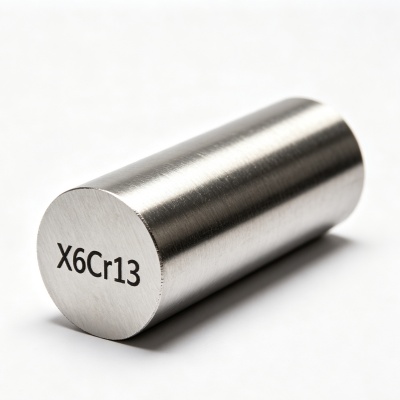
X6Cr13, designated as EN 1.4000, UNS S41008, and JIS SUS410S (trade name AISI 410S), is a low-carbon martensitic stainless steel that occupies a unique metallurgical position: it bridges the gap between hardenable martensitic grades and non-hardenable ferritic grades. FUSHUN METAL supplies this versatile material under ISO 9001:2015 and AS9120B certified quality systems. The defining design choice in X6Cr13 is its deliberately low carbon content—capped at 0.08% versus the 0.15% allowed in standard 410 (S41000)—which fundamentally alters its behavior in two critical ways. First, it suppresses the formation of hard, brittle martensite in the heat-affected zone during welding, making 410S far more weldable than standard 410 without the need for elaborate preheat and post-weld heat treatment protocols. Second, in the annealed condition, the microstructure is predominantly ferritic with only limited martensite islands, giving it a softer, more ductile, more formable character than its higher-carbon sibling—yet it retains the ability to be hardened through quenching and tempering when higher strength is required for the finished component. With approximately 12–14% chromium and negligible nickel (≤0.60%), X6Cr13 offers a compelling intermediate cost position: it is approximately 50% more expensive than the leanest ferritic grade (X2CrTi12 / 409) but still 30–40% cheaper than the cheapest austenitic grade (304), making it the preferred choice for applications that need better corrosion resistance than 409 but cannot justify the nickel cost of 304.
X6Cr13 (1.4000 / S41008) Overview
X6Cr13 is classified under EN 10088-2 and ASTM A240 as a martensitic stainless steel, though in the fully annealed condition its microstructure is often described as predominantly ferritic—a duality that reflects the grade’s carbon level straddling the boundary between ferrite-stabilized and martensite-forming behavior. The 12–14% chromium content is sufficient to form a protective passive oxide film that provides good resistance to atmospheric corrosion, fresh water, mild organic and inorganic acids, and dilute alkaline solutions—performance that is notably superior to the 10.5–12.5% Cr of 409. At FUSHUN METAL, every heat of X6Cr13 is verified by optical emission spectroscopy, with particular attention to the carbon level, which is the single most important quality variable for this grade. Material is supplied in either the annealed condition (830–880°C slow cool, hardness ≤183 HBW) for formability and weldability, or in the quenched-and-tempered condition (950–1050°C oil quench + 400–750°C temper) for applications requiring higher strength—typically achieving yield strengths exceeding 345 MPa, a 60%+ improvement over the annealed state. The grade exhibits good oxidation resistance in continuous service up to approximately 705°C, is fully ferromagnetic in all heat treatment conditions, and has thermal conductivity (~25–30 W/m·K) and thermal expansion (~10.6–11 × 10⁻⁶/K) values characteristic of the body-centered-cubic (BCC) crystal structure, providing superior dimensional stability under thermal cycling compared to austenitic grades. Key industries served include chemical processing (mild-corrosion vessels and piping), food and beverage equipment, automotive exhaust and structural components, heat exchangers, general mechanical engineering, and consumer appliance manufacturing.
Typical Applications by Industry
Chemical Processing
- Mild-corrosion storage tanks
- Low-pressure process piping
- Heat exchanger shells & plates
- Valve bodies & trim (non-acid)
- Agitator shafts & impellers
Food & Beverage
- Sanitary-grade vessel liners
- Conveyor & processing frames
- Mixing tank bodies
- Pasteurizer plate packs
- Food-grade pipe fittings
Automotive Components
- Exhaust system muffler shells
- Catalytic converter housings
- Exhaust pipe sections
- Underground fuel piping
- Structural brackets & supports
Heat Exchangers
- Shell-and-tube exchanger shells
- Tube sheets (mild media)
- Baffle plates & tie rods
- Water-cooled condenser bodies
- Oil cooler housings
Consumer Appliances
- Kitchen sink bodies & bowls
- Cookware & utensil components
- Bathroom fixture bodies
- Washing machine structural parts
- Water heater burner tubes
Mechanical Engineering
- Pump shafts & impellers
- Fasteners (bolts, studs, nuts)
- Bearing housings & sleeves
- Guide rails & wear strips
- Hydraulic cylinder bodies
Medical Equipment
- Surgical instrument handles & bodies
- Sterilizer tray frames
- Dental tool components
- Laboratory bench frames
Infrastructure & Utilities
- Underground water piping
- Sewage treatment components
- Bridge bearing plates
- Fire hydrant bodies
X6Cr13 Supply Range — FUSHUN METAL
FUSHUN METAL stocks and processes X6Cr13 (1.4000 / 410S) in annealed or quenched-and-tempered conditions as specified by the customer. Every shipment includes MTC 3.1 documentation with heat number, full optical emission spectroscopy, mechanical test results, and dimensional conformance. Third-party inspection, PMI, and supplementary testing are available on request.
| Product Form | Process / Condition | Thickness / Diameter Range | Width / Length & Notes |
|---|---|---|---|
| Hot-Rolled Plate | Annealed / Q+T | T: 3.0 – 100mm | W: 1000 – 2500mm; L: up to 12000mm; finish: No.1 |
| Cold-Rolled Sheet | Annealed, 2B / BA Finish | T: 0.3 – 3.0mm | W: 1000 – 2000mm; coil or cut-to-length |
| Round Bar | Hot-Rolled / Forged; Annealed or Q+T | Φ5mm – Φ500mm | L: 3000 – 12000mm; per ASTM A276 |
| Flat Bar | Hot-Rolled | T: 3 – 40mm; W: 10 – 150mm | L: 3000 – 6000mm |
| Seamless Tube | Cold-Drawn / Hot-Finished | OD: 6 – 168mm; WT: 0.5 – 20mm | L: up to 12000mm; ASTM A268 / EN 10216-5 |
| Forging / Flange | Open-Die; Annealed or Q+T | Custom: shafts, discs, flanges, valve bodies — to customer drawing per ASTM A182 F410S | |
Chemical Composition — X6Cr13 per EN 10088-2 / ASTM A240
At FUSHUN METAL, each incoming heat is verified by optical emission spectroscopy. The carbon level is the single most critical quality variable for 410S: it must be kept below 0.08% to ensure the grade behaves as intended during welding (limited HAZ hardening) while retaining enough carbon to permit hardening by quench-and-temper when desired for the finished component.
| Element | C | Si | Mn | P | S | Cr | Ni |
|---|---|---|---|---|---|---|---|
| Value (%) | ≤0.08 | ≤1.00 | ≤1.00 | ≤0.040 | ≤0.030 | 11.5–13.5 (ASTM) 12.0–14.0 (EN) |
≤0.60 |
Iron (Fe) balance. EN 10088-2 limits S to ≤0.015% (tighter than ASTM’s 0.030%). The nickel level is residual only (≤0.60%)—this grade is not alloyed with nickel. Compared to standard 410 (S41000 / 1.4006, C ≤0.15%), the carbon reduction is the defining metallurgical feature: it suppresses the martensite start (Ms) temperature to such an extent that air cooling from the annealing temperature produces a predominantly ferritic structure rather than the hard martensitic structure characteristic of standard 410.
Mechanical Properties — X6Cr13 in Annealed and Quenched+Tempered Conditions
X6Cr13 / 410S is unique among the grades in this product series because its mechanical properties can be engineered across a wide range through heat treatment. The annealed condition optimizes formability and weldability; the quenched-and-tempered condition delivers significantly higher strength for structural and wear applications. FUSHUN METAL supplies in either condition, with heat treatment cycles fully instrumented and logged for ISO 9001 and AS9120B traceability.
| Property | Annealed | Q+T (Typical) | Remarks |
|---|---|---|---|
| Tensile Strength (Rm) | ≥410–500 MPa | ≥490 MPa | 60–75 ksi annealed; typical range 480–620 MPa |
| Yield Strength (Rp0.2) | ≥205–260 MPa | ≥345 MPa | 30–38 ksi annealed; Q+T adds ~60%+ strength gain |
| Elongation (A) | ≥20–25% | ≥24% | Good ductility retained even in Q+T condition |
| Reduction of Area | — | ≥60% | Indicates excellent toughness in Q+T condition |
| Hardness | ≤183 HBW | 183–250 HBW | Hardness controllable via tempering temperature |
| Density | ~7.75 g/cm³ (0.280 lb/in³) | Ambient temperature | |
| Thermal Conductivity | ~25–30 W/m·K | Excellent heat transfer; ~55% above austenitic grades | |
| Thermal Expansion | ~10.6–11 × 10⁻⁶/K | Low thermal expansion; good dimensional stability | |
| Magnetic? | YES (all conditions) | Ferromagnetic in annealed and Q+T states | |
| Max. Service Temp | ~705°C (oxidation limit) | Long-term recommended: 500°C max | |
Frequently Asked Questions on X6Cr13 / 410S
What makes 410S different from standard 410?
Carbon content—and its cascading metallurgical consequences. Standard 410 (S41000, 1.4006) allows up to 0.15% carbon. At this level, air cooling from the annealing temperature produces a predominantly hard martensitic structure (HRC 35–45), and welding generates a brittle, crack-susceptible heat-affected zone that demands preheat at 200–300°C and immediate post-weld tempering. 410S (S41008) caps carbon at 0.08%, which depresses the martensite-start temperature sufficiently that air cooling yields a predominantly ferritic structure that is soft, formable, and—crucially—resistive to HAZ cracking during welding with only moderate precautions (preheat 150–200°C, post-weld stress relief at 650–750°C). The trade-off: 410S cannot achieve the same peak hardness as 410 after quench-and-temper, topping out at approximately 250 HBW versus 350–400 HBW for fully hardened 410. For applications requiring both weldability and moderate strength, 410S is the correct choice; for maximum hardness in non-welded components (cutlery, valve seats, pump shafts), standard 410 is specified.
Is X6Cr13 martensitic or ferritic? The answer matters.
It is both—depending on heat treatment condition—and this duality is the grade’s defining characteristic. In the fully annealed condition (830–880°C, slow cool), the microstructure is predominantly ferrite with only small islands of martensite or pearlite, and the material behaves mechanically like a ferritic stainless. In the quenched-and-tempered condition (950–1050°C oil quench + temper at 400–750°C), the structure transforms to tempered martensite with substantially higher strength. This means the same heat of steel can serve two different application profiles: as-annealed sheet for welded exhaust components and formed appliance bodies, and Q+T bar for pump shafts and high-strength fasteners. No other grade in this product series offers this dual heat-treatment capability—the ferritic 409 cannot be hardened, and the austenitic 304H/321H/347H harden only by cold work, not by heat treatment.
What welding procedures does FUSHUN METAL recommend for 410S?
X6Cr13 / 410S welds significantly more easily than standard 410, but it still requires more care than austenitic or Ti-stabilized ferritic grades. Recommended practice: TIG (GTAW) is preferred; MIG (GMAW) and SMAW are acceptable. Preheat to 150–200°C to slow the cooling rate and minimize HAZ hardness. Use AWS ER410 or ER410NiMo filler metal to match the base metal composition. Maintain interpass temperature below 300°C. After welding, perform a post-weld stress relief at 650–750°C for 30 minutes per 25mm of thickness, followed by slow cooling in still air or furnace—this tempers any martensite that may have formed in the HAZ and restores ductility. Do NOT use austenitic filler metals (ER308, ER309) unless the service environment specifically demands it, as the galvanic mismatch between austenitic weld metal and martensitic base metal can accelerate corrosion at the fusion line in aqueous environments.
How does 410S compare to 409 (X2CrTi12) for automotive exhaust?
Both grades are widely used in exhaust systems, but they represent different cost-performance tiers. 409 (X2CrTi12) is titanium-stabilized, contains ~11% Cr, and is inherently ferritic in all conditions—it cannot be hardened by heat treatment. Its titanium stabilization makes it highly weldable with minimal procedure controls, and its lower chromium content makes it the more economical choice. 410S (X6Cr13) contains ~12–14% Cr, is not stabilized with titanium, and offers slightly better corrosion and oxidation resistance due to the higher chromium content. For the bulk of the exhaust system (muffler shells, tailpipes, mid-pipes), 409 is the standard choice on a cost basis. 410S is typically specified for components closer to the engine where exhaust gas temperatures are higher (500–700°C range) and where the extra oxidation resistance justifies the incremental material cost. Both grades are magnetic, have similar thermal expansion, and can be formed using similar tooling—they are, in many ways, complementary rather than competitive.
What certifications accompany FUSHUN METAL shipments of X6Cr13?
Every shipment of X6Cr13 (1.4000 / S41008 / SUS410S) from FUSHUN METAL is supplied with an EN 10204 Type 3.1 Mill Test Certificate bearing heat number, full chemical analysis by optical emission spectroscopy (with particular attention to carbon verification, the grade’s defining quality variable), mechanical property results (tensile, yield, elongation, hardness in the as-supplied heat treatment condition), and dimensional conformance report. The material is produced and verified under our ISO 9001:2015 registered quality management system, with AS9120B protocols governing traceability, storage, handling, and documentation retention. For critical applications, FUSHUN METAL offers supplementary testing including: hardness traverse across welded joints to verify HAZ softening, impact testing per ISO 148-1 or ASTM E23 (particularly important for Q+T material in low-temperature service), intergranular corrosion testing, metallographic examination of microstructure and grain size, third-party witnessed testing, PMI, and custom test protocols defined at the time of order placement. All test equipment is calibrated to national standards.