
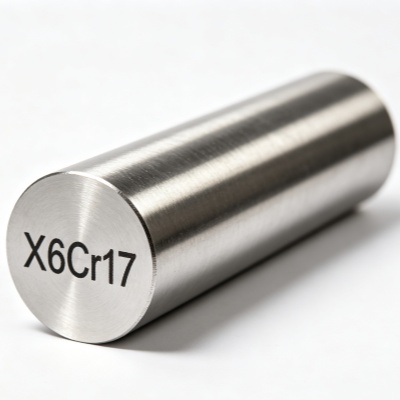
X6Cr17, designated as EN 1.4016, UNS S43000, and JIS SUS430 (trade name AISI 430), is the world’s most widely produced ferritic stainless steel and the definitive general-purpose chromium stainless grade. FUSHUN METAL supplies this high-volume material under ISO 9001:2015 and AS9120B certified quality systems. X6Cr17 sits at the sweet spot of the ferritic stainless steel family: its 16–18% chromium content—approximately 50% higher than that of the leaner 409 (X2CrTi12, ~11% Cr)—delivers a meaningful step-up in atmospheric corrosion resistance, oxidation resistance, and surface aesthetics, while its deliberate exclusion of nickel keeps raw-material costs roughly 40–50% below those of austenitic 304 (X5CrNi18-10). The grade is non-hardenable by heat treatment, fully ferritic in all conditions, and inherently ferromagnetic—properties that make it the material of choice for induction-compatible cookware, magnetic-attachment appliance panels, and any application where the combination of bright polished surface finish, moderate corrosion resistance, and low cost defines the value proposition. With continuous oxidation resistance rated up to 815°C and intermittent tolerance to 870°C, X6Cr17 also serves in moderately elevated-temperature applications where its higher chromium content and lack of nickel-induced sigma-phase issues make it a safer choice than austenitic grades for certain thermal-cycling environments.
X6Cr17 (1.4016 / S43000) Overview
X6Cr17 is classified under EN 10088-2 and ASTM A240 as a ferritic stainless steel—the body-centered-cubic (BCC) crystal structure is stable from room temperature to the melting point, and no phase transformation occurs during heating or cooling. This metallurgical simplicity is both a strength and a limitation: it means the grade cannot be hardened by quenching (there is no austenite-to-martensite transformation), but it also means the annealing cycle is straightforward—heat to 750–850°C, air cool, and the structure is fully softened and ready for forming. At FUSHUN METAL, every heat of X6Cr17 is verified by optical emission spectroscopy, with particular attention to chromium content—the 16–18% Cr window is what distinguishes 430 from 409 (~11% Cr) and gives it its characteristic balance of properties. The grade exhibits good resistance to atmospheric corrosion, fresh water, mild organic acids, and food-contact environments, and its polished surface can achieve a bright, reflective finish that is the aesthetic standard for decorative stainless applications. Oxidation resistance is excellent for a non-nickel grade: continuous service to 815°C, intermittent exposure to 870°C. Two important cautions apply to ferritic grades of this chromium level: prolonged exposure between 400°C and 600°C can cause 475°C embrittlement (alpha-prime phase formation), and exposure between 550°C and 850°C can cause sigma-phase embrittlement in higher-chromium ferritics—though 430 is less susceptible than grades with >20% Cr. Welding is feasible but requires preheat (150–200°C), low heat input, and post-weld annealing at 790–815°C to restore ductility to the coarsened heat-affected zone. Key industries served include household appliances, kitchen equipment, architectural decoration, automotive trim, food processing equipment, and light industrial applications where cost, aesthetics, and moderate corrosion resistance are the primary selection drivers.
Typical Applications by Industry
Kitchen Equipment
- Stainless steel sinks & basins
- Gas stove & cooktop panels
- Range hood bodies & ducts
- Oven interior liners & trays
- Dishwasher inner cabinets
- Food preparation worktables
Home Appliances
- Washing machine drums & tubs
- Refrigerator door panels & sides
- Microwave oven cavities
- Water heater outer shells
- Tumble dryer drums
Architectural & Decorative
- Elevator door cladding & interiors
- Curtain wall panels & facades
- Interior partition panels
- Handrail & balustrade systems
- Roof cladding & flashing
- Signage & display frames
Automotive Trim
- Exterior decorative trim strips
- Exhaust system decorative tips
- Wheel cover inserts
- Interior decorative panels
- Grille & bezel components
Food & Beverage Processing
- Non-acidic storage tanks
- Conveyor belt covers & trays
- Mixing vessel bodies
- Bottling line components
- Bakery trays & racks
Furniture & Interior Design
- Table tops & counter surfaces
- Cabinet door panels
- Shelf brackets & supports
- Lighting fixture bodies
- Decorative inlays & trim
Industrial Equipment
- Mild-environment storage tanks
- Heat exchanger shells (non-acid)
- Ducting & ventilation panels
- Machine guarding & covers
Medical & Laboratory
- Non-implantable instrument trays
- Laboratory bench tops & frames
- Equipment housing panels
- Low-corrosion storage cabinets
X6Cr17 Supply Range — FUSHUN METAL
FUSHUN METAL stocks and processes X6Cr17 (1.4016 / 430) in high-volume form, manufactured under ISO 9001:2015 quality management and AS9120B distribution protocols. Every shipment includes MTC 3.1 documentation with heat number, full optical emission spectroscopy, mechanical test results, and dimensional conformance. As the world’s most widely produced ferritic stainless grade, lead times are short and minimum order quantities are flexible.
| Product Form | Process / Condition | Thickness / Diameter Range | Width / Length & Notes |
|---|---|---|---|
| Cold-Rolled Sheet | Annealed; 2B / BA / No.4 / Hairline | T: 0.3 – 3.0mm | W: 1000 – 2000mm; coil or cut-to-length; mirror polish available |
| Hot-Rolled Plate | Annealed; No.1 Finish | T: 3.0 – 100mm | W: 1000 – 2500mm; L: up to 12000mm |
| Bright Round Bar | Cold-Drawn; Annealed; Bright Finish | Φ3 – 100mm | L: 3000 – 6000mm; tight tolerance h8/h9 |
| Hot-Rolled Round Bar | Hot-Rolled; Annealed | Φ10mm – Φ200mm | L: 3000 – 6000mm; per ASTM A276 |
| Flat / Square / Hex Bar | Hot-Rolled / Cold-Drawn | Various: 3 – 80mm section | L: 3000 – 6000mm |
| Seamless Tube | Cold-Drawn / Hot-Finished | OD: 6 – 168mm; WT: 0.5 – 15mm | L: up to 12000mm; upon inquiry |
| Welded Tube | HF / TIG Welded; Annealed | OD: 8 – 168mm; WT: 0.5 – 6.0mm | L: up to 6000mm; pickled or polished finish |
Chemical Composition — X6Cr17 per EN 10088-2 / ASTM A240
At FUSHUN METAL, each heat is verified by optical emission spectroscopy. The chromium level—16–18%—is the defining compositional parameter: it is high enough to deliver a visible improvement in corrosion and oxidation resistance over the leaner 10.5–12.5% Cr grades, yet low enough to avoid the sigma-phase embrittlement issues that affect ferritic grades above ~20% Cr during prolonged thermal exposure.
| Element | C | Si | Mn | P | S | Cr | Ni |
|---|---|---|---|---|---|---|---|
| EN (%) | ≤0.08 | ≤1.00 | ≤1.00 | ≤0.040 | ≤0.015 | 16.0–18.0 | — |
| ASTM (%) | ≤0.12 | ≤1.00 | ≤1.00 | ≤0.040 | ≤0.030 | 16.0–18.0 | ≤0.75 |
Iron (Fe) balance. Zero intentional nickel addition—the trace Ni in ASTM 430 is a residual from the melting process, not an alloying addition. The EN standard is tighter on sulfur (≤0.015%) and carbon (≤0.08%). Unlike 409 (X2CrTi12), 430 contains no titanium stabilizer, which simplifies the chemistry but reduces weldability and intergranular corrosion resistance in the as-welded condition.
Mechanical Properties — X6Cr17 in Annealed Condition
Values below represent room-temperature properties after annealing at 750–850°C with air cooling, per EN 10088-2 and ASTM A240. Mechanical properties vary by product form and thickness; the table below separates thin sheet (t≤8mm) and plate (t>8mm) per EN 10088-2 where the standard distinguishes them. Note: 430 cannot be hardened by heat treatment—strength increases can only be achieved through cold working.
| Property | Metric Value | Imperial Value | Remarks |
|---|---|---|---|
| Tensile Strength (Rm) | 400–630 MPa | 58–91 ksi | Range depends on thickness; thin sheet: 450–600 MPa |
| Yield Strength (Rp0.2) | ≥240–280 MPa | ≥35–41 ksi | Sheet t≤8mm: ≥260 MPa; plate t>8mm: ≥240 MPa |
| Elongation (A) | ≥18–22% | ≥18–22% | Sheet t≤8mm: ≥20%; plate t>13.5mm: ≥20% |
| Hardness | ≤200–201 HBW | ≤~94 HRB | Annealed condition |
| Density | ~7.7 g/cm³ | ~0.278 lb/in³ | Ambient temperature |
| Elastic Modulus | ~200–220 GPa | ~29–32 × 10⁶ psi | Slightly higher than austenitic grades (~195 GPa) |
| Thermal Conductivity | ~25 W/m·K | ~173 BTU/h·ft·°F | At 20°C; ~55% above austenitic grades |
| Thermal Expansion | ~10.4 × 10⁻⁶/K | ~5.8 × 10⁻⁶/°F | 20–100°C; ~40% lower than austenitic grades |
| Magnetic? | YES | — | In all conditions; ideal for induction cooktops |
| Max. Service Temp | 815°C (cont.) | 1500°F | Intermittent: 870°C; avoid prolonged 400–600°C (embrittlement) |
Frequently Asked Questions on X6Cr17 / 430
Why is 430 the most produced ferritic stainless steel in the world?
It occupies the cost-performance optimum. At ~17% chromium, 430 delivers a clearly visible improvement in corrosion resistance, oxidation resistance, and surface aesthetics over the 10.5–12.5% Cr grades (409, 410S)—enough to serve the kitchen, appliance, and architectural markets where appearance and durability matter. Yet it contains zero nickel, keeping its raw-material cost approximately 40–50% below 304. The combination of good formability (deep drawing, bending, roll forming), excellent polishability (bright mirror finishes are standard), full magnetism, and proven performance in millions of everyday products has created an irreplaceable market position: 430 is the default material specification for stainless steel sinks, washing machine drums, refrigerator panels, elevator cladding, and range hood bodies worldwide, with annual production volumes far exceeding any other ferritic grade.
Can X6Cr17 replace 304 in my application?
In indoor, dry, or mildly corrosive environments—yes, and with significant cost savings. In outdoor, marine, acidic, or chloride-rich environments—no. The decision hinges on corrosion resistance. 304 (18% Cr + 8% Ni) forms a more stable and repairable passive film than 430 (17% Cr, no Ni) and resists pitting in chloride-containing environments that would corrode 430 within months. For indoor kitchen equipment, appliance panels, furniture, and architectural interiors, 430 is perfectly adequate and widely specified. For outdoor architectural cladding, marine hardware, chemical processing equipment, or food-contact surfaces exposed to acidic foods (citrus, vinegar), 304 or 316 is required. The magnetic nature of 430 is an advantage for induction-compatible cookware and magnetic-attachment panels, where non-magnetic 304 would be a functional liability.
What are the welding limitations of 430?
430 is considered to have only moderate weldability—this is its principal limitation compared to austenitic and Ti-stabilized ferritic grades. Two simultaneous problems occur in the heat-affected zone: grain coarsening (because ferrite cannot be grain-refined by phase transformation) and martensite formation at grain boundaries (from the small amount of carbon present). Both cause embrittlement. The mitigation strategy is: preheat to 150–200°C, use the lowest practical heat input, and perform post-weld annealing at 790–815°C for 30 minutes per 25mm of thickness followed by rapid air cooling through the 540–400°C brittleness range. Acceptable filler metals include matching ER430, or austenitic fillers (ER308L, ER309, ER310) when the galvanic mismatch between austenitic weld metal and ferritic base metal is acceptable for the service environment. For thin sheet (≤1.5mm), resistance spot welding and seam welding are practical without post-weld annealing, though the weld nugget will be more brittle than the base metal. For structural or pressure-containing welds in plate thicker than 3mm, 430 is generally not recommended—switch to 304L or a Ti-stabilized ferritic grade instead.
What is 475°C embrittlement and why does it matter for 430?
475°C embrittlement (also called alpha-prime embrittlement) is a metallurgical phenomenon unique to ferritic stainless steels with chromium content above approximately 13%. When the material is held for extended periods between approximately 400°C and 550°C, chromium atoms in the ferrite lattice diffuse and cluster into iron-rich and chromium-rich nanoscale domains through a spinodal decomposition mechanism. The chromium-rich domains (alpha-prime phase) are hard and brittle, and their formation causes a dramatic loss of room-temperature ductility and impact toughness—the steel can become glass-brittle while showing no visible change in appearance. This is a genuine service limitation for 430: it should not be used for components that operate continuously in the 400–550°C range, such as certain heat exchanger or furnace parts. If embrittlement has occurred, it can be reversed by re-annealing above 600°C, which dissolves the alpha-prime clusters back into the homogeneous solid solution. This phenomenon does not affect austenitic stainless steels.
What certifications accompany FUSHUN METAL shipments of X6Cr17?
Every shipment of X6Cr17 (1.4016 / S43000 / SUS430) from FUSHUN METAL is supplied with an EN 10204 Type 3.1 Mill Test Certificate bearing heat number, full chemical analysis by optical emission spectroscopy, mechanical property results (tensile, yield, elongation, hardness in the annealed condition), and dimensional conformance report. The material is produced and verified under our ISO 9001:2015 registered quality management system, with AS9120B protocols governing traceability, storage, handling, and documentation retention. For demanding applications, FUSHUN METAL offers supplementary testing including: Erichsen cupping test for deep-draw formability assessment, surface roughness measurement, intergranular corrosion testing, ferrite grain size determination, magnetic permeability measurement, salt-spray corrosion testing (ASTM B117) for comparative performance evaluation, third-party witnessed testing, PMI, and custom test protocols. All test equipment is calibrated to national standards.