
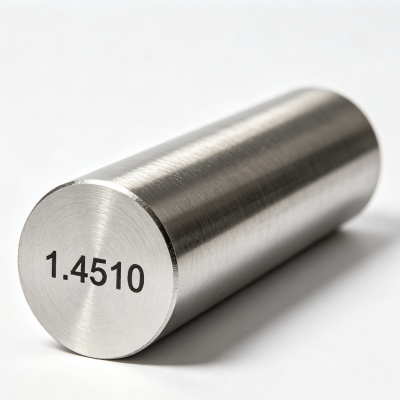
X3CrTi17, designated as EN 1.4510, UNS S43035, and JIS SUS430LX (trade name AISI 439), is the titanium-stabilized evolution of the world’s most-produced ferritic stainless steel—it takes the proven 16–18% chromium foundation of 430 (X6Cr17 / 1.4016) and eliminates its two principal weaknesses through a low-carbon + titanium stabilization strategy. FUSHUN METAL supplies this technically enhanced grade under ISO 9001:2015 and AS9120B certified quality systems. The metallurgical logic is precise: reducing carbon from 0.08% max (430) to 0.03–0.05% max, and adding titanium at [0.20+4×(C+N)] to 1.10% to lock up residual interstitial atoms, transforms 430 from a grade that is easy to form but difficult to weld into one that is both formable AND reliably weldable. The titanium carbides and nitrides formed during solidification are thermally stable and will not dissolve during welding or high-temperature exposure, meaning the chromium at grain boundaries remains untouched and the passive oxide film remains continuous. This upgrade closes the gap between the economics of ferritic stainless (zero nickel, ~17% Cr) and the fabrication flexibility of austenitic grades, making X3CrTi17 the preferred choice for welded assemblies and formed components that must resist intergranular corrosion after joining—hot water tanks, automotive exhaust systems with welded joints, elevator cladding panels, and food/dairy processing equipment that are cleaned with mildly acidic solutions at elevated temperatures.
X3CrTi17 (1.4510 / S43035) Overview
X3CrTi17 is classified under EN 10088-2 and ASTM A240 as a titanium-stabilized ferritic stainless steel. It is the direct metallurgical upgrade of standard 430: same chromium base (~16–19% depending on standard), but with carbon slashed to ≤0.03–0.05% and titanium deliberately added to form stable Ti(C,N) precipitates. At FUSHUN METAL, every heat is verified by optical emission spectroscopy with independent titanium quantification—the Ti:C+N ratio is the defining quality control gate. The annealed microstructure consists of equiaxed ferrite grains with finely dispersed titanium carbonitrides; because Ti locks up carbon and nitrogen, grain-boundary chromium depletion does not occur during welding or thermal exposure, and the grade resists intergranular attack in the as-welded condition without requiring post-weld heat treatment. Corrosion resistance approaches that of 304 in many environments—the 17–19% chromium (ASTM) matches 304’s chromium level, and while the absence of nickel means the passive film is slightly less repairable, the Ti stabilization prevents the sensitization that would otherwise create corrosion pathways. X3CrTi17 also exhibits excellent resistance to chloride stress-corrosion cracking (SCC)—a failure mode that plagues austenitic grades in hot chloride environments—making it a safer choice for hot-water tanks and heat exchangers where chloride-bearing water is present. Oxidation resistance is rated to approximately 850°C continuous. The grade is fully ferromagnetic, has a low coefficient of thermal expansion (~10.4 × 10⁻⁶/K), and offers thermal conductivity approximately 55% higher than austenitic grades. Key industries served include automotive exhaust systems, water heating and plumbing, architectural cladding (elevators, facades), food and dairy equipment, domestic appliances, and industrial heat exchangers in mildly corrosive service.
Typical Applications by Industry
Automotive Exhaust
- Welded exhaust pipe assemblies
- Muffler shells & internals
- Catalytic converter housings
- Flexible coupling bellows
- Exhaust manifold components
Water Heating & Plumbing
- Hot water storage tanks
- Solar water heater panels
- Electric water heater inner liners
- Plumbing fittings & connectors
- Heat pump water tank bodies
Architectural & Cladding
- Elevator interior & door panels
- Escalator cladding & skirts
- Building facade panels
- Roofing & wall cladding
- Canopy & awning structures
Food & Dairy Industry
- Milk processing tanks & piping
- Cheese vat liners
- Brewery fermentation vessels
- Food-grade conveyor systems
- Clean-in-place (CIP) piping
Home Appliances
- Dishwasher inner cabinets
- Washing machine drums & tubs
- Oven interior liners & trays
- Microwave oven cavities
- Refrigerator inner panels
Sanitary Ware
- Stainless steel sink bowls
- Bathroom fixture bodies
- Toilet partition panels
- Public washroom equipment
Heat Exchangers
- Shell-and-tube exchanger tubing
- Condenser tube bundles
- HVAC heating coils
- Waste-heat recovery units
Agricultural Equipment
- Fertilizer storage & handling bins
- Irrigation system components
- Animal water troughs
- Dairy farm piping & fittings
X3CrTi17 Supply Range — FUSHUN METAL
FUSHUN METAL stocks and processes X3CrTi17 (1.4510 / 439) in sheet, coil, bar, and tube form, manufactured under ISO 9001:2015 quality management and AS9120B distribution protocols. Every shipment includes MTC 3.1 with heat number, full spectroscopy (including Ti verification), mechanical test results, and dimensional conformance.
| Product Form | Process / Condition | Thickness / Diameter Range | Width / Length & Notes |
|---|---|---|---|
| Cold-Rolled Sheet | Annealed; 2B / BA / No.4 / HL | T: 0.3 – 3.0mm | W: 1000 – 2000mm; coil or cut-to-length |
| Hot-Rolled Plate | Annealed; No.1 Finish | T: 3.0 – 100mm | W: 1000 – 2500mm; L: up to 12000mm |
| Round Bar | Hot-Rolled / Cold-Drawn; Annealed | Φ5mm – Φ200mm | L: 3000 – 6000mm |
| Flat / Square / Hex Bar | Hot-Rolled / Cold-Drawn | Various: 3 – 80mm section | L: 3000 – 6000mm |
| Welded Tube | HF / TIG Welded; Annealed | OD: 6 – 200mm; WT: 0.5 – 20mm | L: up to 12000mm; pickled or polished |
| Seamless Tube | Cold-Drawn / Hot-Finished | OD: 10 – 168mm; WT: 0.5 – 15mm | L: up to 12000mm; upon inquiry |
Chemical Composition — X3CrTi17 per EN 10088-2 / ASTM A240
At FUSHUN METAL, each heat is verified by optical emission spectroscopy with independent titanium quantification. The Ti:C+N ratio is the defining quality metric: titanium must be present in sufficient quantity to stoichiometrically combine with all free carbon and nitrogen, preventing chromium carbide/nitride formation at grain boundaries.
| Element | C | Si | Mn | P | S | Cr | Ni | Ti | N |
|---|---|---|---|---|---|---|---|---|---|
| EN (%) | ≤0.05 | ≤1.00 | ≤1.00 | ≤0.040 | ≤0.015 | 16.0–18.0 | — | 0.15–0.80 | — |
| ASTM (%) | ≤0.03 | ≤1.00 | ≤1.00 | ≤0.040 | ≤0.030 | 17.0–19.0 | ≤0.50 | [0.20+4(C+N)]–1.10 | ≤0.03 |
Iron (Fe) balance. ASTM 439 may also include Al ≤0.15%. The ASTM variant specifies tighter carbon (≤0.03%) and nitrogen (≤0.03%), and the Ti minimum is formula-based: [0.20+4×(C+N)], ensuring stoichiometric stabilization even at the lowest Ti levels. The EN variant uses a fixed Ti band (0.15–0.80%) with C ≤0.05%. FUSHUN METAL verifies the Ti:C+N ratio on every heat certificate regardless of the specified standard.
Mechanical Properties — X3CrTi17 in Annealed Condition
Values below represent room-temperature properties after annealing at 780–950°C with air or slow cooling, per EN 10088-2 and ASTM A240. The Ti stabilization slightly increases yield strength compared to non-stabilized 430 (~230–240 MPa minimum vs ~240–260 MPa for 430), but elongation remains comparable and formability is excellent. At FUSHUN METAL, annealed material is verified for hardness (≤183 HBW) to confirm complete softening.
| Property | Metric Value | Imperial Value | Remarks |
|---|---|---|---|
| Tensile Strength (Rm) | 420–600 MPa | 61–87 ksi | EN values; ASTM typical ~415–438 MPa annealed |
| Yield Strength (Rp0.2) | ≥230–240 MPa | ≥33–35 ksi | EN min ~230 MPa; ASTM min ~205–263 MPa typical |
| Elongation (A) | ≥22–23% | ≥22–23% | Good formability for deep drawing and bending |
| Hardness | ≤183 HBW / ≤88 HRB | — | Annealed condition; similar to 430 |
| Density | ~7.7 g/cm³ | ~0.278 lb/in³ | Ambient temperature |
| Elastic Modulus | ~200 GPa | ~29 × 10⁶ psi | At 20°C |
| Thermal Conductivity | ~25–35 W/m·K | — | Excellent heat transfer; ~55% above austenitic grades |
| Thermal Expansion | ~10.4 × 10⁻⁶/K | ~5.8 × 10⁻⁶/°F | Low expansion; good thermal-cycle stability |
| Magnetic? | YES | — | Ferromagnetic in all conditions |
| Max. Service Temp | ~850°C (oxidation) | ~1560°F | Continuous service; similar to 430; avoid 400–550°C long-term |
Frequently Asked Questions on X3CrTi17 / 439
What does titanium stabilization achieve that standard 430 cannot?
Standard 430 (X6Cr17 / 1.4016) contains approximately 0.05–0.08% carbon dissolved in the ferrite matrix. During welding or prolonged exposure above ~500°C, this carbon diffuses to grain boundaries where it combines with chromium to form chromium carbides (Cr₂₃C₆), depleting the adjacent matrix of chromium and creating a pathway for intergranular corrosion. The resulting sensitized zone will corrode preferentially along grain boundaries within hours of exposure to even mildly corrosive media. In X3CrTi17, titanium has a far stronger chemical affinity for carbon and nitrogen than chromium does. All available interstitial atoms are sequestered as stable Ti(C,N) particles during solidification and remain inert through all subsequent thermal cycles, including welding. The chromium at grain boundaries stays at the bulk concentration of ~17%, the passive film remains continuous, and the component resists intergranular attack in the as-welded condition. This is the same stabilization mechanism that makes 321 (austenitic) and 409 (ferritic) weldable, applied to the 17% Cr ferritic platform of 430.
How does 439 compare to 304 for corrosion resistance?
In many practical environments, the gap is surprisingly narrow. ASTM 439 contains 17–19% chromium—matching or exceeding 304’s 18–20%—and the titanium stabilization prevents the sensitization that would otherwise create localized corrosion sites. In atmospheric exposure, fresh water, mildly acidic food-contact environments, and oxidizing chemical media, 439 performs comparably to 304. In chloride-containing environments (seawater, road salt), 304 holds an advantage due to its nickel content, which stabilizes the passive film and improves repassivation kinetics. However, 439 has one decisive advantage over 304: immunity to chloride stress-corrosion cracking (SCC). Austenitic grades above ~50°C in chloride environments can suffer catastrophic SCC, whereas ferritic grades are intrinsically resistant. For hot-water tanks, solar thermal panels, and heat exchangers handling chloride-bearing water, 439 is the metallurgically safer choice despite its lower nominal corrosion rating. The cost advantage is substantial: 439 contains zero nickel and is typically 30–40% less expensive than 304.
What welding procedures apply to X3CrTi17?
Thanks to titanium stabilization, X3CrTi17 welds significantly better than standard 430 and approaches the weldability of austenitic grades for similar thicknesses. Gas tungsten arc welding (GTAW/TIG) is preferred; GMAW/MIG and resistance welding are also suitable. Preheat to 150–200°C is recommended for sections above 3mm to minimize thermal gradients. Heat input should be controlled below ~1.5 kJ/mm and interpass temperature kept below 250°C to limit grain growth in the HAZ. Recommended filler metals: ER430Ti (matching titanium-stabilized filler), ER308L or ER309L (austenitic fillers for joints between ferritic and austenitic materials), or ER409Nb (niobium-stabilized ferritic filler). Post-weld annealing at 780–850°C is beneficial but not mandatory for corrosion resistance—unlike standard 430, where it is essential. After annealing, rapid cooling through the 540–400°C range is important to avoid 475°C embrittlement. For thin sheet (≤2mm) in non-load-bearing applications, welding without preheat or PWHT is routinely performed in production environments with good results.
Which is better for hot water tanks: 439 or 304?
439 is increasingly specified over 304 for hot water storage tanks, and the reasoning is both metallurgical and economic. At the operating temperatures of a domestic hot water tank (60–85°C), chloride ions present in tap water can cause stress-corrosion cracking in austenitic 304—a failure mode that is sudden, catastrophic, and unpredictable. Ferritic 439 is immune to chloride SCC. Its 17–19% chromium provides ample corrosion resistance for treated municipal water, and its titanium stabilization means the circumferential and longitudinal welds in the tank body remain corrosion-resistant without post-weld annealing. The magnetic nature of 439 is irrelevant to tank performance. The cost saving of 30–40% versus 304 translates directly to a more competitive finished product. The same logic applies to solar water heater panels, electric water heater inner tanks, and heat-pump water tank bodies. For industrial hot-water systems with aggressive water chemistry (high chloride, low pH), 316L or duplex stainless should be evaluated, but for the vast majority of residential and commercial applications, 439 is the technically and economically correct choice.
What certifications accompany FUSHUN METAL shipments of X3CrTi17 / 439?
Every shipment of X3CrTi17 (1.4510 / S43035 / SUS430LX) from FUSHUN METAL is supplied with an EN 10204 Type 3.1 Mill Test Certificate bearing heat number, full chemical analysis by optical emission spectroscopy (with independent titanium verification and Ti:C+N ratio calculation), mechanical property results (tensile, yield, elongation, hardness in the annealed condition), and dimensional conformance report. The material is produced and verified under our ISO 9001:2015 registered quality management system, with AS9120B protocols governing traceability, storage, handling, and documentation retention. For demanding applications, FUSHUN METAL offers supplementary testing including: intergranular corrosion testing per ASTM A763 Practice Z or ISO 3651-2 (to verify Ti stabilization effectiveness), weld procedure qualification coupons, Erichsen cupping test for deep-draw formability, surface roughness measurement, salt-spray testing per ASTM B117, third-party witnessed testing, PMI with titanium verification, and custom protocols. All test equipment is calibrated to national standards.