
Steel Heat Treatment: Six Questions from Annealing to Hardenability
What each of the six core heat-treatment processes does to the microstructure, which temperature range it runs in, and the difference between the two numbers buyers most often confuse — hardenability and hardness capability.
Two heats of the same grade, poured to the same ladle analysis, can leave two different heat-treatment shops and behave like two different materials. One machines cleanly and holds its size through a thousand cycles; the other distorts in the quench, grinds with a soft spot in the middle, or cracks after two weeks in service. The chemistry was never the variable. The thermal cycle was.
This is why experienced buyers ask for a heat-treatment condition and not just a grade. The six questions below are the ones that come back most often from die shops, forge shops and OEM purchasing departments. They are answered here the way a shop needs them: what the process does to the structure, what temperature it runs at, and where the window closes.
The Three Critical Temperatures That Define Every Process Window
Every heat-treatment specification in this article is written relative to three lines on the iron–carbon diagram. They are worth fixing in mind before the six questions, because all six answers follow from them.
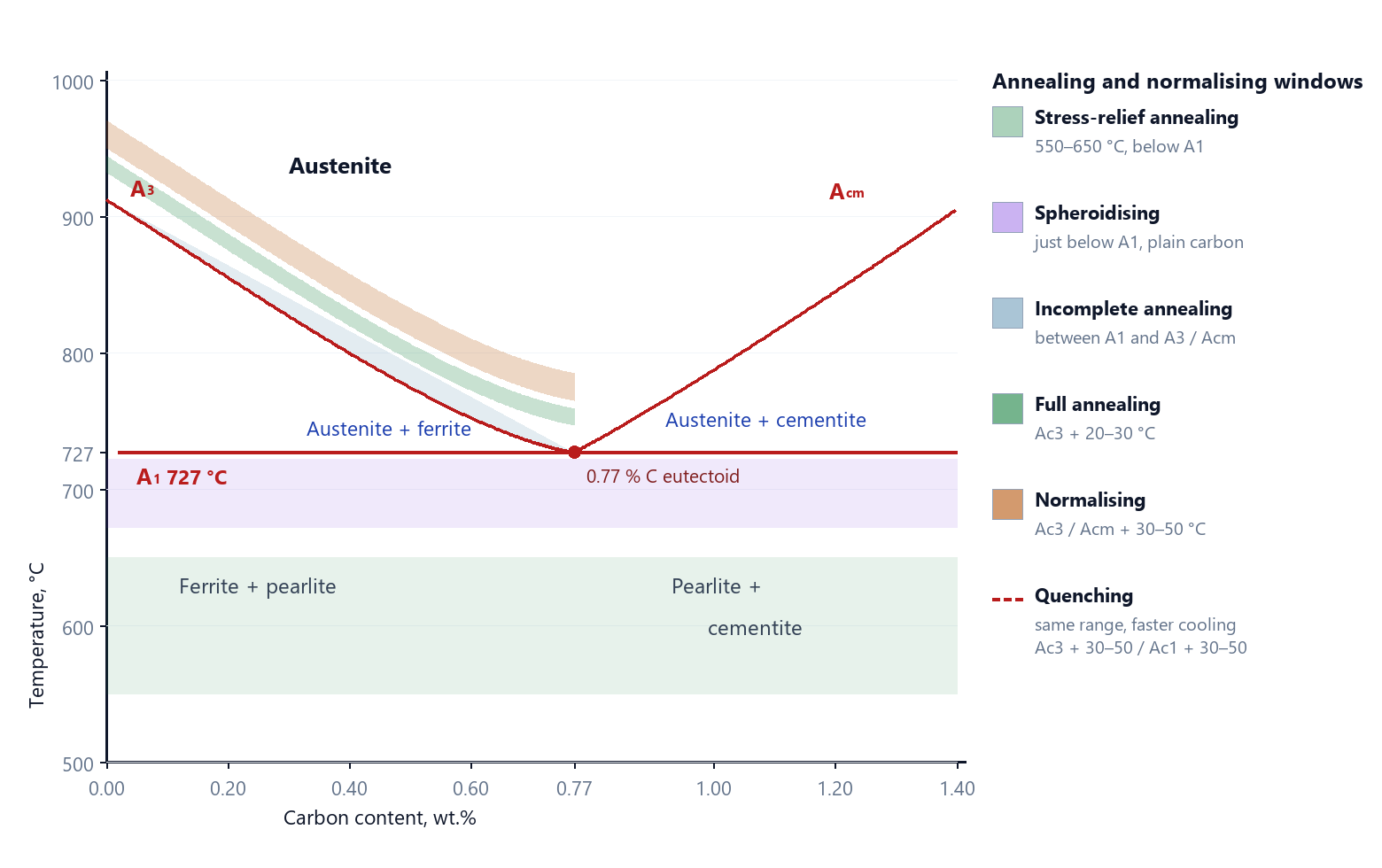
Ac1 is the lower critical temperature — the point at which austenite first forms on heating. In the plain iron–carbon system it sits at 727 °C. Ac3 is the upper critical temperature for hypoeutectoid steels, the point at which the last ferrite has transformed to austenite; it falls from 912 °C in pure iron to 727 °C at the eutectoid composition of 0.77 % C. Accm is the equivalent boundary on the hypereutectoid side, the temperature at which the last cementite dissolves, rising from 727 °C as carbon increases.
The subscript “c” stands for chauffage, heating; the corresponding cooling values are written Ar1 and Ar3. European and Chinese standards use the Ac notation, American texts usually write A1, A3 and Acm. Alloying elements move these lines — chromium and molybdenum raise them, nickel and manganese lower them — which is why a tool steel is never heat-treated to the same numbers as a plain carbon steel of the same carbon content.
Question 1: What Is Annealing, and Which of the Six Types Do You Need?
Annealing is the generic name for a family of processes that heat steel to a temperature above or below Ac1, hold it long enough for the structure to change, and then cool it slowly — usually in the furnace — so that the steel arrives at a structure close to equilibrium. Slow cooling is the defining feature. It is what separates annealing from normalizing, and it is why annealing produces the softest, most machinable, most stress-free condition a steel can be delivered in.
The family divides along two axes. By temperature, processes above Ac1 — full, incomplete, spheroidizing and homogenizing — rely on austenite formation; processes below Ac1 — recrystallization and stress-relief annealing — do not. By cooling method, the cycle can be continuous (cooling at a controlled rate) or isothermal (holding at a temperature until the transformation finishes, then cooling in air). Six variants cover almost every purchase order.
| Annealing type | Heating temperature | Cooling | What it changes | Typical use |
|---|---|---|---|---|
| Full annealing | Ac3 + 20–30 °C | Furnace, slow | Complete austenitization, then ferrite + pearlite; refines grain, removes Widmanstätten and banded structures, cuts hardness | Hypoeutectoid forgings and castings before machining |
| Incomplete annealing | Ac1–Ac3 (hypo) or Ac1–Accm (hyper) | Furnace, slow | Partial re-austenitization; lowers hardness and relieves stress without a full cycle | Hypoeutectoid steel with a suitable prior structure; softening before machining |
| Spheroidizing | Just below Ac1, or cycled around it; steel-dependent | Slow, often isothermal | Cementite lamellae break up into spheroids; lowest hardness, best machinability | Eutectoid and hypereutectoid steels, cold-work and tool steels |
| Homogenizing (diffusion) | Below the solidus, typically 1050–1250 °C, long hold | Furnace, very slow | Removes dendritic and regional segregation inherited from solidification | Ingots, large forging blanks, remelting electrodes |
| Recrystallization | Above the recrystallization temperature, roughly 550–700 °C | Slow, controlled | Deformed grains replaced by new equiaxed grains; work hardening and residual stress removed | Cold-drawn bar, cold-rolled strip, wire between drawing passes |
| Stress-relief | Below Ac1 and below the recrystallization temperature, typically 550–650 °C | Slow, controlled | Relaxes residual stress without changing the microstructure | Welded fabrications, rough-machined parts, dimensional stabilisation before finishing |
Table 1 — The six annealing variants, their heating windows and what each is bought for.
Choice is usually decided by carbon content and by the next operation. For hypoeutectoid structural steels, full annealing is the default when the prior structure is poor — a casting with dendritic segregation, or a forging with a Widmanstätten network that will not machine cleanly. Incomplete annealing is the cheaper route when the prior structure is already acceptable and only softening is needed.
Above 0.77 % C the logic changes. A hypereutectoid steel must not be fully austenitized for softening, because slow cooling from a single-phase austenite field re-precipitates cementite as a continuous network along the grain boundaries — the hardest, most crack-sensitive structure the steel can have. Spheroidizing is the correct answer instead, and it is the standard delivery condition for cold-work tool steels. The effect of the soak temperature on the carbide population is larger than most buyers expect: in a trial on Cr12Mo1V1 we compared two spheroidizing cycles and found that dropping the austenitizing soak by 60 °C changed the carbide distribution from a boundary network to a fine dispersion — AISI D2 / 1.2379 / SKD11 spheroidising covers that comparison in detail.
Two variants are worth separating from the rest. Homogenizing is an upstream operation: it is run on ingots or large forging blanks, at a temperature high enough and a time long enough for diffusion to flatten dendritic segregation. It cannot be applied to a finished bar, and it is not a remedy for banding discovered after delivery — at that stage the segregation is already set. Recrystallization annealing is the cold-working industry’s tool: it restores ductility between drawing passes by replacing the elongated, work-hardened grains with new equiaxed ones. Stress-relief annealing is the only one of the six that deliberately leaves the microstructure untouched; its whole purpose is to relax the first-kind residual stress left by welding, rough machining or heavy section changes, so the part keeps its dimensions after final machining.
Question 2: What Does Normalizing Do That Annealing Does Not?
Normalizing heats the steel to Ac3 or Accm plus 30–50 °C, holds it for full austenitization, and then cools it in still air, moving air or a spray — fast enough to miss the slow-cooling transformations, slow enough to avoid martensite. The product is a pearlitic structure, but a finer one than annealing produces, because the higher cooling rate pushes the transformation to a lower temperature where the pearlite lamellae are closer together.
The essential mechanism is complete austenitization followed by a pseudoeutectoid transformation. The higher austenitizing temperature dissolves more of the carbide and homogenizes the austenite; the faster cooling then suppresses the proeutectoid reaction that would otherwise form coarse ferrite or a carbide network on the grain boundaries.
| Characteristic | Annealing (full) | Normalizing |
|---|---|---|
| Heating temperature | Ac3 + 20–30 °C | Ac3 / Accm + 30–50 °C |
| Cooling | Furnace, tens of °C per hour | Still or moving air, tens of °C per minute |
| Resulting structure | Coarse pearlite, free ferrite, lowest hardness | Fine pearlite, little or no free ferrite, higher hardness |
| Cycle time | Long, furnace-bound | Short, parts leave the furnace to cool |
| Residual stress and distortion | Lowest | Higher than annealed, still far below quenched |
| Primary purpose | Soften for machining, relieve stress, condition structure | Refine grain, remove hot-working defects, adjust hardness, prepare for hardening |
Table 2 — Full annealing against normalizing. The difference is the cooling rate, and everything else follows from it.
In production, normalizing does four jobs. It improves the machinability of low-carbon steels, which otherwise tear rather than cut because they are too soft and too ductile. It removes the hot-working defects of medium-carbon steels — Widmanstätten structure, banding, coarse grains — before the part is machined. It breaks up the carbide network in hypereutectoid steels so that a subsequent spheroidizing cycle can work, which is why normalizing often appears immediately before spheroidizing in a tool-steel route. And for ordinary structural parts that will not be quenched and tempered, normalizing is the final heat treatment, chosen because it delivers better strength than annealing at a fraction of the cycle time.
One caution belongs with the last point: normalizing is not a substitute for annealing where dimensional stability matters. The faster cool leaves more residual stress, and a part normalized for strength and then heavily machined can move after the last cut.
Question 3: Why Does Normalizing Raise the Strength of Hypoeutectoid Steel?
The strength of a hypoeutectoid steel is largely the strength of its pearlite, diluted by soft, ductile ferrite. In a 0.20 % C steel cooled slowly, the lever rule puts the pearlite fraction at roughly a quarter and free ferrite at three quarters; the ferrite carries very little load and the steel stays soft. The practical question, therefore, is how to increase the pearlite fraction without changing the chemistry.
The answer is normalizing, and the mechanism is a competition between cooling rate and the proeutectoid reaction. As the steel cools from the fully austenitic state, ferrite precipitates first — on the prior austenite grain boundaries — and carbon is rejected into the remaining austenite. The slower the cooling, the more time ferrite has to form and grow, and the less carbon is left in the austenite when it reaches the eutectoid temperature. Fast cooling reverses that: it gives ferrite little time to precipitate, so more of the austenite survives to the eutectoid point and transforms there, as a pseudoeutectoid structure consisting almost entirely of pearlite.
Two effects then act together. The pearlite fraction rises, which directly raises hardness and tensile strength; and the pearlite itself becomes finer, because the transformation happens at a lower temperature. Since the strength of pearlite scales with the inverse square root of its interlamellar spacing — the same Hall–Petch form used for grain size — the closer lamellae of a normalized structure contribute a second, independent increase.
| Cooling route from Ac3 | Proeutectoid ferrite | Pearlite fraction | Strength and hardness | Residual stress |
|---|---|---|---|---|
| Furnace cooling | High, coarse network | Low | Lowest | Lowest |
| Still air | Reduced, finer | Higher | Moderate increase | Moderate |
| Forced air or spray | Low, dispersed | Highest, approaching pseudoeutectoid | Highest | Highest of the three |
Table 3 — Cooling rate against structure and strength in a hypoeutectoid steel. The trend is the mechanism behind the normalizing specification.
The limit of the trick is the hardenability of the steel. In a thin section, air cooling may be fast enough to suppress ferrite completely; in a heavy section it will not, and the centre will still show a ferrite network no matter how the surface looks. That is why the same normalizing specification can produce two different structures in a 30 mm bar and a 300 mm forging, and why heavy sections are fan-cooled or spray-cooled rather than left in still air.
Question 4: What Quenching Is For, and the Four Cooling Routes
Quenching exists to produce martensite. The steel is heated above Ac3 (hypoeutectoid) or Ac1 (hypereutectoid), held long enough to austenitize, and then cooled faster than the critical cooling rate so that the austenite transforms to martensite instead of pearlite or bainite. The result is the highest strength, hardness and wear resistance the grade can deliver — and almost no toughness.
That is why quenching is never a final operation. Every quenched part is tempered, and the tempering temperature is what actually sets the property balance: a die steel quenched to 62 HRC may be tempered at 180 °C to keep that hardness, or at 520 °C to trade it for toughness and dimensional stability. Quenching creates the potential; tempering decides how much of it is used.
The four cooling routes below differ only in how they pass through the martensite range. The first is the cheapest and the most stressful; the last two trade cycle time and section size for distortion control.
| Method | Cooling path | Advantages | Limitations |
|---|---|---|---|
| Single-medium quench | One medium — water, polymer, oil or gas — all the way to room temperature | Simple, fast, lowest cost; the default for straightforward work | Only for small, simple shapes; highest thermal and transformation stress; the medium is hard to match to the section |
| Double-medium quench | Fast medium to just above Ms, then a slow medium through the martensite range | Lowers transformation stress; less distortion and cracking; suits larger sections | The transfer timing is operator-dependent and demands experience |
| Martempering (step quench) | Quench to a salt or metal bath just above Ms, hold to equalize, then air-cool | Cuts both thermal and transformation stress; easier to control than a double-medium quench | Small sections only; still produces martensite in the end |
| Austempering (isothermal) | Quench to a bath above Ms and hold until the bainite transformation is complete | Lowest distortion; bainite with good toughness; ideal for complex, precision parts | Small sections only; long cycle; no martensite, so the hardness ceiling is lower |
Table 4 — The four quenching methods compared. Martempering and austempering look similar on a cooling curve but end in different structures.
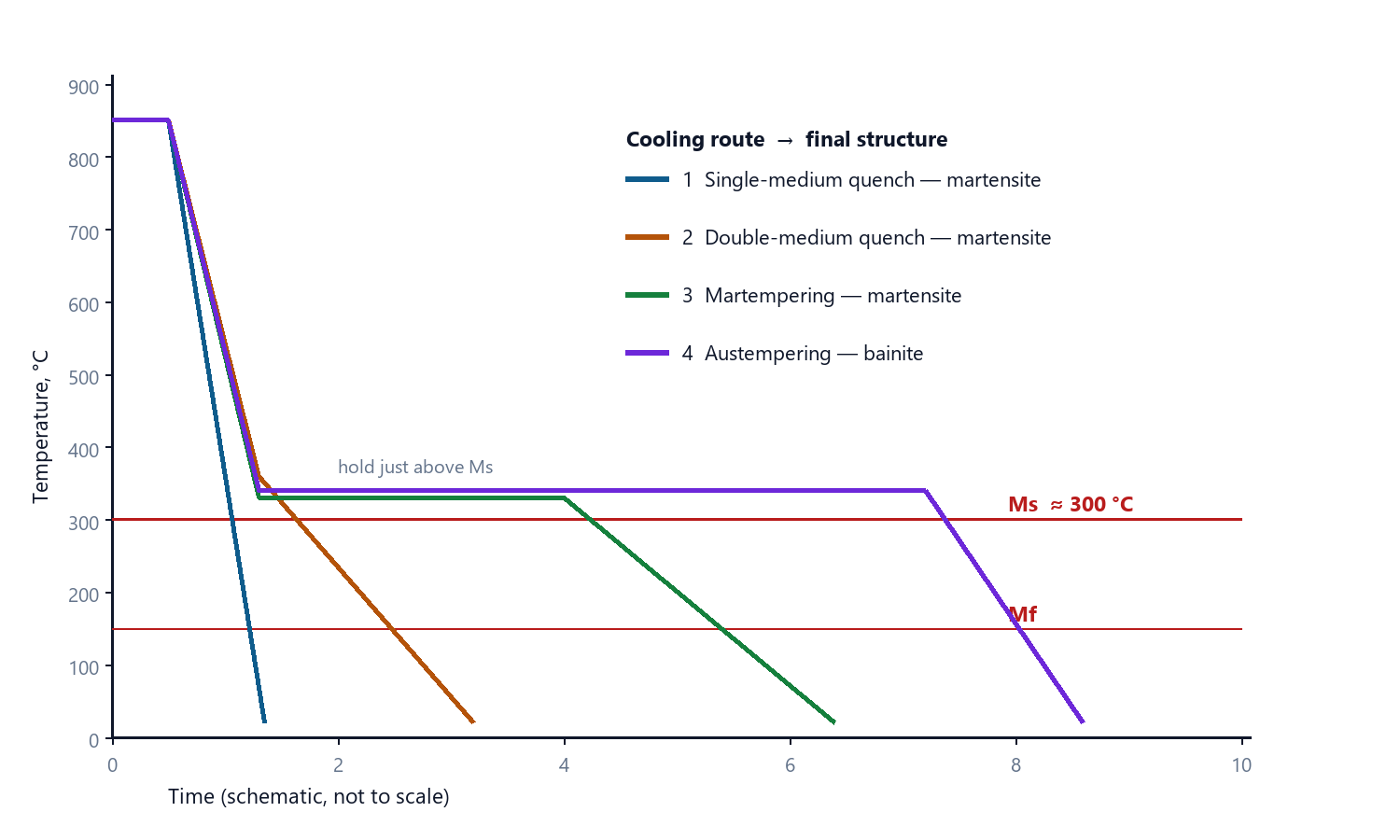
Selection is a section-size problem before it is a metallurgical one. A 20 mm die insert in an oil-hardening tool steel can be single-medium quenched and tempered without drama. The same steel at 200 mm will not through-harden in oil at all — the centre cools too slowly, the core transforms to pearlite or bainite, and the part ends up with a hard case on a soft core, with the residual stress pattern that implies. The fix is not a more aggressive quenchant, which usually just cracks the surface; it is a steel with higher hardenability, or a different process. Vacuum furnaces with high-pressure gas quenching and polymer quenchants have widened the available cooling rates, but they have not changed the underlying rule.
Question 5: Choosing the Austenitizing Temperature — and Why Hypereutectoid Steels Stop at Ac1
The austenitizing temperature is chosen to produce a uniform, fine austenite grain, because the martensite that forms on quenching can only be as fine as the austenite it came from. Coarse austenite means coarse martensite plates, and coarse martensite is where quench cracks start.
For hypoeutectoid steels the rule is Ac3 + 30–50 °C: high enough to complete the ferrite-to-austenite transformation throughout the section, low enough to avoid grain growth. For hypereutectoid steels the rule is Ac1 + 30–50 °C — deliberately just above the lower critical temperature, so that the steel is austenitized but a controlled fraction of cementite remains undissolved.
That residual carbide is not a defect. It is the point of the process. Undissolved carbides pin the austenite grain boundaries and stop the grain from coarsening during the soak, and after quenching they remain as hard particles in a martensitic matrix, which is exactly the wear-resistant structure a cold-work die or a bearing needs. Push the temperature past Accm and all of it dissolves, with three consequences:
1. Retained austenite rises and hardness falls. With every carbide dissolved, the austenite carbon content climbs toward the steel’s full carbon level. Higher carbon lowers both Ms and Mf, so less of the austenite transforms to martensite on cooling. The retained austenite that remains is soft and unstable; it lowers hardness and wear resistance, and it can transform later in service, changing the part’s dimensions.
2. The martensite becomes coarse and crack-prone. A high austenitizing temperature coarsens the austenite grain, and a high carbon content makes the martensite that forms from it plate-like and heavily twinned. Coarse plate martensite is brittle and frequently carries microcracks from the transformation itself — cracks that only reveal themselves later, under load or during grinding.
3. Thermal stress, oxidation and decarburization all increase. The larger the temperature difference between the furnace and the quenchant, the larger the thermal stress on the section. At the same time, the higher temperature accelerates scale formation and surface decarburization, which softens the very surface that has to resist wear, and adds another source of distortion and cracking.
| Characteristic | Hypoeutectoid steel | Hypereutectoid steel |
|---|---|---|
| Carbon range | Below 0.77 % | 0.77–2.1 % |
| Austenitizing temperature | Ac3 + 30–50 °C | Ac1 + 30–50 °C |
| State at the soak | Single-phase austenite | Austenite + undissolved carbides |
| Role of the carbide | None — it must all dissolve | Pins grain growth, carries wear resistance |
| If the temperature runs too high | Grain coarsening, more distortion | Retained austenite, coarse plate martensite, cracking |
| Examples | 1045, 42CrMo4 / 4140, 20MnCr5 | D2 / 1.2379, Cr12MoV, 52100 / 100Cr6 |
Table 5 — Hypereutectoid steels are deliberately under-austenitized: the undissolved carbide is part of the specification, not a shortfall of the cycle.
Alloy tool steels need one qualification. The “Ac1 + 30–50 °C” rule is written for plain hypereutectoid carbon steels; in a highly alloyed tool steel the carbides are far more stable and the working temperature is much higher. Tool steels such as D2 are austenitized at 1010–1050 °C, H13 at 1000–1030 °C and M2 high-speed steel at 1190–1230 °C, yet the principle is identical: stop short of complete carbide dissolution. Judged against Ac1, those numbers look reckless; judged against the carbide solvus of the particular grade, they are the same controlled under-austenitization.
Question 6: Hardenability, Hardness Capability and Hardened Depth Are Three Different Numbers
These three terms are routinely used interchangeably in purchase enquiries, and the confusion causes more rejected parts than any other single misunderstanding in heat treatment. They are not the same property, and they are not measured the same way.
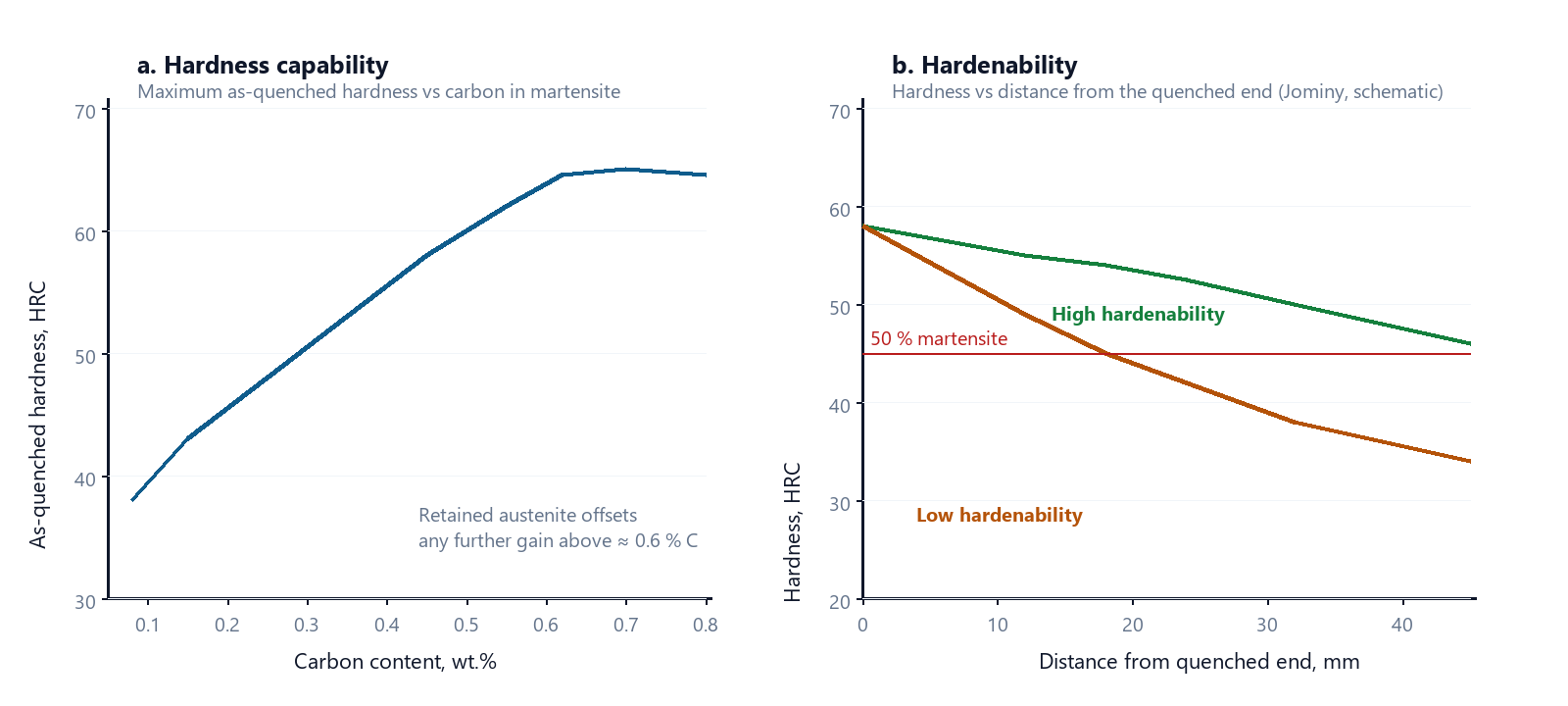
Hardenability is the ability of austenitized steel to form martensite. It reflects the stability of the undercooled austenite, and therefore the critical cooling rate the steel needs: a high-hardenability steel can form martensite at a slow cooling rate, deep into a thick section. It is a property of the steel, determined by composition and grain size, and it is measured as the depth and hardness distribution obtained under a defined test — in practice, by the Jominy end-quench test to ASTM A255, or expressed as an ideal critical diameter (DI) in the Grossmann approach.
Hardness capability is the maximum hardness the steel can reach after quenching. It is governed almost entirely by the carbon content of the martensite, not by the alloy content. A 0.4 % C steel tops out around 55 HRC whether it is plain carbon or heavily alloyed; a 0.6 % C steel reaches about 65 HRC. Adding chromium or molybdenum makes the steel harden deeper; it does not make it harder at the surface.
Hardened depth is what a specific part actually achieves. It is the distance from the surface to the point where the structure is 50 % martensite — the semi-martensite zone — and it depends on the steel’s hardenability, the section size, the quenchant and its agitation, and the surface condition. The same steel quenched in the same oil gives a different depth in a 25 mm bar and a 250 mm bar.
| Factor | Hardenability | Hardness capability | Hardened depth in a part |
|---|---|---|---|
| Carbon content | Weak to moderate | Dominant | Indirect |
| Mn, Cr, Mo, Ni, B | Strong | None | Strong, through hardenability |
| Austenite grain size | Coarser grains raise it | None | Indirect |
| Segregation and banding | Raises scatter, creates soft bands | None | Uneven depth |
| Austenitizing temperature | Raises it — more dissolution, coarser grain | Falls once carbides dissolve | Indirect |
| Section size | Not a steel property | None | Dominant |
| Quenchant and agitation | None | None | Strong |
| Surface condition | None | Decarburization lowers it | Lowers it at the surface |
Table 6 — Which factor moves which number. Only carbon moves hardness capability; only alloy content and grain size move hardenability; section size and quench severity move the depth achieved in a specific part.
The practical consequences follow directly. A 4140 bar that reads 55 HRC at the surface and 40 HRC at the centre does not have a hardness problem — it has a hardenability and section problem, and quenching it harder will only risk cracking. A 0.2 % C steel that will not exceed 45 HRC no matter what the heat treater does is limited by carbon, not by the quench. And two suppliers offering the same grade to different hardenability bands — one to the base composition, one to an H-band under ASTM A304 — are offering genuinely different products at the same nominal name. When the part is through-hardened and the section is heavy, the band belongs in the purchase order.
This is also where heat treatment becomes a quality-system question rather than a metallurgical one. Because the result cannot be verified by inspecting the finished part alone — you cannot cut up every forging to check its core hardness — the control has to sit in the process records: furnace charts, quench records, hardness surveys and the traceability that ties them to the heat. We have written separately about that discipline in heat-treatment total quality control.
What to Put in a Purchase Order
Most heat-treatment disputes are settled by the wording of the order, not by the furnace. Six items are worth stating explicitly:
1. Delivery condition and standard. Annealed, spheroidize-annealed, normalized, or quenched and tempered — named against a standard, for example ASTM A681 for tool steels or ASTM A29 for structural bar.
2. Hardness range, method and location. A range alone is not enough. Specify Brinell or Rockwell, the standard used to test it (ASTM E10 or E18), and where on the section the reading is taken — mid-radius and end-face readings are not interchangeable.
3. Microstructure requirements. Carbide size and network rating for tool steels, banding level for structural steels, grain size to ASTM E112. This is the only way to control the properties that hardness alone cannot see.
4. Hardenability band, where it matters. For through-hardened parts in heavy sections, specify the H-band to ASTM A304 rather than the base composition.
5. Machining allowance and straightness. Distortion is a process outcome, not a defect to be argued about after delivery; give the allowance the process needs.
6. Documentation. Mill certificate, heat-treatment record and hardness survey, traceable to the heat number.
Where Fushun Metal Fits
FUSHUN METAL supplies mould steel, tool steel and special steel in the condition the next operation needs — annealed, spheroidize-annealed, or quenched and tempered — with hardness and microstructure verified against the order rather than assumed. Our heat-treatment route covers full and incomplete annealing, spheroidizing, normalizing and hardening and tempering, and the metallurgical records travel with the steel.
The same discipline applies across the product range. For nickel-based alloys the mechanism changes — Inconel 718 and its Chinese equivalent GH4169 harden by γ′ and γ″ precipitation rather than by martensite, so solution and aging temperatures replace austenitizing and tempering — but the principle does not: the thermal cycle is specified, recorded and verified. The process–structure link for that family is set out in our article on Inconel 718 turbine disc forging parameters.
If you are specifying a heat-treatment condition, send us the grade, the section size, the required hardness and the process the part will see. We will come back with the delivery condition, the hardenability band where it applies, and the test documentation that goes with it.