
AISI 321 Stainless Steel (1.4541 / S32100 / SUS321)
304 with titanium added to lock up the carbon. That single addition stops chromium carbide forming at the grain boundaries, so the steel can be welded and then held at 450–850 °C without losing its corrosion resistance — which is exactly what 304 cannot do.
At a glance
| Item | Detail |
|---|---|
| Designations | AISI 321 / UNS S32100 / 1.4541 / SUS321 / X6CrNiTi18-10 |
| Standards | ASTM A240, A312, A276; EN 10088-2 |
| Delivery condition | Solution annealed, pickled, or bright annealed |
| Melt route | EAF + AOD refining; VD on request |
| Typical use | Exhaust systems, heat exchangers, furnace parts, welded pressure vessels |
| Certificate | EN 10204 3.1 with chemistry and intergranular corrosion test on request |
What the titanium actually does
When 304 is held between 450 and 850 °C — during welding, or in service — chromium carbides precipitate at the grain boundaries and drag chromium out of the matrix. The grain boundary then rusts, even though the bulk of the steel is fine. That is sensitisation, and it is why a welded 304 vessel in hot service can fail at the weld line.
Titanium has a stronger affinity for carbon than chromium does. Adding Ti at five times the carbon content ties the carbon up as titanium carbide before chromium carbides can form, so the chromium stays in solution. The steel can then be welded and used in the sensitising range without a post-weld solution anneal.
The trade-off is that 321 is harder to polish than 304 and the titanium inclusions affect machinability and surface finish. It is also not a substitute for 316 in chloride service — the titanium does nothing for pitting resistance.
Supply range and delivery condition
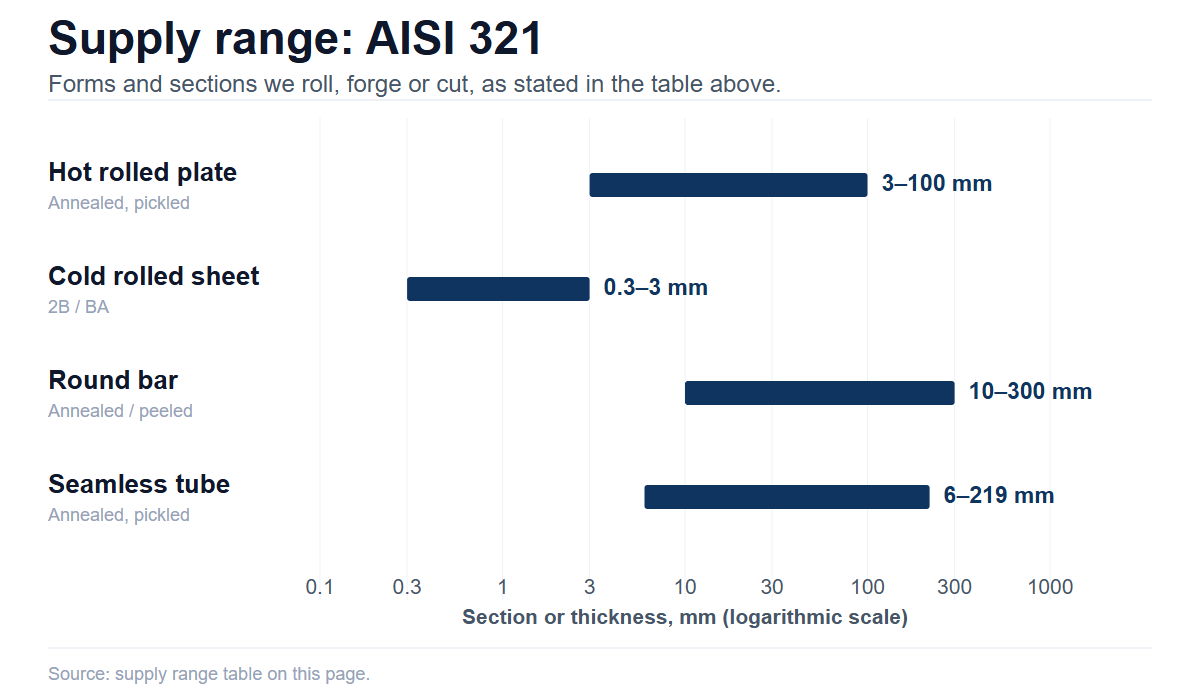
| Form | Size range | Condition |
|---|---|---|
| Hot rolled plate | Thickness 3–100 mm × width up to 2000 mm | Annealed, pickled |
| Cold rolled sheet | Thickness 0.3–3.0 mm × width up to 1250 mm | 2B / BA |
| Round bar | Ø10–300 mm | Annealed / peeled |
| Seamless tube | OD 6–219 mm | Annealed, pickled |
Chemical composition
| C | Si | Mn | P | S | Cr | Ni | Ti |
|---|---|---|---|---|---|---|---|
| ≤0.08 | ≤0.75 | ≤2.00 | ≤0.045 | ≤0.030 | 17.0–19.0 | 9.0–12.0 | 5×C to 0.70 |
ASTM A240 / EN 1.4541. Ti must be at least five times the carbon content; below that the steel is not fully stabilised.
Mechanical properties
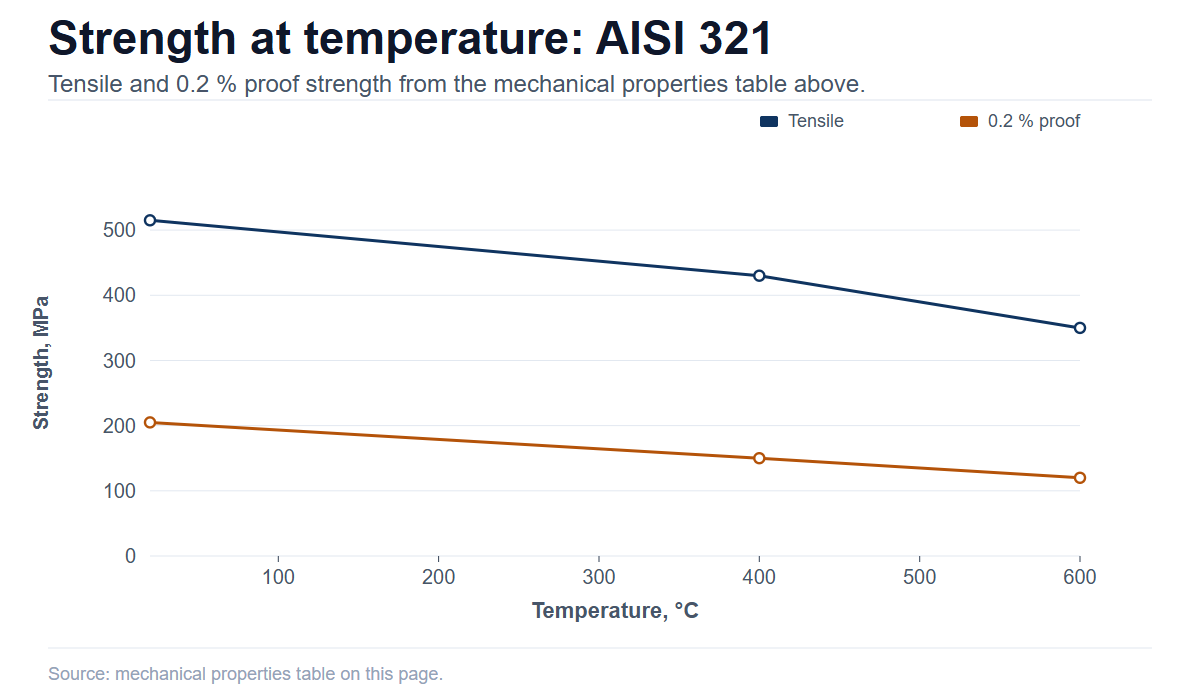
| Condition | Tensile MPa | 0.2 % proof MPa | Elongation % | Hardness |
|---|---|---|---|---|
| Annealed | ≥515 | ≥205 | ≥40 | ≤95 HRB |
| Annealed, 400 C | ≥430 | ≥150 | ≥35 | — |
| Annealed, 600 C | ≥350 | ≥120 | ≥30 | — |
Heat treatment
Solution anneal 1030–1080 °C, water quench or rapid air cool. Do not slow cool through 850–450 °C — even stabilised steel will precipitate titanium carbides that reduce toughness.
Stress relieve below 450 °C only. Above that, the risk of sensitisation returns even with the titanium present.
Where 321 orders go wrong
The titanium has to be at least five times the carbon, and the certificate has to prove it. A heat with 0.06 % carbon and 0.25 % titanium passes a chemistry check and is not stabilised — the carbon is still free to form chromium carbides at the grain boundary. Ask for the Ti/C ratio, not just the titanium figure.
321 and 321H are different products. 321H runs 0.04–0.10 % carbon for creep strength above 500 °C, and that carbon makes it harder to weld and less resistant to intergranular attack. Ordering “321” for a furnace part that the drawing calls 321H will give the wrong answer at temperature.
Titanium does nothing for chloride. 321 resists sensitisation; it does not resist pitting. A 321 line in seawater or in a chloride-bearing process stream will pit exactly like 304, and the fix is 316L or a duplex, not a higher titanium addition.
It is harder to polish than 304. The titanium carbide and nitride inclusions tear under a polishing wheel and leave a speckled finish. If the part is visible or has to take a mirror polish, 304 or 316L will finish better; 321 is chosen for temperature, not for appearance.
When 321 is the wrong grade
In chloride service use 316L, or 2205 if the chloride is warm and the load is real. For plain corrosion resistance at ambient temperature with no welding, 304L is cheaper and welds more easily.
Above about 800 °C, 321 runs out of creep strength; 309 or 310 take over. And if the requirement is welding without any post-weld treatment in a thin section, 304L is usually the practical answer rather than paying for titanium that the application does not need.
What ships with every lot
- EN 10204 3.1 with chemistry including the Ti/C ratio
- Intergranular corrosion test to ASTM A262 Practice E on request
- Grain size and inclusion rating
- Surface finish report — 2B, BA or pickled
- Tensile test at the supplied condition
Cutting, machining and surface
| Operation | What we hold |
|---|---|
| Saw cutting | Section up to 1200 mm; square within 1 mm per 100 mm |
| Surface grinding | Thickness tolerance −0 to +0.1 mm; flatness 0.01/100 mm |
| Milling | Bright milled, six faces squared |
| Vacuum heat treatment | Hardening and double tempering to your window |
| CNC / deep drilling | Quoted from drawing — DXF, STEP or PDF |
Trade terms and how an order runs
The terms below apply unless the enquiry states otherwise. They are the terms most of our European and North American buyers work to, and they can be adjusted in the quotation.
| Item | Standard terms |
|---|---|
| Incoterms 2020 | FOB Shanghai, Qingdao or Shenzhen; CIF and CFR quoted against the destination port. |
| Payment | T/T 30 % advance with the order, 70 % against the bill of lading copy; irrevocable L/C at sight accepted for orders above 20 t |
| Lead time | 20–30 days from order confirmation for stock sizes; 30–45 days where forging, heat treatment or machining is included |
| Documents | 3.1 certificate, packing list, commercial invoice, bill of lading, certificate of origin; legalisation or chamber attestation on request |
Packing and delivery
Plate and sheet interleaved and crated; bar bundled by heat. Typical lead time 25–35 days.
Request a quote
- Standard — ASTM A240 / A312, or EN 1.4541
- Form and size — plate thickness, sheet, bar diameter, or tube OD × wall
- Quantity in pieces or kilograms
- Condition — annealed and pickled, or bright annealed
- Inspection — 3.1, A262 Practice E, grain size
Email [email protected] or use the form below. Drawings in DXF, STEP or PDF are all fine.
Related grades
One heat-treatment route, one certification route — grades can be combined in a single shipment.
Governing standard: download the standard (PDF).
Frequently asked questions
The same steel is sold under these designations: AISI 321 / UNS S32100 / 1.4541 / SUS321 / X6CrNiTi18-10. We supply against the designation you specify on the purchase order, and the 3.1 certificate carries that designation plus the heat number.
ASTM A240, A312, A276; EN 10088-2. Chemistry and mechanical properties are tested to that standard, and the certificate names the edition used for the heat.
Our widest section is round bar at Ø10–300 mm. Anything above that is quoted individually, usually as a forging, with the same certificate route.
hot rolled plate thickness 3–100 mm; cold rolled sheet thickness 0.3–3 mm; round bar Ø10–300 mm; seamless tube OD 6–219 mm. Stock sizes ship from the warehouse; other sizes are rolled or forged to order.
515 MPa tensile and 205 MPa 0.2 % proof. Values are minimums for the delivery condition stated in the table above, tested on a sample from the same heat.