Common Nickel Alloy Types and Trade Names
| Name | Alloy type | Alternative trade names |
| Nickel 200 | 99% + pure Nickel | Nickel 99.2 |
| Nickel 201 | 99% + pure Nickel | Nickel 201, LC Nickel 99.2 |
| Monel 400® | Nickel-Copper | Nickelvac® 400, Nicorros® 400 |
| Monel R405® | Nickel-Copper | |
| Monel K500® | Nickel-Copper | |
| Inconel 600® | Nickel-Chromium-Iron | Nickelvac® 600, Ferrochronin® 600 |
| Inconel 601® | Nickel-Chromium-Iron | Pyromet® 601, Nicrofer® 601 |
| Inconel 617® | Nickel-Chromium-Cobalt | Nicrofer® 617 |
| Inconel 625® | Nickel-Chromium-Iron | Chornin® 625, Altemp® 625, Nickelvac® 625, Haynes® 625 Nicrofer® 6020 |
| Inconel 718® | Nickel-Chromium-Iron | Nicrofer® 5219, Alvac® 718, Haynes® 718, Altemp® 718 |
| Inconel X750® | Nickel-Chromium-Iron | Haynes X750®, Pyromet® X750, Nickelvac®X750, Nicorros® 7016 |
| Incoloy 800® | Nickel-Chromium-Iron | Ferrochronin® 800, Nickelvac® 800, Nicrofer® 3220 |
| Incoloy 825® | Nickel-Chromium-Iron | Nickelvac® 825, Nicrofer 4241® |
| Hastelloy C22® | Chromium-Molybdenum-Tungsten | Inconel® 22, Nicrofer® 5621 |
| Hastelloy C276® | Nickel-Chromium-Molybdenum | Nickelvac® HC-276, Inconel® 276, Nicrofer® 5716 |
| Hastelloy B2® | Nickel-Chromium-Molybdenum | Nimofer® 6928 |
| Hastelloy X® | Nickel-Chromium-Iron-Molybdenum | Nickelvac® HX, Nicrofer® 4722, Altemp® HX, Inconel® HX |
| Vascomax® C250 | Nickel-Cobalt-Molybdenum | Maraging C250™, Maraging 250™ |
| Vascomax® 300 | Nickel-Cobalt-Molybdenum | Maraging 300, Maraging C300®, and Vascomax® C300 |
| Vascomax® C350 | Nickel-Cobalt-Steel | Maraging C350™ |
| Rene® 41 | Nickel-Chromium | |
| Multimet® N155 | Nickel-Chromium-Cobalt | |
| Waspaloy 25™ | Nickel-Cobalt | |
| Invar 36® | Nickel-Iron | Nilo 6®, Pernifer 6® |
| Invar 42® | Nickel-Iron | Nilo 42® |
Fushun Special Steel LTD CO
Fushun Metal is a large special steel manufacturer and supplier. We are metal experts and have been providing quality customer service and products since 1998.
At Fushun Metal, we supply a wide range of metals for a variety of applications. Our products/stock includes: stainless steel, alloy steel, spring steel, tool steel, high speed steel, mould steel, nickel alloy.
Our hot rolled and cold rolled steel is available in a wide range of shapes including: bars, tubes, sheets and plates. We can cut metal to your exact specifications.
Send your inquiry information to us and get a free quotation today!
The six families, and what each one is actually for
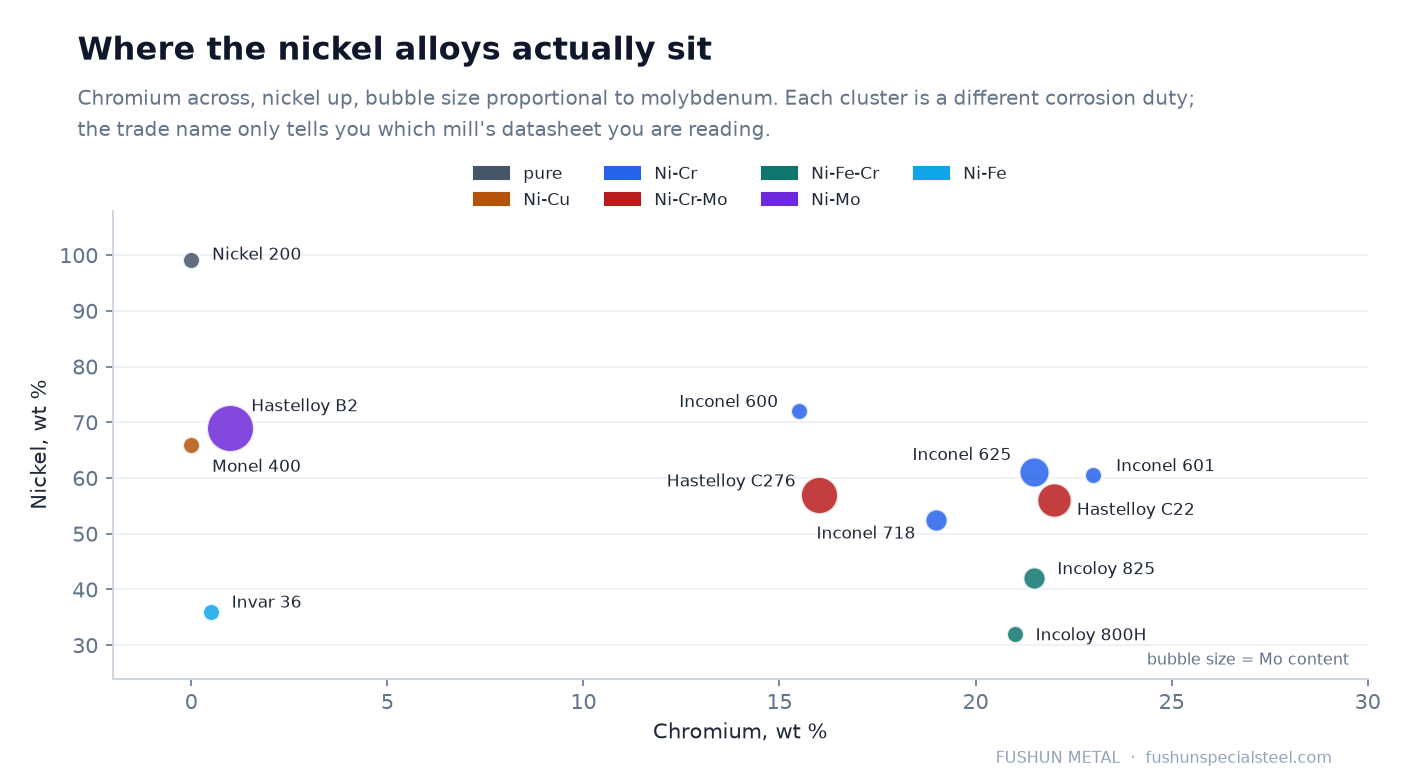
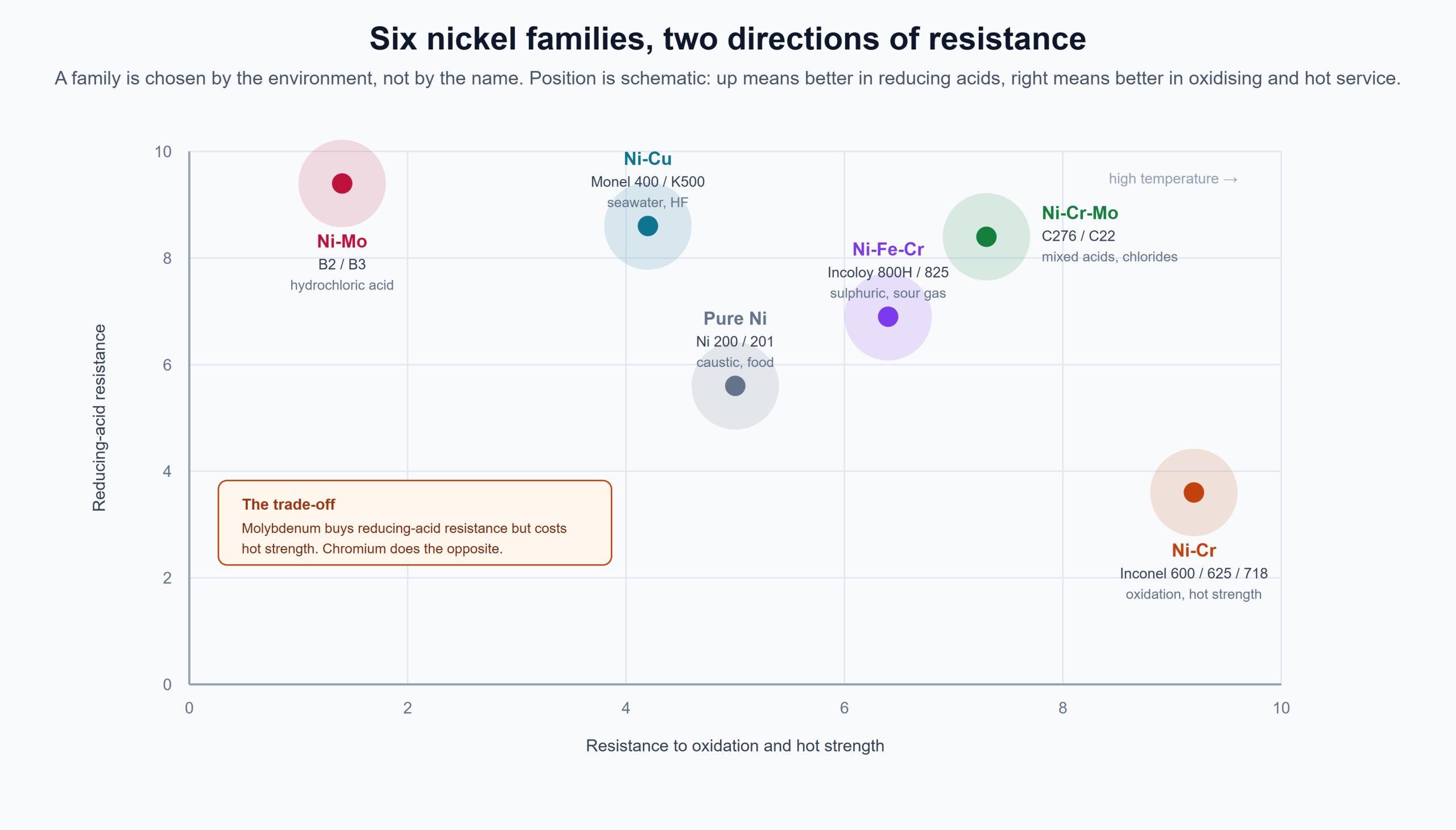
Nickel alloys are grouped by what the second element does, because that is what decides which environment the alloy survives. The trade names below are useful for recognition but useless for specification — Inconel, Incoloy, Hastelloy, Monel and Nimonic are all trademarks, and the same alloy is sold under different names by different mills. The UNS number is the only identifier that does not move.
Individual grades are covered in more detail under Monel 400, Incoloy 825, Hastelloy C276 and Inconel 625.
| Family | Typical grades | What it resists | Where it fails |
|---|---|---|---|
| Commercially pure Ni 200 / 201 |
N02200 / N02201 | Caustic soda, food contact, electronic components | Sulphur-bearing atmospheres above 315 °C |
| Nickel-copper Monel |
400, K500, R405 | Seawater, hydrofluoric acid, steam | Oxidising acids, ammonia |
| Nickel-chromium Inconel |
600, 601, 690, 625, 718 | Oxidation, high temperature, chlorides (625/718) | Reducing acids unless molybdenum is present |
| Nickel-iron-chromium Incoloy |
800H, 825, 925 | Sulphuric and phosphoric acid, sour gas, moderate temperature | Strong oxidising media, high chloride with stress |
| Nickel-molybdenum | B2, B3 | Hydrochloric acid and other reducing acids | Any oxidising condition — even dissolved oxygen hurts |
| Nickel-chromium-molybdenum Hastelloy C, Alloy 59 |
C276, C22, C2000 | Mixed acids, chlorides, oxidising plus reducing in one vessel | High-temperature strength — these are corrosion alloys, not creep alloys |
The seventh family: controlled expansion
The six families above are chosen for corrosion resistance or high-temperature strength. There is a seventh group chosen for the opposite reason — to barely move when heated. These are the nickel-iron alloys, and their defining property is a thermal expansion coefficient around a tenth that of carbon steel.
| Grade | Trade names | Property | Used for |
|---|---|---|---|
| Invar 36 (N03600) | Nilo 36, Pernifer 36 | Expansion about 1.2 × 10⁻⁶/°C | Precision instruments, metrology, LNG pipe |
| Kovar (N03300) | Nilo K, Pernifer 29-18 | Expansion matched to borosilicate glass | Glass-to-metal seals, vacuum envelopes |
| Alloy 42 (N04200) | Nilo 42 | Expansion matched to silicon | Lead frames, semiconductor packages |
These grades are not corrosion alloys and not high-temperature alloys. Specifying one for a chemical duty, or a 625 for a dimensional-stability duty, is the kind of mix-up that comes from reading the name rather than the datasheet.
Invar’s low expansion comes from a magnetic effect: below its Curie point the material contracts slightly as it heats, which cancels most of the normal thermal expansion. Above about 230 °C the effect is lost and the alloy expands like ordinary steel — a limit worth knowing before it is used near a furnace.
How to choose by environment, not by name
Three questions narrow almost every case. First: is the medium oxidising or reducing? Oxidising conditions (nitric acid, hot air, chromic acid) need chromium, so the answer is Inconel 600/601/690. Reducing conditions (hydrochloric acid, dilute sulphuric) need nickel and molybdenum, so the answer is Hastelloy B or C. Second: are chlorides present with stress? That points to 625, C276 or C22 rather than 825. Third: what temperature? Above roughly 550 °C the corrosion alloys give way to the creep-resistant grades — 617, 230, 263 — which are a different selection problem altogether.
For the precipitation-hardening grades used at temperature, see Inconel 718 and Incoloy 825 against Inconel 625.
Why the same alloy carries five names
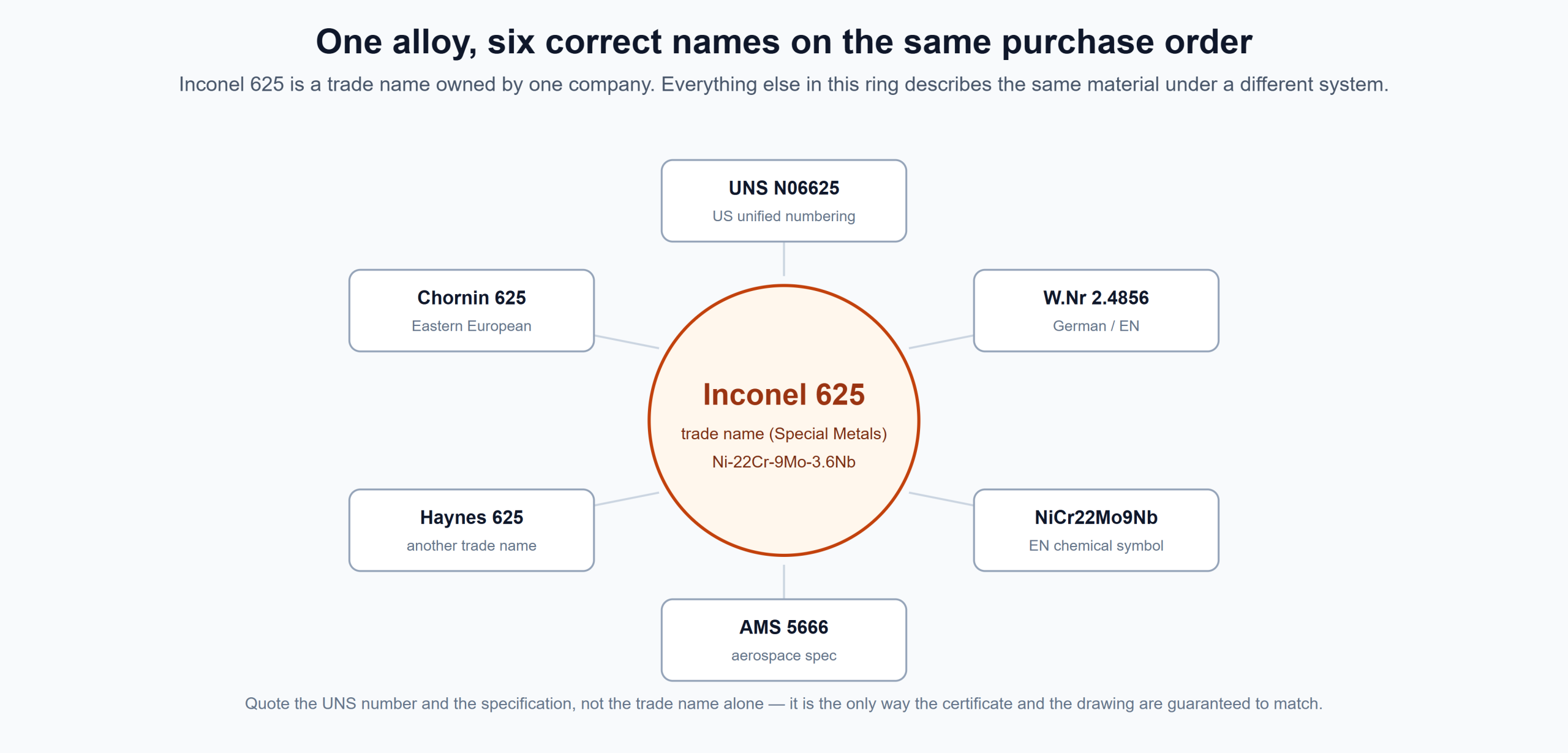
Take one example: the alloy with 21 % chromium, 9 % molybdenum and 3.6 % niobium is sold as Inconel 625, as N06625, as W.-Nr. 2.4856, as NC22DNb and as Haynes 625. They are the same material. The trade name tells you which mill’s datasheet you are reading; the UNS number tells you the composition range; the Werkstoff number tells you which European standard applies. When a drawing cites only a trade name, the mill certificate still has to state the UNS number — otherwise there is nothing to inspect against.
Where the table above stops being enough
A name table tells you what an alloy is. It does not tell you whether it is qualified for your service. Sour gas needs ISO 15156 compliance, nuclear work needs the material qualified to a code, and aerospace needs AMS. Two alloys that appear interchangeable in this table can differ entirely in whether they are allowed on a given project.
Related reading
- Monel 400 — nickel-copper for seawater and hydrofluoric acid.
- Incoloy 825 — nickel-iron-chromium for sulphuric and phosphoric acid.
- Hastelloy C276 — the mixed-acid and chloride answer.
- Inconel 718 — the grade that carries the hot section.