
Effect of Cryogenic Treatment on 3Cr13 Steel Microstructure and Mechanical Properties
FUSHUN METAL Technical Blog
Introduction to Cryogenic Treatment
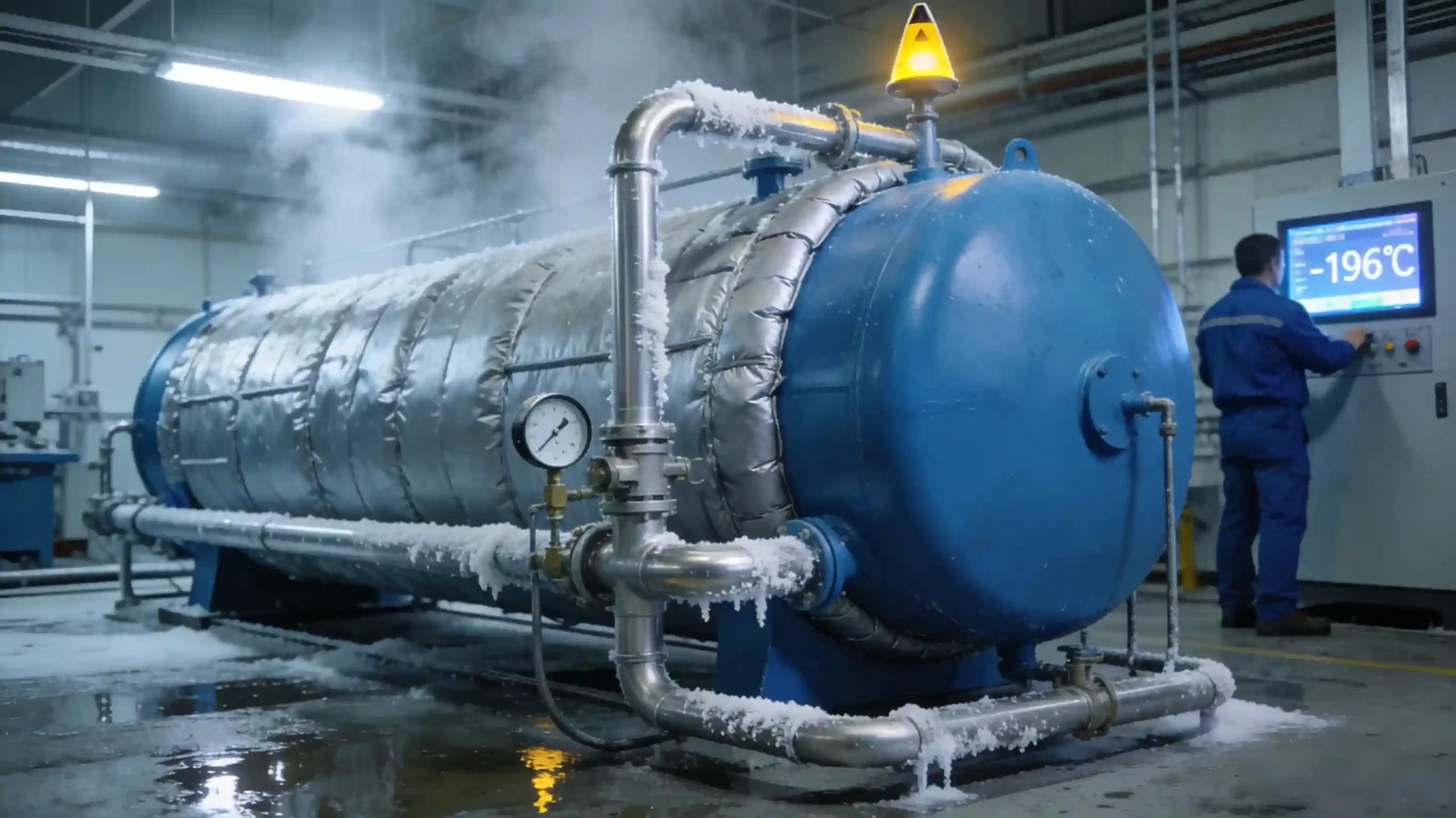
In industrial applications, materials subjected to conventional heat treatment can be further cooled below zero degrees Celsius to enhance their properties. When materials are cooled to temperatures typically around -80°C, the process is referred to as conventional cold treatment. However, when temperatures drop below -130°C, usually reaching -196°C using liquid nitrogen, the process is termed deep cryogenic treatment.
Deep cryogenic treatment serves as an extension of conventional heat treatment. The workpiece is placed in a controlled low-temperature environment where the material’s microstructure undergoes specific changes. This innovative technology achieves improvements in material performance that conventional heat treatment alone cannot accomplish.
Background and Industry Context
Cutlery represents a traditional manufacturing sector with significant global importance. While production volumes and variety have increased substantially, service performance still shows gaps compared to international advanced levels. The primary material used in domestic cutlery manufacturing is martensitic stainless steel, particularly 3Cr13 grade steel.
“Heat treatment technology, as one of the fundamental manufacturing processes for cutlery, plays a critical role in ensuring product quality and extending service life.”
Current research on martensitic stainless steel primarily focuses on conventional heat treatment processes. Studies on deep cryogenic treatment for 3Cr13 steel remain extremely limited, and research into the treatment mechanisms for this material is even more scarce. Therefore, improving traditional heat treatment processes and developing new treatment technologies to maximize material potential represents a significant opportunity for the industry.
Experimental Materials and Methods
The experimental 3Cr13 steel was obtained from formed blade samples with a thickness of 2.5mm. The deep cryogenic treatment equipment used was a program-controlled cryogenic chamber developed by a certain research institute, with a cooling rate of 1°C/min. This equipment employs an intelligent temperature control system ensuring precise internal temperature control for proper execution of the cryogenic treatment process.
Chemical Composition
| Element | C | Cr | Si | Mn | Ni |
|---|---|---|---|---|---|
| Mass Fraction (%) | 0.31 | 13.0 | 0.45 | 0.35 | 0.25 |
Testing Equipment and Methods
Microstructure observation was performed using an optical metallographic microscope and scanning electron microscope (SEM). Rockwell hardness testing utilized a standard hardness tester, while impact toughness testing was conducted on a pendulum impact testing machine using Charpy V-notch specimens (dimensions: 10mm × 10mm × 55mm) to determine the impact energy at room temperature.
Microstructure Analysis Results
The microstructural morphology of 3Cr13 steel after different treatment processes revealed that the matrix structure in all samples consisted of tempered martensite. Additionally, the structure contained certain amounts of precipitated phases and retained austenite distributed throughout the material.
Comparing the microstructures after conventional heat treatment versus deep cryogenic treatment showed a significant difference: the microstructure of cryogenically treated samples exhibited notably greater density and refinement. This denser microstructure contributes directly to improved mechanical properties.
“The experimental steel after deep cryogenic treatment showed a microstructure that was significantly more dense and refined compared to conventional heat treatment.”
Carbide Precipitation Changes
SEM observations of 3Cr13 steel after different treatment processes revealed distinct differences in precipitated phase morphology. Samples subjected to deep cryogenic treatment exhibited significantly more carbides compared to conventionally heat-treated samples. Furthermore, considerable quantities of fine carbides precipitated both within grain interiors and at grain boundary positions.
Mechanism of Carbide Formation
This carbide precipitation phenomenon occurs because during deep cryogenic treatment, the phase transformation driving force increases substantially. A portion of the retained austenite continues to undergo martensitic transformation, leading to reduced retained austenite content and increased martensite content. The volumetric contraction of the martensitic matrix causes a decrease in the iron matrix lattice parameters.
This lattice contraction produces two significant effects. First, it generates substantial microscopic internal stresses and micro-deformations in the matrix, causing crystal defects to increase markedly. Second, it amplifies the lattice distortion induced by supersaturated carbon, thereby increasing the thermodynamic driving force for carbide precipitation.
During subsequent warming to room temperature and the following tempering process, carbon atom diffusion capability strengthens. This enhanced diffusion leads to precipitation of fine carbides coherent with the matrix at crystal defect locations, creating the observed uniform carbide distribution.
Strengthening Mechanism Discussion
As a martensitic stainless steel, 3Cr13 primarily relies on three strengthening mechanisms: phase transformation strengthening, precipitation strengthening, and grain refinement strengthening. The function of deep cryogenic treatment lies in promoting further transformation of retained austenite to martensite at lower temperatures, thereby exploiting the potential for both phase transformation and precipitation strengthening.
Martensitic Transformation Temperature
The effectiveness of deep cryogenic treatment is closely related to the retained austenite content in the steel after quenching. Using empirical formulas established by researchers for calculating Ms (martensite start) temperature, the martensitic transformation temperature for this experimental material was calculated to be in the range of 180-200°C.
Since this material has a relatively high martensitic transformation temperature, carbon atoms can rapidly enrich in regions that have not yet undergone martensitic transformation during the phase change process. This enrichment increases resistance to martensitic transformation in these regions.
Transformation Mechanics
The austenite-to-martensite transformation is accompanied by a maximum positive strain of approximately 4% and a shear strain of about 20%. When the final portion of austenite transforms to martensite, the surrounding regions that have already undergone martensitic transformation strongly resist its volume expansion and shear deformation—strongly impeding the martensitic transformation.
Under the dual effects of carbon atom enrichment and surrounding stress fields, this portion of austenite requires greater driving force to undergo martensitic transformation. Deep cryogenic treatment provides precisely this driving force, promoting the martensitic transformation of the remaining austenite.
The newly formed martensite strongly compresses the surrounding previously-formed martensite, promoting increased internal stress in the material and even causing fragmentation of martensite laths. This lath fragmentation, combined with uniform carbide distribution, increases hardness while maintaining toughness.
Mechanical Properties Improvement
The mechanical properties of 3Cr13 steel after different treatment processes demonstrate the effectiveness of deep cryogenic treatment in enhancing material performance.
| Heat Treatment Process | Hardness (HRC) | Impact Toughness (J/cm²) |
|---|---|---|
| Conventional Heat Treatment | 50.5 | 24.0 |
| Deep Cryogenic Treatment | 51.5 | 28.0 |
| Improvement | +1.0 HRC | +16.7% |
The results clearly demonstrate that deep cryogenic treatment provides measurable improvements in both hardness and impact toughness. The 1 HRC increase in hardness, while appearing modest, represents significant improvement in edge retention for cutlery applications. More importantly, the 16.7% increase in impact toughness indicates enhanced resistance to chipping and breakage during use.
Conclusions
Enhanced Carbide Precipitation: After deep cryogenic treatment, 3Cr13 cutlery steel exhibits significantly more carbide precipitation compared to conventional heat treatment. Considerable quantities of fine carbides precipitate at grain boundaries, contributing to improved wear resistance and edge retention.
Improved Mechanical Properties: Deep cryogenic treatment increases Rockwell hardness by 1.0 HRC and enhances impact toughness by 16.7%. This simultaneous improvement in both properties is particularly valuable, as conventional methods often sacrifice toughness for hardness or vice versa.
Extended Service Life: The combined improvements in hardness and toughness will ultimately extend the service life of cutlery products manufactured from deep cryogenically treated 3Cr13 steel, providing better value for end users and enhancing product competitiveness in global markets.
Frequently Asked Questions
What is cryogenic treatment for steel?
Cryogenic treatment is a process where steel is cooled to extremely low temperatures, typically below -130°C (-202°F), to transform retained austenite into martensite and promote fine carbide precipitation. This results in improved hardness, wear resistance, and dimensional stability that cannot be achieved through conventional heat treatment alone.
How does cryogenic treatment improve 3Cr13 steel properties?
Cryogenic treatment improves 3Cr13 steel through multiple mechanisms: it increases Rockwell hardness by approximately 1 HRC, enhances impact toughness by 16.7%, and promotes uniform distribution of fine carbides throughout the microstructure. The treatment transforms retained austenite to martensite and creates nucleation sites for beneficial carbide precipitation during subsequent tempering.
What is the difference between conventional cold treatment and deep cryogenic treatment?
Conventional cold treatment typically operates at temperatures around -80°C, while deep cryogenic treatment uses much lower temperatures, usually between -130°C to -196°C (liquid nitrogen temperature). The lower temperatures in deep cryogenic treatment provide greater transformation driving force, enabling more complete conversion of retained austenite and more extensive carbide precipitation.
Why is 3Cr13 steel commonly used for cutlery?
3Cr13 is a martensitic stainless steel containing approximately 13% chromium and 0.3% carbon. It offers an excellent balance of properties for cutlery applications: adequate hardness after heat treatment for edge retention, good corrosion resistance from its chromium content, reasonable machinability for manufacturing, and cost-effectiveness compared to higher-alloy alternatives.
What happens to carbides during cryogenic treatment?
During cryogenic treatment, the martensitic transformation causes lattice contraction and increased crystal defects. This creates numerous nucleation sites for fine carbides to precipitate during subsequent warming and tempering stages. The result is a more uniform carbide distribution with finer particle sizes, which improves both hardness and wear resistance while maintaining material toughness.
For more information about 3Cr13 steel and other specialty steel products, contact FUSHUN METAL – your trusted partner for high-quality steel materials.
© 2025 FUSHUN METAL. All rights reserved.