
Elements in Tool Steel
In this post, we would like to discuss the elements that make up tool & high speed steels. What do these elements do to provide the mechanical and physical properties we need for our applications? The most common elements are the following:
CARBON (C): this is the most basic alloying element which enables steel to harden. Carbon combines with the other elements to form hard, wear-resistant carbides.
MANGANESE (Mn): controls hardenability in alloy cold work steels.
SILICON (Si): improves toughness in the shock resisting steels group. Added to hot work steels to raise critical points and reduce scaling tendencies. Added to O-6 & A-10 to form graphite.
CHROMIUM (Cr): controls hardenability and is added for abrasion resistance and hot hardness.
TUNGSTEN (W): provides red hardness and hard wear resistant carbides that are harder than chrome and iron carbides. Also used to improve hardenability in tool & high speed steels. Combines very well with molybdenum and vanadium.
MOLYBDENUM (Mo): molybdenum has double the potency of tungsten to provide red hardness resistance. Added to steels to improve hardenability.
VANADIUM (V): provides red hardness resistance. Vanadium carbides are harder than and more abrasion resistant than other carbides. Contributes to grain refinement when added in small quantities. Combines very well with other carbides.
COBALT (Co): greatly improves red hardness. Cobalt does not combine with other carbides as it does not form carbides and remains in solid solution.
Six elements, one balance
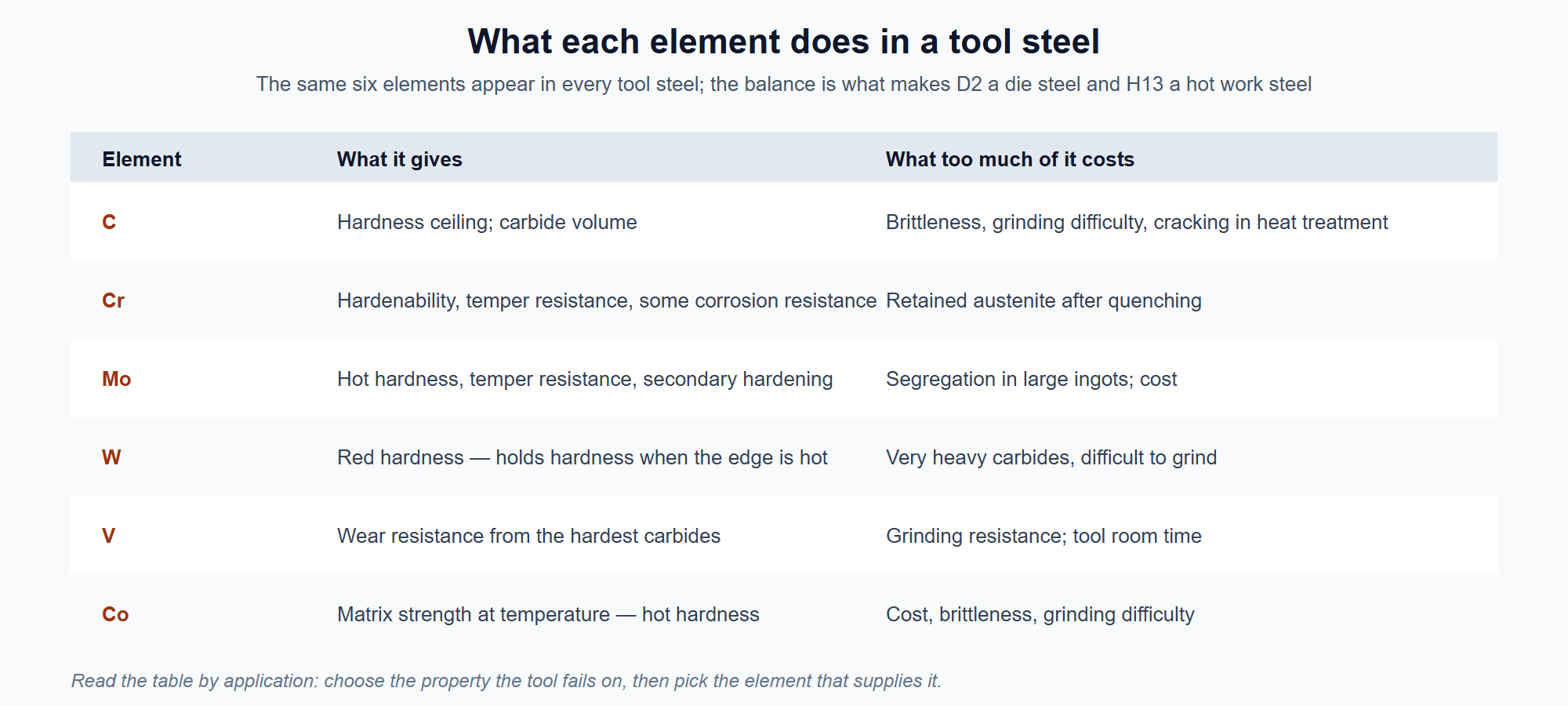
Almost every tool steel is built from the same six elements. What separates D2 from H13 from M2 is the balance, and each element has both a gift and a cost.
Reading the analysis as a list of properties is the right habit: choose the element that supplies the property the tool is failing on, rather than the one that sounds strongest.
How to read a specification against a failure
| The tool fails by | Element to look at | Grade direction |
|---|---|---|
| Wearing out too fast | Carbon and vanadium | Higher carbide volume — D2, 1.2436 |
| Cracking or chipping | Too much carbon | Lower carbon, more toughness — S7, H13 |
| Softening when hot | Tungsten, molybdenum, cobalt | HSS or hot work grades |
| Not hardening through | Chromium and manganese | Higher hardenability, or a faster quench |
What the certificate will not tell you
Carbide size and distribution. Two heats of D2 with identical analysis can differ in carbide banding, and that difference decides whether the die chips at the edge. For critical tooling, ask for the banding rating as well as the composition.
Reading a tool steel specification
A tool steel certificate lists six or seven elements and a hardness. That is not enough to predict performance, because the same analysis can be supplied with different carbide structures, different cleanliness and different amounts of decarburisation.
What the numbers do tell you is the design intent: which property the mill was aiming at, and therefore what the steel is likely to be good and bad at.
The two elements people misread
Chromium is usually read as corrosion resistance. In a tool steel it is mostly there for hardenability and temper resistance — D2 with 12 % chromium still rusts, because the carbon has taken the chromium into carbides.
Cobalt is read as hardness. It does not form carbides and does not raise room-temperature hardness much; what it does is keep the matrix from softening when the tool runs hot. That is why it appears in high speed steels and almost nowhere else.
What to ask for on critical tooling
- The carbide banding rating, not just the composition.
- Decarburisation depth, especially on bar that will be used as-supplied.
- Annealed hardness range, for machinability.
- For cold work grades, the ESR or vacuum treatment if the die has to polish.