
F55: A super duplex stainless steel
F55 is a kind of super duplex stainless steel, superior to the 2205 in overall performance. “Super” refers to the high alloying of its components. Compared with other duplex stainless steels, the high alloying of super duplex steels mainly refers to high molybdenum and nitrogen.
The characteristics performance are (1) excellent resistance to stress corrosion cracking, excellent resistance to pitting and crevice corrosion, resistance to various inorganic acids and organic acids, excellent resistance to non-oxidizing acid corrosion, strong alkali corrosion; (2) good weldability, excellent mechanical properties, can reduce the weight of the structure, with design advantages; (3) in the working temperature above 300°C for a long time service, the toughness of the material will decline significantly.
F55 has been included in the specification for metal materials and ASME boilers and pressure vessels resistant to sulfide stress cracking for NACE MR 0175 oil field equipment. Its main applications include submarine pipelines, flue gas desulfurization, osmotic desalination equipment, sulfuric acid plants, and fasteners for Marine engineering.
What “super duplex” actually means
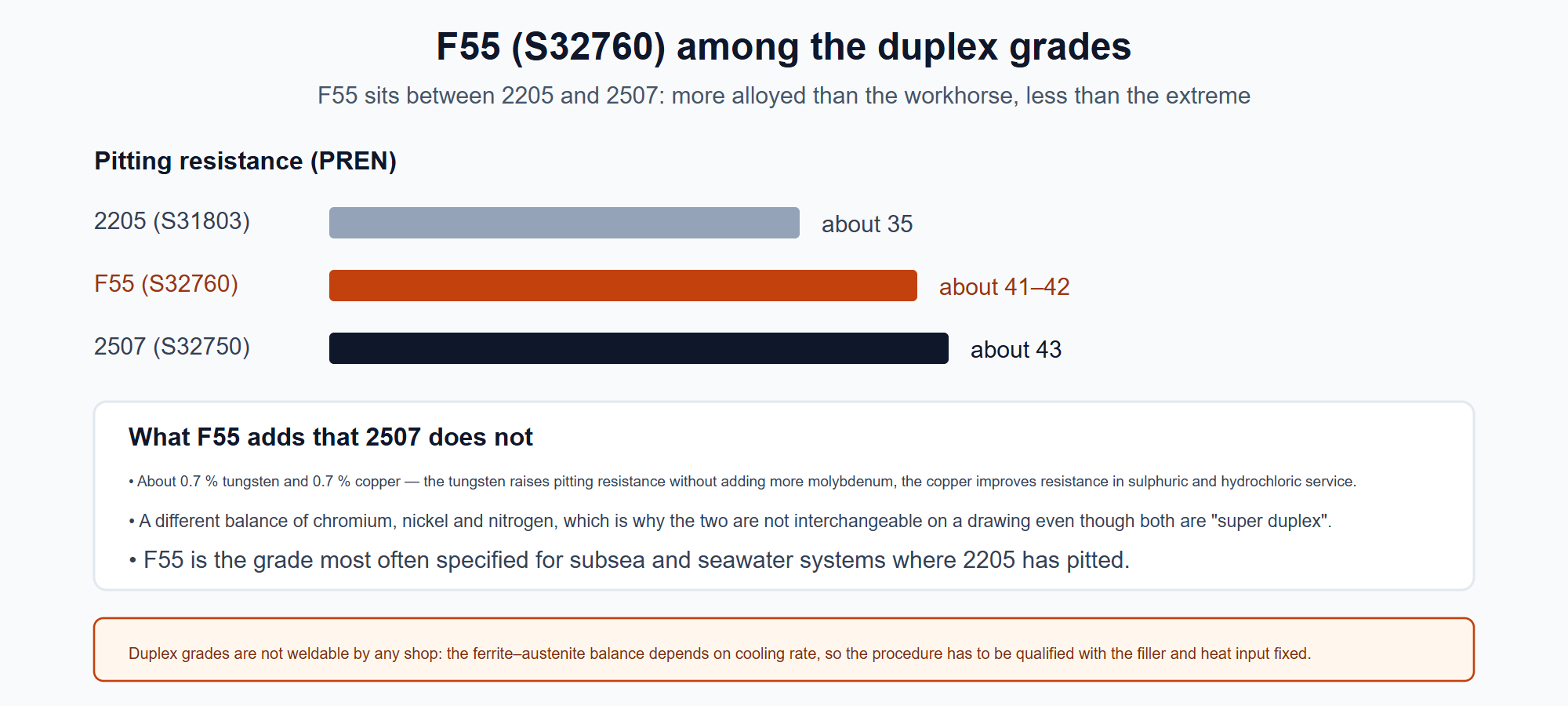
Duplex stainless steels have a mixed ferrite–austenite structure, roughly 50/50. “Super” duplex means the alloying has been pushed far enough that the pitting resistance equivalent exceeds about 40 — which is what allows the grade to be used in chlorides where 2205 pits.
F55 (UNS S32760) sits at about 41–42, alongside 2507 at about 43. They are close but not interchangeable.
Why F55 exists alongside 2507
F55 adds about 0.7 % tungsten and 0.7 % copper. The tungsten raises pitting resistance without adding more molybdenum, and the copper improves performance in sulphuric and hydrochloric service. The practical effect is a grade that tolerates slightly more aggressive water than 2507 in some environments, particularly where acids are present alongside chlorides.
In seawater piping and subsea equipment, F55 is often the grade specified after 2205 has pitted in service — the step up is to F55 or 2507, and the choice usually comes down to availability and the welding procedure already qualified.
The welding condition
Duplex grades are not welded by any shop with any procedure. The ferrite–austenite balance depends on cooling rate, so heat input, interpass temperature and filler have to be fixed and the procedure qualified. An unqualified weld in a super duplex pipe can lose most of its corrosion resistance in the heat-affected zone while passing a visual inspection.
Related reading
- Pitting and crevice corrosion — what 2205 fails by, and why F55 exists.
- Stainless steel in oil and gas — choosing a grade by H2S severity.
- Standards library — the material standards we work to.