
Is 317 stainless steel Well Worth Cost Over 316 & 304?
Grade stainless 304 withstands adverse environmental conditions while Grade stainless 316 can sustain under high cryogenic temperature and corrosive actions by chlorides etc. On the opposite hand Grade stainless 317 is brought into the image against extreme operating conditions of temperature and moisture that demand even higher performance characteristics as compared with grades like stainless 304 and stainless 316. Though of these alloys share some similar characteristics but they are doing have difference in their respective chemical compositions. Now, allow us to have a look on their actual chemical composition:
| Grades | Reference Chemistry(%) | |||||||||
| EN | ASTM | C | Si | Mn | P | S | Cr | Mo | Ni | |
| 1.4301 | 304 | Max 0.07 | Max 1 | Max
2 |
Max
0.045 |
Max
0.030 |
17.5-19.5 | _ _
|
8.0-10.5 | Max
0.11 |
| 1.4401 | 316 | Max 0.07 | Max 1 | Max
2 |
Max
0.045 |
Max
0.030 |
16.5-18.5 | 2.0-2.5 | 10.0-13.0 | Max
0.11 |
| 1.4449 | 317 | Max 0.07 | Max 1 | Max
2 |
Max
0.045 |
Max
0.030 |
17.5-19.5 | 3.0-4.0 | 13.0-16.0 | Max
0.11 |
As clearly noticed from the table above that especially , the quantity of metal Chromium, Nickel and Molybdenum varies in them from one another . Molybdenum is added so as to supply resistance against pitting corrosion from chlorides, that’s why these grades are getting used in chemical, gas oil refinery and marine industry to perform well in acidic environment. Moreover, Nickel add variety of properties to them prefer formability, hot working, high strength ,welding ability and sustainability. Hence these elements (Ni, Mo), in turn, also enhances the value of those grades in accordance with their increasing percentage content. SS 317 is costliest among them whereas SS 316 is slightly expensive than SS 304.
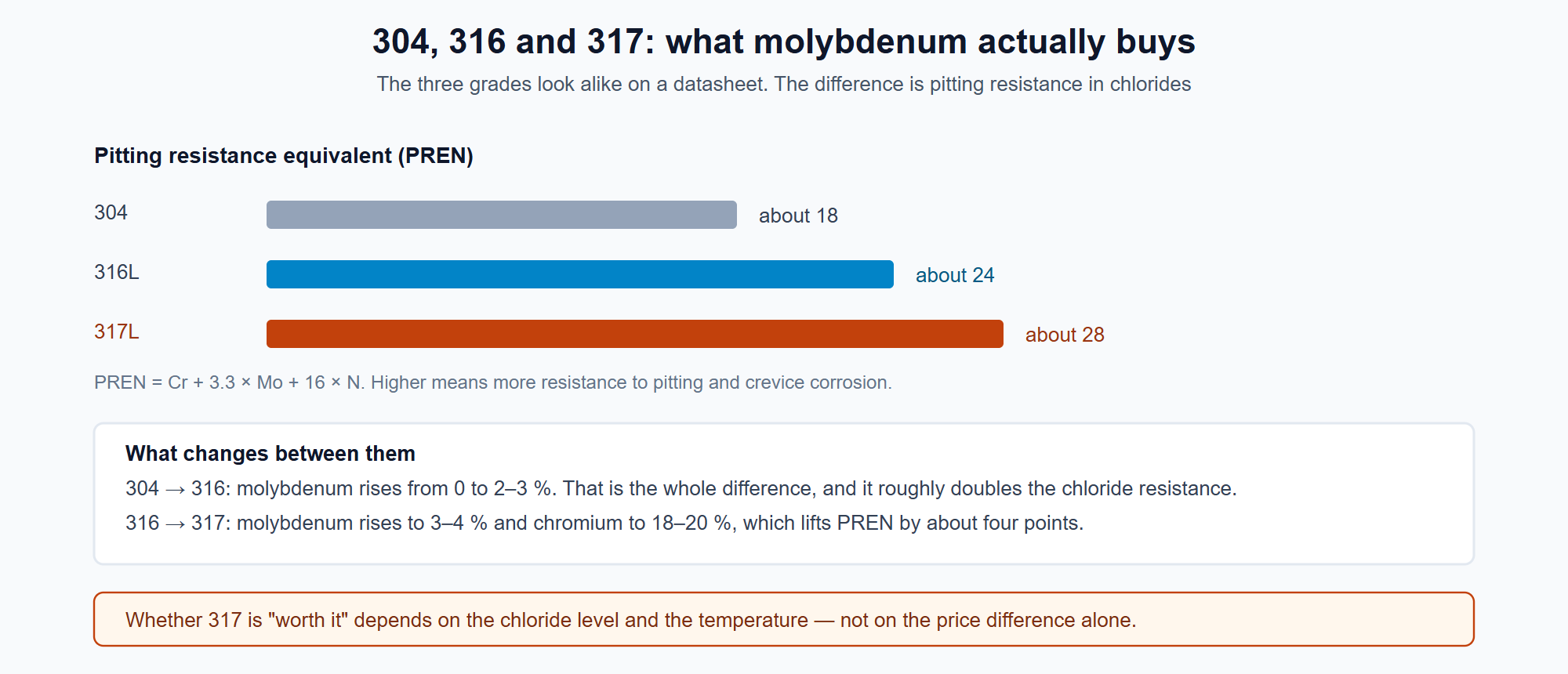
stainless 317 convince be an honest material in device manufacture because it resists Galvanic Corrosion between the plates and therefore the frame of the warmth exchanger during a much better way than stainless 304 and stainless 316. The trend in PREN (Pitting Resistance Equivalent Number) values also depicts an equivalent superiority of stainless 317 over stainless 304 and stainless 316. One can easily conclude by reading the table below that stainless 317 is almost 20% and 40% more immune to pitting corrosion than stainless 316 and stainless 304 respectively.
In nutshell, all the figures reveal this incontrovertible fact that stainless 317 justifies its extra cost due to extra longevity because it lasts for a extended time before failing within the same manner that stainless 304 and stainless 316 fail.
| PREN Value | ASTM Grade | ||
| SS 304 | SS 316 | SS 317 | |
| 21 | 24 | 29 | |
The only real difference is molybdenum
304, 316L and 317L are the same austenitic family. Molybdenum goes from essentially zero in 304 to 2–3 % in 316L and 3–4 % in 317L, and chromium rises slightly in 317L. Nothing else about them changes in a meaningful way.
Molybdenum is what resists pitting in chlorides. That is why the price step from 304 to 316 is large and the step from 316 to 317 is smaller but still real.
When 317 is worth the extra
When the chloride level and temperature put 316L close to its limit — warm seawater, brine, or a process stream with chlorides and some acidity. Above that, 317L is not the answer either; the next step is a super austenitic or duplex grade, not another austenitic with slightly more molybdenum.
Below that, 317L is money spent for margin you will never use.
Calculating rather than guessing
PREN = Cr + 3.3 × Mo + 16 × N. Comparing PREN values is a rough screen, not a design method — the actual limit depends on temperature, pH and crevice geometry. Use it to see whether the grade is in the right family, then check the corrosion data.