
M2 High Speed Steel Heat Treatment Analysis
M2 High Speed Steel Preheating
To minimize distortion and stresses in large or complex tools use a double preheat. Heat at a rate not exceeding 400°F per hour (222°C per hour) to 1100°F (593°C) equalize, then heat to 1450-1550°F (788-843°C). For normal tools, use only the second temperature range as a single preheating treatment
M2 High Speed Steel Austenizing(High Heat)
Heat rapidly from the preheat.
For Cutting Tools:
Furnace: 2200-2250°F (1204-1232°C)
Salt: 2175-2225°F (1191-1218°C)
To maximize toughness, use the lowest temperature. To maximize hot hardness, use the highest temperature.
For punches, dies, and tools that require maximum toughness without hot hardness:
Furnace: 2075-2175°F (1175-1191°C)
Salt: 2050-2150°F (1121-1177°C)
M2 High Speed Steel Quenching
Pressurized gas, warm oil, or salt. For pressurized gas, a rapid quench rate to below 1000°F (538°C) is critical to achieve the desired properties. For oil, quench until black, about 900°F (482°C), then cool in still air to 150-125°F (66-51°C). For salt maintained at 1000-1100°F (538-593°C), equalize, then cool in still air to 150-125°F (66-51°C).
M2 High Speed Steel Tempering
Temper immediately after quenching. Typical tempering range is 1025-1050°F (552-566°C). Hold at temperature for 2 hours, then air cool to ambient temperature. Double tempering is required. For large cross sections, and especially for blanks from which tools will be cut by wire EDM, triple tempering is strongly recommended.
M2 High Speed Steel Hardening Temperature,°F
| Double Tempering Temperature,°F | 2150 | 2200 | 2225 |
| 800 | 61HRC | 61.5HRC | 62HRC |
| 850 | 61.5HRC | 62HRC | 62.5HRC |
| 900 | 62.5HRC | 63HRC | 63.5HRC |
| 950 | 63HRC | 64HRC | 65HRC |
| 1000 | 64HRC | 65HRC | 65.5HRC |
| 1025 | 63.5HRC | 65HRC | 65.5HRC |
| 1050 | 63HRC | 64.5HRC | 65HRC |
| 1100 | 61.5HRC | 62.5HRC | 63.5HRC |
| 1150 | 57.5HRC | 59HRC | 60HRC |
| 1200 | 51HRC | 54HRC | 55HRC |
M2 High Speed Steel Annealing
Annealing must be performed after hot working and before re-hardening
Heat at a rate not exceeding 400°F per hour (222°C per hour) to 1525-1550°F (829-843°C), and hold at temperature for 1 hour per inch (25.4 mm) of thickness, 2 hours minimum. Then cool slowly with the furnace at a rate not exceeding 50°F per hour (28°C per hour) to 1000°F (538°C). Continue cooling to ambient temperature in the furnace or in air.
M2 High Speed Steel Forging
Pre heat slowly to 850 – 900°C, then increase more quickly to the forging temperature of 1050 – 1150°C. Do not forge below 880 – 900°C. Cool very slowly after forging. If during the forging the temperature of the M2 high speed tool steel material drops below 880-900°C, re-heating will be necessary. Cool the M2 steel component very slowly after forging.
M2 High Speed Steel Harden
Heat slowly to 1550° F, soak thoroughly, heat to 1850° F, soak thoroughly. Soak time in the furnace varies from a few minutes to 15 minutes, depending tool size, heat capacity of the furnace, and the size of the charge. – Heat to 2150 to 2200° F for max. toughness and minimum distortion. – Heat to 2250 to 2275° F for max. hardness and abrasion resistance.
M2 High Speed Steel Heat Treating
| ANNEALING | PREHEAT | AUSTENITIZING | QUENCH | TEMPERING |
| Temp | Temp | Temp | Medium | Temp |
| °F | °F | °F | °F | |
| 1550/1600 | 1500/1550 | 2175/2225 | Salt/Oil/Atm | 1025/1050 |
M2 HIGH SPEED STEEL THERMAL EXPANSION
| Temperature | 10^-6 m/(m*K) | 10^-6 in/in °F | |
| °F | °C | ||
| 212 | 100 | 11.5 | 6.5 |
| 392 | 200 | 11.7 | 6.6 |
| 572 | 300 | 12.2 | 6.9 |
| 752 | 400 | 12.4 | 7 |
| 932 | 500 | 12.7 | 7.1 |
| 1112 | 600 | 13 | 7.3 |
| 1292 | 700 | 12.9 | 7.3 |
M2 HIGH SPEED STEEL MECHANICAL PROPERTY
| Hardness, Rockwell C (tempered at 620°C, quenched at 1200°C) | 62 |
| Hardness, Rockwell C (as hardened, quenched at 1200°C) | 65 |
| Compressive yield strength (when tempered at 150°C) | 3250 MPa |
| Izod impact unnotched (when tempered at 150°C) | 67 J |
| Abrasion (loss in mm 3 , as-hardened; ASTM G65) | 25.8 |
| Abrasion (loss in mm 3 , tempered at 690°C; ASTM G65) | 77.7 |
| Poisson’s ratio | 0.27-0.30 |
| Elastic modulus | 190-210 GPa |
Fushun Special Steel LTD CO
Fushun Metal is a large special steel manufacuter and supplie. We are metal experts and have been providing quality customer service and products since 1998.
At Fushun Metal, we supply a wide range of metals for a variety of applications. Our products/stock includes: stainless steel, alloy steel, spring steel, tool steel, high speed steel, mould steel, nickel alloy.
Our hot rolled and cold rolled steel is available in a wide range of shapes including: bars, tubes, sheets and plates. We can cut metal to your exact specifications.
Send your inquiry information to us and get a free quotation today!
Why the austenitising temperature is so high
M2 is hardened from 1200–1230 °C, which is far hotter than most tool steels and close to the point where the steel starts to melt at the grain boundaries. The reason is carbide dissolution: at 1000 °C most of the alloy carbides stay undissolved, the matrix never gets the alloy content it needs, and the steel will not reach 64 HRC or hold its hardness when hot.
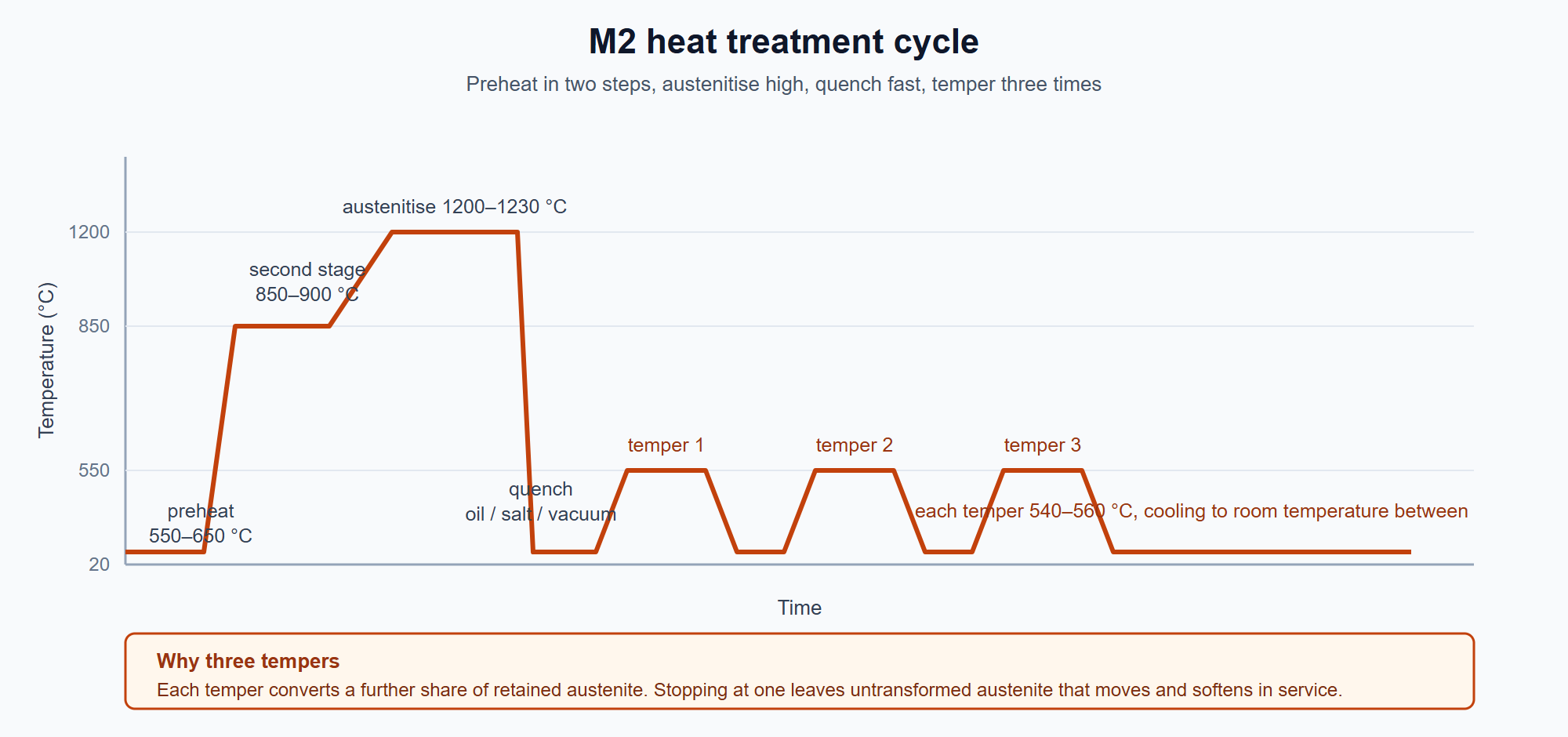
That is also why the preheat is done in two stages — a cold tool going straight into a 1220 °C furnace will crack from thermal shock before it ever gets to temperature.
Why three tempers instead of one
After quenching, a significant fraction of the austenite has not transformed. Each temper converts part of what remains; a single temper leaves enough behind that the tool keeps changing dimension and losing hardness in service. Three tempers at 540–560 °C, each followed by cooling to room temperature, is the standard for a reason.
The tempering temperature also does double duty: this is where secondary hardening occurs, so the tool often comes out of temper harder than it went in.
What goes wrong in practice
- Overheated — grain growth at too high a temperature or too long a soak. The tool still hardens but chips.
- Burnt — incipient melting at the grain boundaries. Unrecoverable scrap.
- Under-tempered — retained austenite left in the structure. The tool moves after grinding.
- Decarburised — a soft skin from an uncontrolled atmosphere at 1220 °C. The core hardness reads correct while the surface fails.

